| | |  SPACE WEATHER
NOAA Forecasts | | Updated at: 2026 Feb 04 2200 UTC FLARE | 0-24 hr | 24-48 hr | CLASS M | 80 % | 80 % | CLASS X | 40 % | 40 % |  Geomagnetic Storms: Geomagnetic Storms:
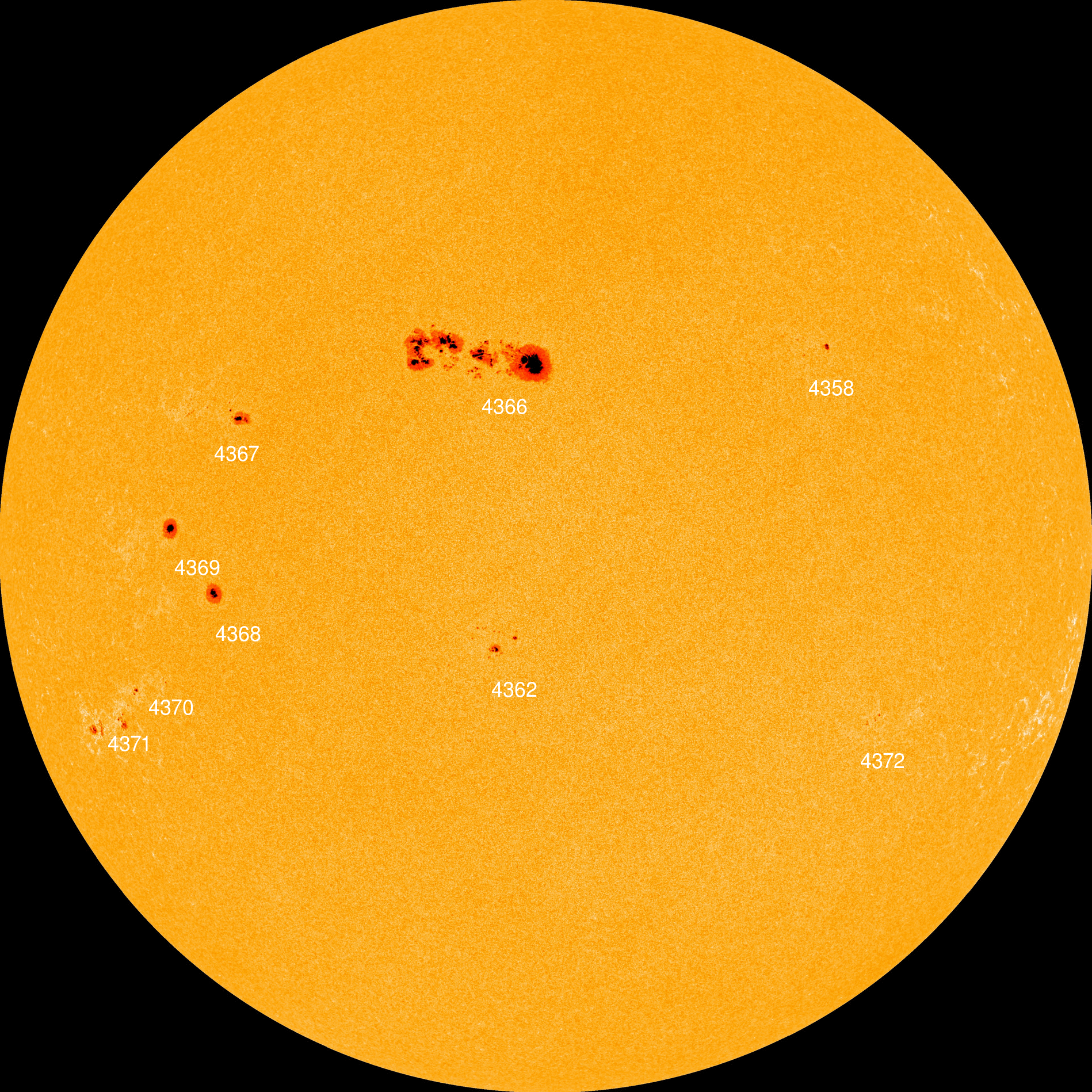
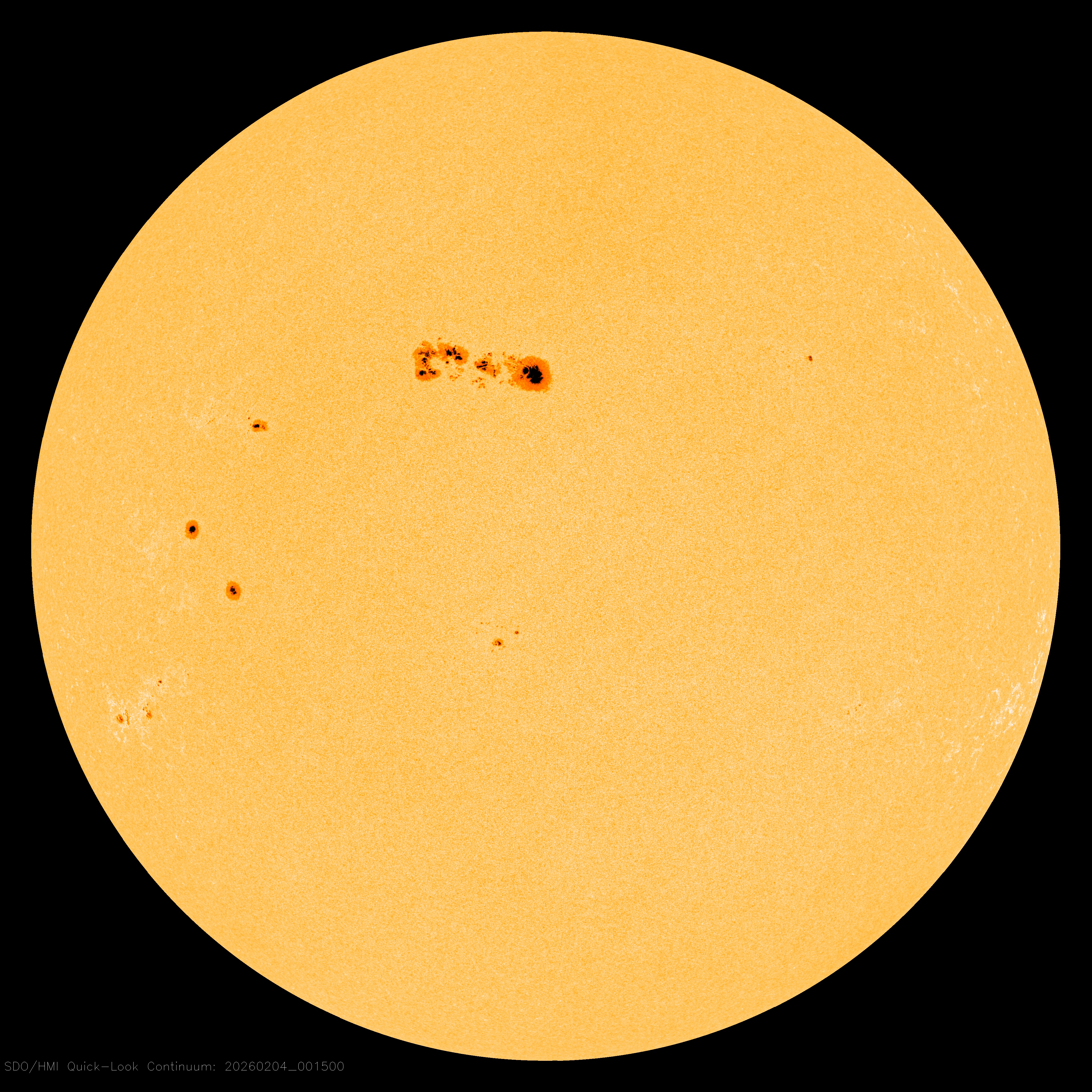
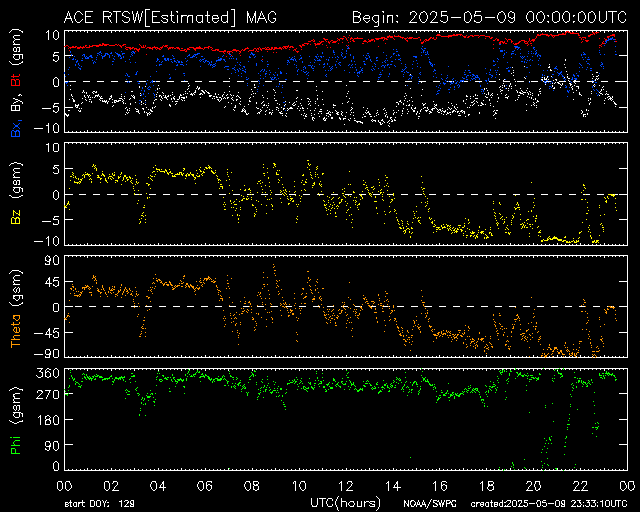
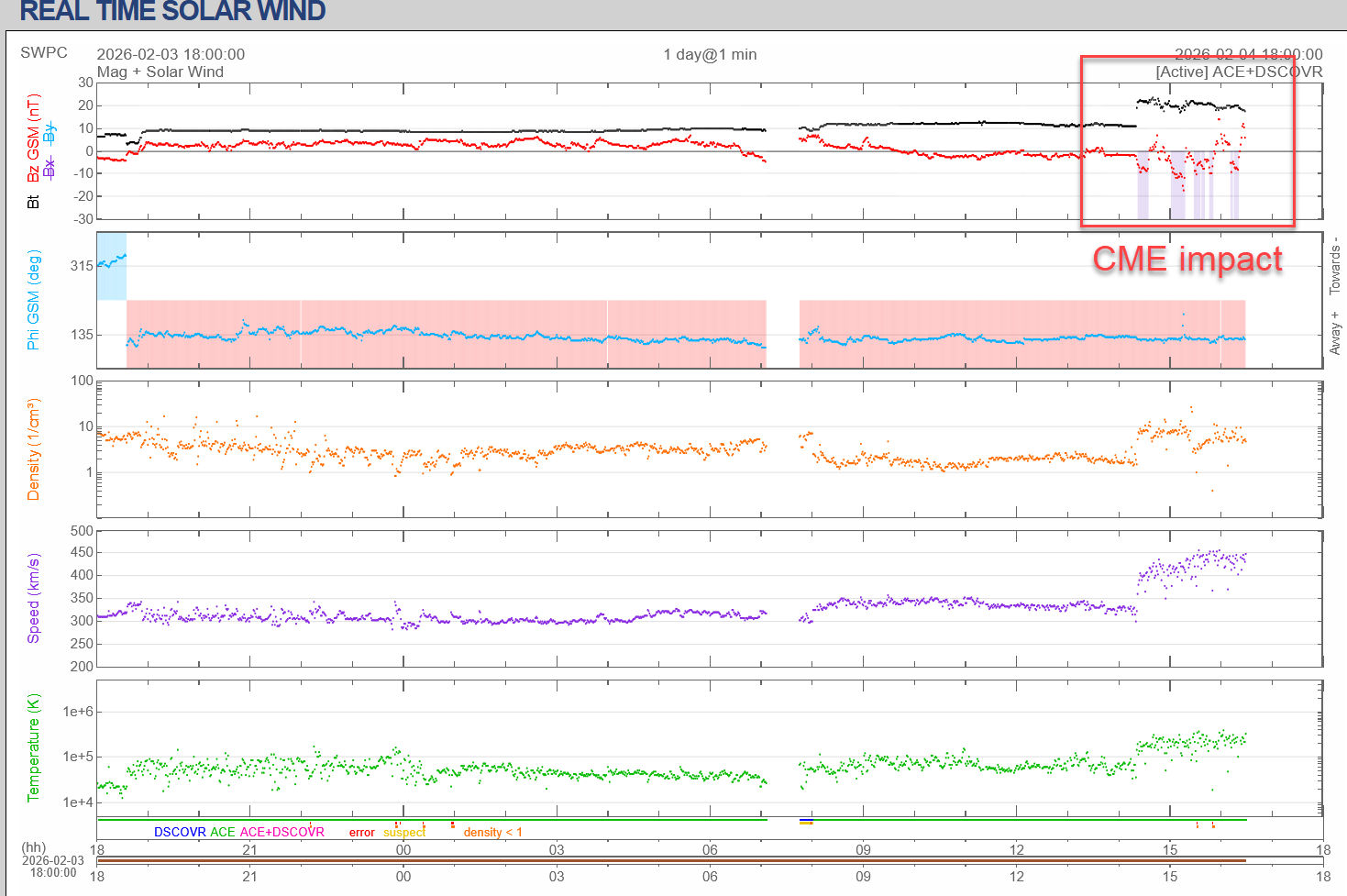
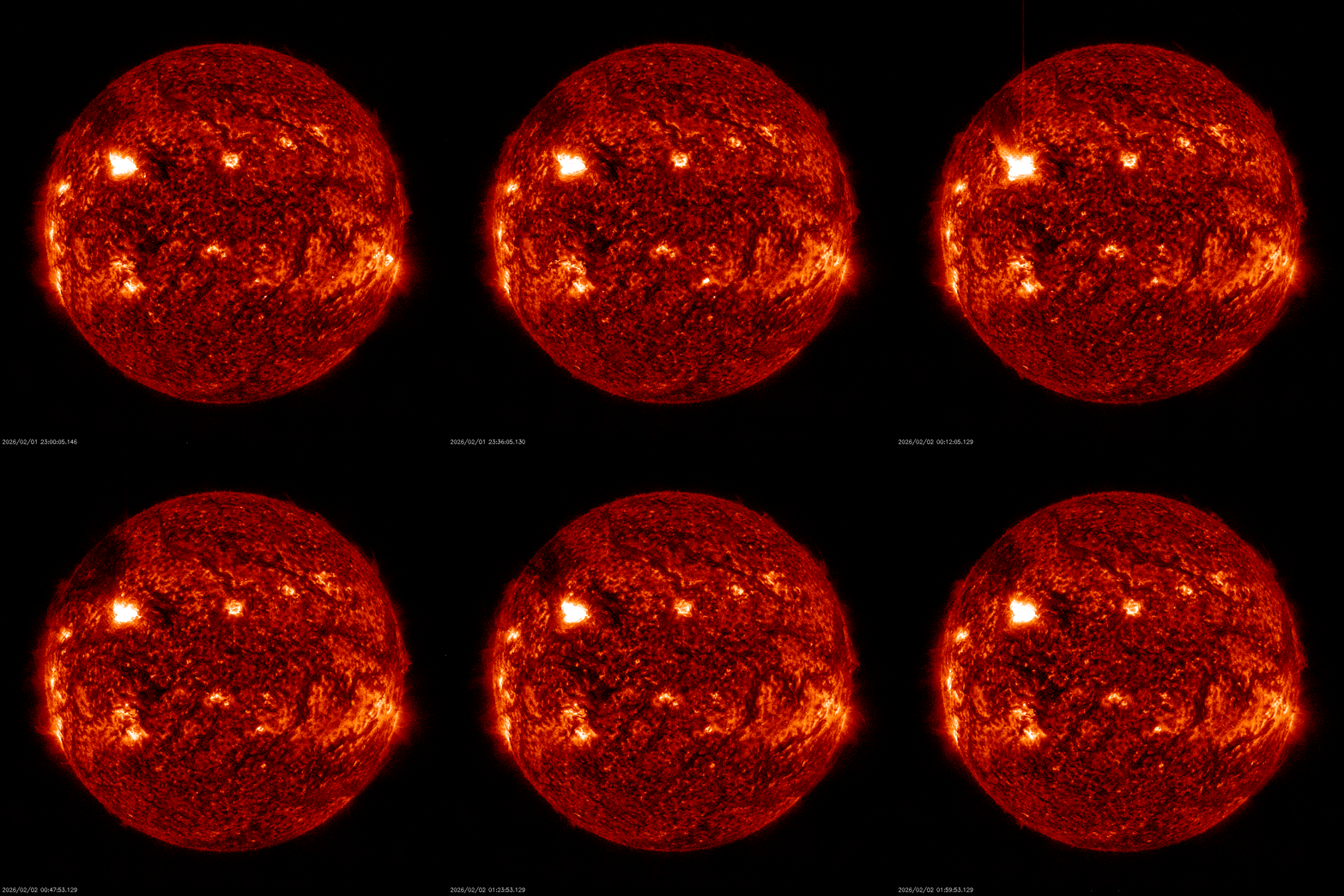
Probabilities for significant disturbances in Earth's magnetic field are given for three activity levels: active, minor storm, severe storm Updated at: 2026 Feb 04 2200 UTC Mid-latitudes | 0-24 hr | 24-48 hr | ACTIVE | 35 % | 40 % | MINOR | 25 % | 30 % | SEVERE | 05 % | 05 % | High latitudes | 0-24 hr | 24-48 hr | ACTIVE | 10 % | 10 % | MINOR | 25 % | 20 % | SEVERE | 55 % | 65 % | | | |  | | | | | | | | | | | This is an AI Free Zone: Text created by Large Language Models is spreading across the Internet. It's well-written, but frequently inaccurate. If you find a mistake on Spaceweather.com, rest assured it was made by a real human being. | | | THE CME HAS ARRIVED: A CME hit Earth's magnetic field today, Feb. 4th. The sharp impact at 1530 UTC jolted magnetometer needles around the world. At the USGS monitoring station in Boulder, Colorado, the jolt was 16 nT--significant, but not enough to cause a major geomagnetic storm. Instead, minor (G1) to moderate (G2) storms are possible in the hours ahead. This CME probably came from the X8-class solar flare on Feb 1st. Aurora alerts: SMS Text SUNSPOT ARCHIPELAGO: Sunspots are magnetic islands on the sun. Sunspot AR4366 is a complete archipelago. Scroll down to scan more than 200,000 miles of island chain: 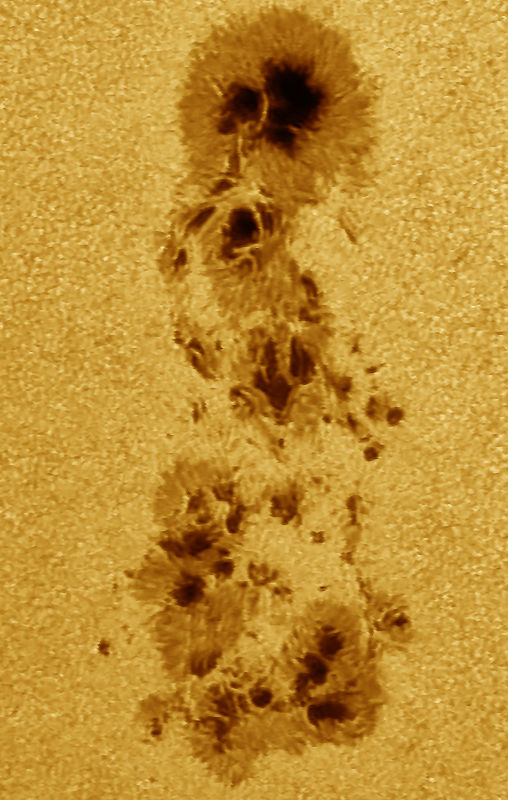
Amateur astronomer James Kevin Ty took this picture on Feb 3rd from his backyard observatory in Manila. "This sunspot started as an inconspicuous pore just a few days ago. Since then it has grown hugely in size!" he says. The island metaphor is apt. Sunspots are buoyant concentrations of magnetism that float on a sea of solar plasma. Archipelago 4366 consists of one big island twice as wide as Earth plus dozens of lesser isles ranging in size from US states to small planets. AR4366 is currently facing Earth, and it poses a threat for X-class solar flares. Such flares can cause shortwave radio blackouts and, if they hurl a CME in our direction, strong-to-extreme geomagnetic storms. Solar flare alerts: SMS Text more images: from Santiago Andres Triana of Hoogstraten, Belgium; from Mariano Ribas of Buenos Aires, Argentina; from Jim Tegerdine of Roseburg, Oregon; Realtime Space Weather Photo Gallery
Free: Spaceweather.com Newsletter A SPACE PENDENT FOR VALENTINE'S DAY: Are you looking for an unforgettable Valentine's Day gift? Consider the Always and Forever Pendent. The students of Earth to Sky Calculus launched it to the top of Earth's atmosphere onboard a cosmic ray research balloon: 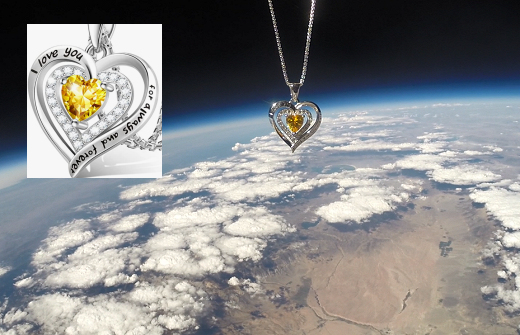
It's yours for $299.95. Engraved with the words "I love you always and forever," this sterling silver pendant features a heart-shaped citrine crystal surrounded by a ring of glittering 5A cubic zirconia nuggets. It comes with a greeting card showing the jewelry in flight and telling the story of its journey to space. Earth to Sky Valentine's gifts have flown above 99.7% of Earth's atmosphere, experiencing space-like blasts of cosmic rays, extreme cold, and a wild ride parachuting back to Earth after the balloon explodes. Even Amazon doesn't carry items this far out. And, best of all, all sales support student science projects and STEM education.
Far Out Gifts: Earth to Sky Store
All sales support hands-on STEM education
Realtime Aurora Photo Gallery
Free: Spaceweather.com Newsletter
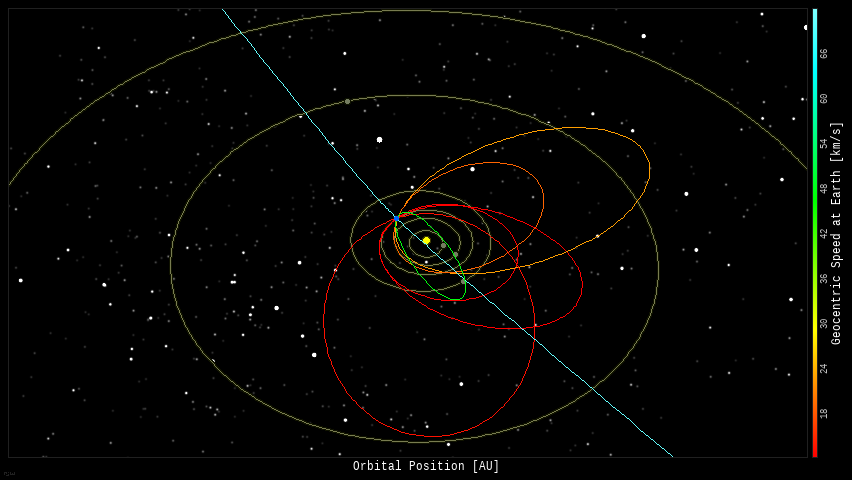
Every night, a network of NASA all-sky cameras scans the skies above the United States for meteoritic fireballs. Automated software maintained by NASA's Meteoroid Environment Office calculates their orbits, velocity, penetration depth in Earth's atmosphere and many other characteristics. Daily results are presented here on Spaceweather.com. On Feb. 03 2026, the network reported 8 fireballs.
(8 sporadics) 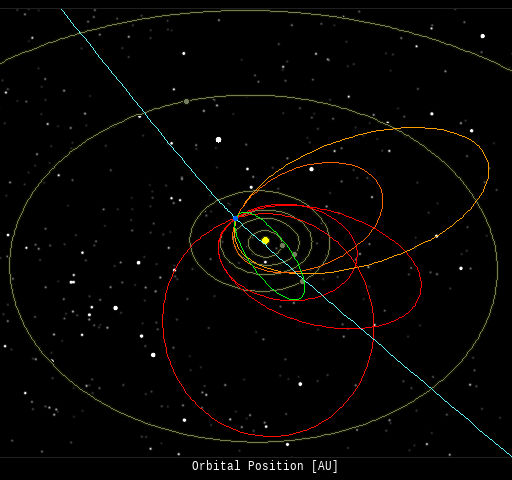 In this diagram of the inner solar system, all of the fireball orbits intersect at a single point--Earth. The orbits are color-coded by velocity, from slow (red) to fast (blue). [Larger image] [movies] Potentially Hazardous Asteroids ( PHAs) are space rocks larger than approximately 100m that can come closer to Earth than 0.05 AU. None of the known PHAs is on a collision course with our planet, although astronomers are finding new ones all the time. On February 4, 2026 there were 2349 potentially hazardous asteroids.
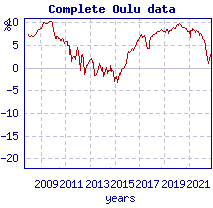
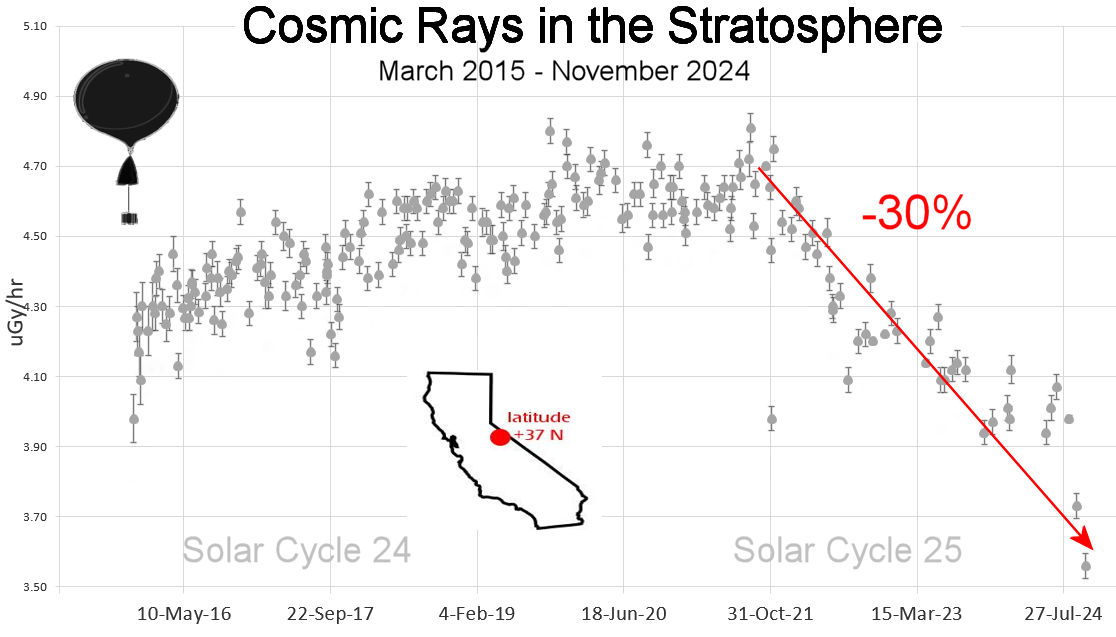
 | Recent & Upcoming Earth-asteroid encounters: | Asteroid | Date(UT) | Miss Distance | Velocity (km/s) | Diameter (m) | | 2026 BK | 2026-Jan-30 | 9.7 LD | 2.2 | 19 | | 2023 RX1 | 2026-Jan-31 | 8.8 LD | 1.2 | 3 | | 2026 BF1 | 2026-Jan-31 | 11.1 LD | 3.9 | 11 | | 2025 YQ12 | 2026-Jan-31 | 12 LD | 3.1 | 30 | | 2022 OC3 | 2026-Jan-31 | 1.3 LD | 3.8 | 8 | | 2026 BD4 | 2026-Feb-01 | 6.3 LD | 5.7 | 11 | | 2026 BS7 | 2026-Feb-04 | 3.8 LD | 10.5 | 17 | | 2026 BY2 | 2026-Feb-04 | 9.9 LD | 8 | 29 | | 2026 BM | 2026-Feb-05 | 10.1 LD | 10.8 | 17 | | 2021 CZ5 | 2026-Feb-09 | 18.3 LD | 9.3 | 23 | | 2026 BY1 | 2026-Feb-09 | 10 LD | 8 | 20 | | 2025 CC | 2026-Feb-09 | 17.6 LD | 5.1 | 11 | | 2026 BU2 | 2026-Feb-09 | 16.3 LD | 9.4 | 32 | | 2019 CN2 | 2026-Feb-11 | 20 LD | 9.2 | 7 | | 2026 BJ8 | 2026-Feb-12 | 10 LD | 11.2 | 35 | | 2022 DV | 2026-Feb-12 | 15.4 LD | 5 | 18 | | 1999 AO10 | 2026-Feb-14 | 10.5 LD | 2.7 | 59 | | 162882 | 2026-Feb-14 | 17 LD | 19.2 | 626 | | 2026 BE7 | 2026-Feb-14 | 19.6 LD | 10.2 | 48 | | 2026 BX4 | 2026-Feb-16 | 7.7 LD | 10.5 | 225 | | 2025 YU15 | 2026-Feb-21 | 15.4 LD | 9.5 | 132 | | 2023 CM2 | 2026-Feb-21 | 4.2 LD | 11.4 | 22 | | 2025 DQ | 2026-Feb-21 | 3 LD | 6.8 | 4 | | 2007 DB61 | 2026-Feb-21 | 9 LD | 8.8 | 65 | | 2026 AM4 | 2026-Feb-22 | 17.5 LD | 3.1 | 31 | | 2012 XF55 | 2026-Feb-23 | 16.3 LD | 4 | 98 | | 2022 EZ6 | 2026-Feb-24 | 11.6 LD | 6.9 | 73 | | 2018 RB1 | 2026-Feb-24 | 8.3 LD | 7.9 | 9 | | 2011 CL50 | 2026-Feb-27 | 13.4 LD | 4.5 | 12 | | 2020 FV4 | 2026-Feb-27 | 16.3 LD | 8.7 | 30 | | 2007 DG8 | 2026-Feb-28 | 10 LD | 9.9 | 32 | | 2011 EH17 | 2026-Mar-02 | 15.8 LD | 16.5 | 39 | | 2021 ER | 2026-Mar-06 | 6.3 LD | 4 | 14 | | 2017 BM123 | 2026-Mar-06 | 19.9 LD | 7.2 | 61 | | 2012 DF31 | 2026-Mar-08 | 13.4 LD | 16 | 43 | | 2020 GE | 2026-Mar-09 | 16.1 LD | 1.3 | 8 | | 2025 EK4 | 2026-Mar-10 | 14.7 LD | 10 | 55 | | 2021 BW1 | 2026-Mar-10 | 14.2 LD | 4.1 | 18 | | 2023 ET2 | 2026-Mar-11 | 7.8 LD | 12.7 | 3 | | 2025 DP3 | 2026-Mar-11 | 9.4 LD | 9.1 | 27 | | 2007 EG | 2026-Mar-15 | 4.5 LD | 7.8 | 44 | | 2015 VO142 | 2026-Mar-17 | 2.7 LD | 3.1 | 6 | | 2021 FS | 2026-Mar-18 | 18.2 LD | 7.2 | 9 | | 2010 RA91 | 2026-Mar-22 | 4.7 LD | 9.9 | 68 | | 2022 FY | 2026-Mar-24 | 10.1 LD | 6.5 | 9 | | 2025 SP20 | 2026-Mar-25 | 18.8 LD | 11 | 12 | | 2025 GL | 2026-Apr-03 | 9.8 LD | 6.4 | 5 | | 2019 FQ1 | 2026-Apr-03 | 9.6 LD | 10.1 | 13 | | 2023 DZ2 | 2026-Apr-04 | 2.6 LD | 7.2 | 50 | Notes: LD means "Lunar Distance." 1 LD = 384,401 km, the distance between Earth and the Moon. 1 LD also equals 0.00256 AU. | | Cosmic Rays in the Atmosphere | SPACE WEATHER BALLOON DATA: Almost once a week, Spaceweather.com and the students of Earth to Sky Calculus fly space weather balloons to the stratosphere over California. These balloons are equipped with sensors that detect secondary cosmic rays, a form of radiation from space that can penetrate all the way down to Earth's surface. Our monitoring program has been underway without interruption for 10 years, resulting in a unique dataset of in situ atmospheric measurements. Latest results (Nov. 2024): Atmospheric radiation is sharply decreasing in 2024. Our latest measurements in November registered a 10-year low: 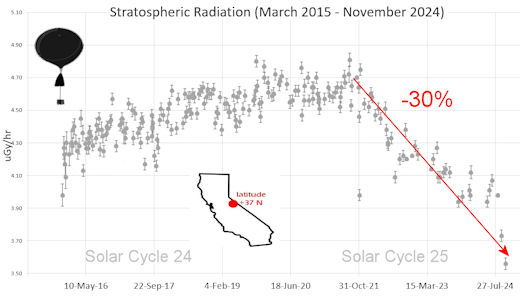
What's going on? Ironically, the radiation drop is caused by increasing solar activity. Solar Cycle 25 has roared to life faster than forecasters expected. The sun's strengthening and increasingly tangled magnetic field repels cosmic rays from deep space. In addition, solar coronal mass ejections (CMEs) sweep aside cosmic rays, causing sharp reductions called "Forbush Decreases." The two effects blend together to bring daily radiation levels down. .Who cares? Cosmic rays are a surprisingly "down to Earth" form of space weather. They can alter the chemistry of the atmosphere, trigger lightning, and penetrate commercial airplanes. According to a study from the Harvard T.H. Chan school of public health, crews of aircraft have higher rates of cancer than the general population. The researchers listed cosmic rays, irregular sleep habits, and chemical contaminants as leading risk factors. A number of controversial studies (#1, #2, #3, #4) go even further, linking cosmic rays with cardiac arrhythmias and sudden cardiac death. Technical notes: The radiation sensors onboard our helium balloons detect X-rays and gamma-rays in the energy range 10 keV to 20 MeV. These energies span the range of medical X-ray machines and airport security scanners. Data points in the graph labeled "Stratospheric Radiation" correspond to the peak of the Regener-Pfotzer maximum, which lies about 67,000 feet above central California. When cosmic rays crash into Earth's atmosphere, they produce a spray of secondary particles that is most intense at the entrance to the stratosphere. Physicists Eric Regener and Georg Pfotzer discovered the maximum using balloons in the 1930s and it is what we are measuring today. | | The official U.S. government space weather bureau | | | The first place to look for information about sundogs, pillars, rainbows and related phenomena. | | | Researchers call it a "Hubble for the sun." SDO is the most advanced solar observatory ever. | | | 3D views of the sun from NASA's Solar and Terrestrial Relations Observatory | | | Realtime and archival images of the Sun from SOHO. | | | information about sunspots based on the latest NOAA/USAF Active Region Summary | | | current counts of failed and deployed Starlink satellites from Jonathan's Space Page. See also, all satellite statistics. | | | Authoritative predictions of space junk and satellite re-entries | | | from the NOAA Space Environment Center | | | fun to read, but should be taken with a grain of salt! Forecasts looking ahead more than a few days are often wrong. | | | from the NOAA Space Environment Center | | | the underlying science of space weather |  | Got a chipped or cracked windshield that prevents you from seeing space weather events while driving? Get windshield replacement from SR Windows & Glass with free mobile auto glass service anywhere in the Phoenix area. | | | These links help Spaceweather.com stay online. Thank you to our supporters! | | | Baltimore Car Accident Lawyers Onlinecasinoinformatie.com is an expert in comparing foreign online casinos for players in the Netherlands, offering reliable insights, clear reviews, and up-to-date information Trusted casinos not connected to GamStop Most Trusted seller for 1:1 super clone watches in the market Premium quality super clone watches for sale with true 1:1 detailing Buy Instagram Followers Text: from Smikky! For the new best Norwegian casinos, visit nyecasino.com
Instant Famous, a reliable provider for followers, likes, and views on Instagram, Facebook, YouTube, TikTok, and more.
NonGamstopCasinos.net compares Non Gamstop Casinos and UK Casinos & Betting sites not on Gamstop. Independent casino reviews & exclusive bonus offers for British Gamblers. Zamsino is one of the most popular online casino guides in the world. Kiwislots.nz is the best free spins no deposit guide in New Zealand! Find your best no deposit bonus in Germany at BetterBonus Adlerslots hat die besten neuen Boni ohne Einzahlung in Deutschland für dich zusammengestellt! BonusZonderStorting.com is de nummer 1 site om online casino's zonder storting in Nederland te vergelijken. Vind de nieuwste free spins-aanbiedingen ter wereld op Leeuwslots.com. Visit prestigewatches for best super clone watches and rolex replica for sale
| | | | | | |  | | |  | ©2021 Spaceweather.com. All rights reserved. This site is penned daily by Dr. Tony Phillips. |