AI writing is everywhere -- except here. This website is written by Dr. Tony Phillips, a carbon-based lifeform with 30 yrs of forecasting experience. Our guarantee: If you find a mistake, it was made by a real human being.
|
|
|
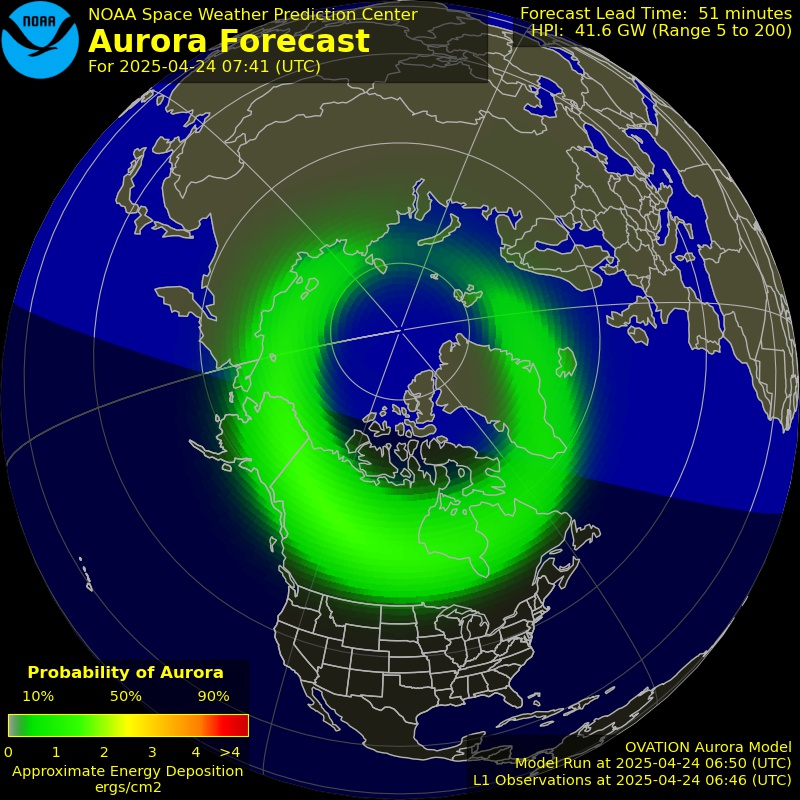
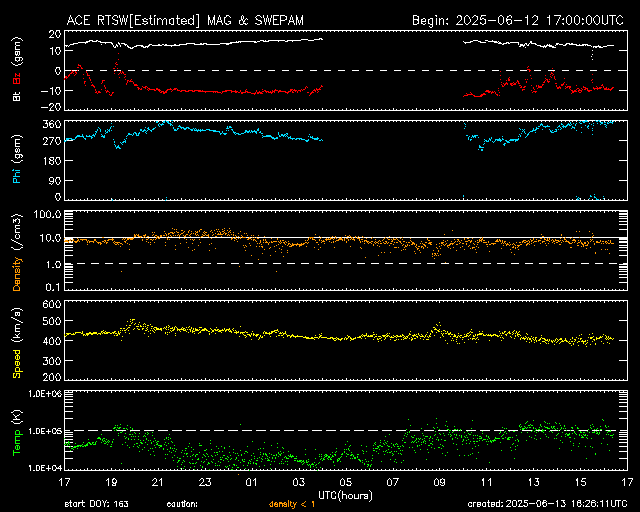
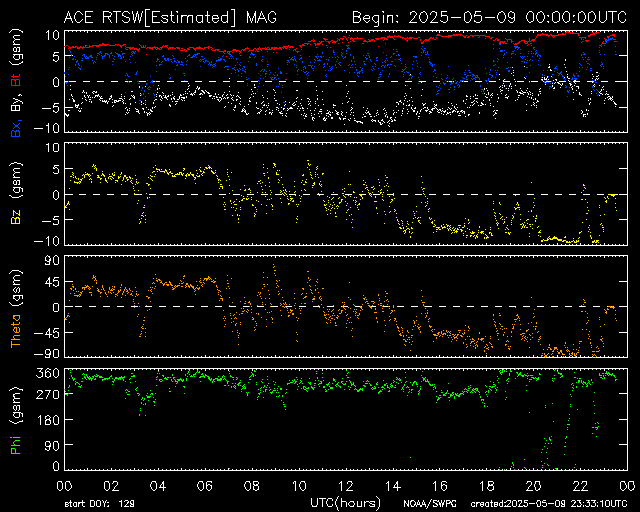
EXITING THE SOLAR WIND STREAM: Earth is exiting a stream of solar wind that sparked Arctic auroras over the weekend. A new stream is approaching. G1-class geomagnetic storms and auroras are likely when it arrives on Dec. 3rd. Aurora alerts: SMS Text
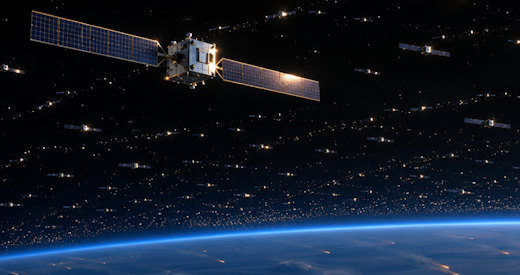
STARMIND VS. THE ATMOSPHERE: On Wednesday, Nov. 25th, while most Americans were getting ready for Thanksgiving, the FCC made an important announcement: "Today, in a historic first, the FCC approved SpaceX's request for 1 million satellites..." wrote Brendan Carr on X.
The timing was perfect, because this is a turkey.
SpaceX wants to put a data center in space--a sprawling constellation of up to a million satellites named "Starmind." If that number gives you sticker shock, you're not alone. Many people are asking themselves "is this for real?" (yes) or are going online to debate the technical feasibility of computing in space.
They should be asking a completely different question: "What will happen to our atmosphere?"
These satellites won't simply materialize in space. They have to be launched, with thousands of rockets burning through the atmosphere--with unknown consequences.
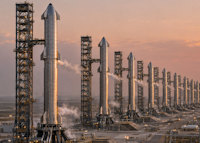 First, the launches: Starship burns methane, which is cleaner than the kerosene used by SpaceX's Falcon 9. But Starship is a much bigger rocket. Atmospheric chemist Eloise Marais of University College London says it may produce just as much soot per launch. Rocket soot goes straight into the stratosphere, where it lingers for years, absorbing sunlight and heating the air around it.
Next, the re-entries: If Starmind satellites last five years, like Starlinks, eventually about 550 of them would burn up every day. At up to 4 tons apiece, that's as much as 800,000 tons of hardware a year--about 50 times the natural rain of meteoroids.
Much of it is aluminum. As each satellite burns, it forms a fine dust of aluminum oxide in the mesosphere. That dust slowly sinks into the ozone layer where it helps chlorine destroy ozone. Once there, the particles can linger for years--so if it's a problem, it won't go away quickly.
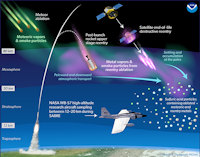 In fact, no one knows. According to the FCC, "Impacts on the atmosphere caused by satellites burning up on re-entry remain speculative and not supported in the record." Indeed, a 2026 study led by University College London found that aluminum oxide from today's re-entries has a negligible effect on ozone.
But today's re-entries are a trickle compared to Starmind. A NOAA-led team modeled 10,000 tons of aluminum oxide per year and found it could warm parts of the upper atmosphere and disturb the polar vortex. Starmind could exceed that several times over.
At least the data centers won't be in our own backyards! That is, unless a Starmind satellite lands there....
Realtime Space Weather Photo Gallery
Free: Space Weather Newsletter
GIFTS FROM THE EDGE OF SPACE: Christmas is coming. Are you looking for a far-out gift? Check out the Earth to Sky Store. It's filled with unique items that have flown to the edge of space onboard cosmic ray research balloons.

Carried aloft by giant helium balloons, these unique gifts have flown above 99.7% of Earth's atmosphere, experiencing space-like blasts of cosmic rays, extreme cold, and a wild ride parachuting back to Earth after the balloon explodes. Even Amazon doesn't carry items this far out.
Don't forget to enter coupon code "BLACKFRIDAY" at checkout for a 15% holiday discount.
Far Out Gifts: Earth to Sky Store
All sales support hands-on STEM education
Realtime Aurora Photo Gallery
Free: Spaceweather.com Newsletter
Every night, a network
of
NASA
all-sky cameras scans the skies above the United
States for meteoritic fireballs. Automated software
maintained by NASA's Meteoroid Environment Office
calculates their orbits, velocity, penetration depth
in Earth's atmosphere and many other characteristics.
Daily results are presented here on Spaceweather.com.
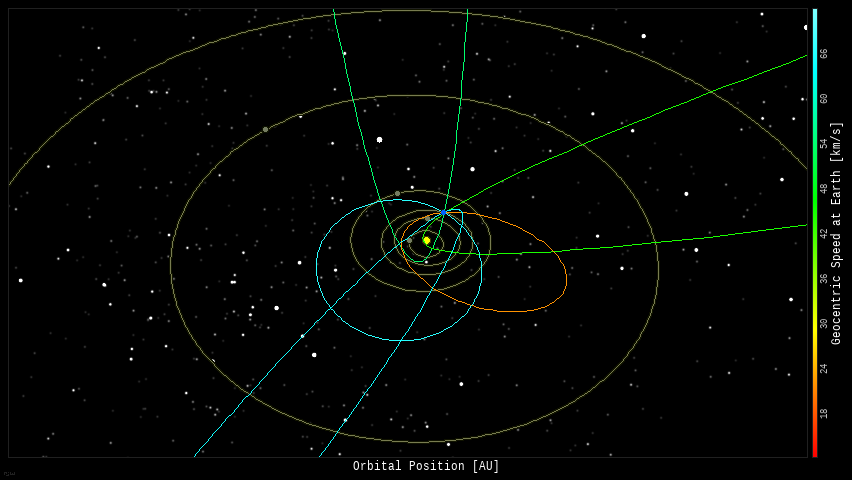
On November 29, 2026, the network reported 5 fireballs.
(4 sporadics, 1 November omega Orionid)
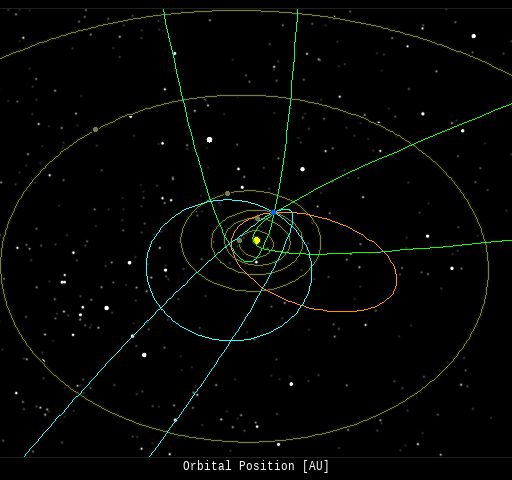
In this diagram of the inner solar system, all of the fireball orbits intersect at a single point--Earth. The orbits are color-coded by velocity, from slow (red) to fast (blue).
[Larger image] [movies]
Potentially Hazardous Asteroids (
PHAs)
are space rocks larger than approximately 100m that
can come closer to Earth than 0.05 AU. None of the
known PHAs is on a collision course with our planet,
although astronomers are finding
new
ones all the time.
On November 29, 2026 there were 2349 potentially hazardous asteroids.
 |
Recent
& Upcoming Earth-asteroid encounters:
| Asteroid |
Date(UT) |
Miss Distance |
Velocity (km/s) |
Diameter (m) |
| 2026 WY3 |
2026-Nov-24 |
7.9 LD |
10.7 |
29 |
| 2026 WO3 |
2026-Nov-24 |
4 LD |
9.4 |
12 |
| 2026 WQ2 |
2026-Nov-24 |
7 LD |
8.2 |
27 |
| 2026 WH4 |
2026-Nov-25 |
6.9 LD |
18.4 |
26 |
| 2026 VV11 |
2026-Nov-25 |
16.2 LD |
8.7 |
39 |
| 2026 VQ5 |
2026-Nov-25 |
5.2 LD |
11.7 |
58 |
| 2026 WL3 |
2026-Nov-26 |
11.7 LD |
17.9 |
40 |
| 2026 VQ19 |
2026-Nov-26 |
4 LD |
6.8 |
31 |
| 2026 WX1 |
2026-Nov-26 |
13.9 LD |
8.7 |
11 |
| 2026 WU1 |
2026-Nov-27 |
12.6 LD |
12.4 |
40 |
| 2026 WX3 |
2026-Nov-28 |
5 LD |
4 |
11 |
| 2026 WK3 |
2026-Nov-28 |
1.5 LD |
9.2 |
15 |
| 2026 WJ4 |
2026-Nov-30 |
0.3 LD |
7 |
2 |
| 2025 CP1 |
2026-Nov-30 |
12.9 LD |
10.8 |
6 |
| 2026 WK1 |
2026-Dec-03 |
5.3 LD |
6.3 |
25 |
| 2019 XF2 |
2026-Dec-04 |
3.1 LD |
10.2 |
14 |
| 2023 XH3 |
2026-Dec-06 |
18.7 LD |
16.5 |
14 |
| 2020 XC3 |
2026-Dec-08 |
14.5 LD |
14.3 |
110 |
| 2026 WG |
2026-Dec-08 |
11.5 LD |
6.3 |
32 |
| 2016 NV |
2026-Dec-08 |
14.3 LD |
10.4 |
379 |
| 2026 WB4 |
2026-Dec-11 |
7.5 LD |
3.1 |
16 |
| 2010 VQ |
2026-Dec-12 |
4.6 LD |
4.3 |
10 |
| 2025 XN6 |
2026-Dec-12 |
6.9 LD |
12.2 |
5 |
| 2026 QQ8 |
2026-Dec-13 |
3.5 LD |
0.8 |
2 |
| 2026 LZ1 |
2026-Dec-14 |
14.4 LD |
11.2 |
36 |
| 2026 WD4 |
2026-Dec-15 |
14 LD |
6.8 |
38 |
| 2025 YN |
2026-Dec-18 |
18.3 LD |
13.1 |
21 |
| 2018 FQ4 |
2026-Dec-19 |
16.7 LD |
10.4 |
14 |
| 2021 PF7 |
2026-Dec-26 |
15.5 LD |
7.7 |
10 |
| 2019 AY3 |
2027-Jan-04 |
20 LD |
20 |
61 |
| 2023 FP1 |
2027-Jan-05 |
10.4 LD |
2.7 |
17 |
| 2014 BP |
2027-Jan-13 |
8.7 LD |
10.4 |
34 |
| 2024 RR14 |
2027-Jan-13 |
8.4 LD |
8 |
140 |
| 2025 BL |
2027-Jan-16 |
15.9 LD |
6.5 |
27 |
| 2025 AK3 |
2027-Jan-17 |
6.5 LD |
7 |
21 |
| 2023 TX |
2027-Jan-17 |
12.9 LD |
7.7 |
4 |
| 2020 BY |
2027-Jan-22 |
5.5 LD |
16.2 |
45 |
| 2015 DG200 |
2027-Jan-22 |
3.7 LD |
20 |
124 |
| 2022 BB2 |
2027-Jan-23 |
18.7 LD |
16.3 |
17 |
| 2020 XA5 |
2027-Jan-27 |
15.3 LD |
9.8 |
49 |
Notes: LD means
"Lunar Distance." 1 LD = 384,401 km, the distance
between Earth and the Moon. 1 LD also equals 0.00256
AU.
| |
Cosmic Rays in the Atmosphere |
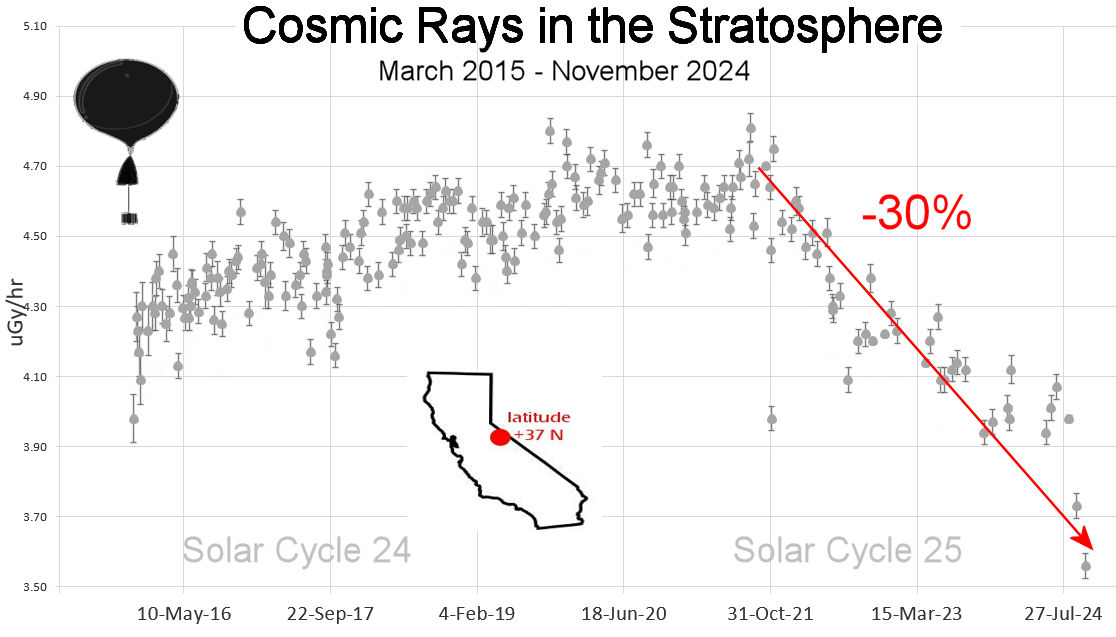
SPACE WEATHER BALLOON DATA: Almost once a week, Spaceweather.com and the students of Earth to Sky Calculus fly space weather balloons to the stratosphere over California. These balloons are equipped with sensors that detect secondary cosmic rays, a form of radiation from space that can penetrate all the way down to Earth's surface. Our monitoring program has been underway without interruption for 10 years, resulting in a unique dataset of in situ atmospheric measurements.
Latest results (Nov. 2024): Atmospheric radiation is sharply decreasing in 2024. Our latest measurements in November registered a 10-year low:
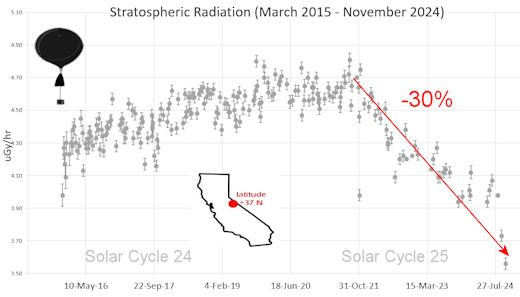
What's going on? Ironically, the radiation drop is caused by increasing solar activity. Solar Cycle 25 has roared to life faster than forecasters expected. The sun's strengthening and increasingly tangled magnetic field repels cosmic rays from deep space. In addition, solar coronal mass ejections (CMEs) sweep aside cosmic rays, causing sharp reductions called "Forbush Decreases." The two effects blend together to bring daily radiation levels down.
.Who cares? Cosmic rays are a surprisingly "down to Earth" form of space weather. They can alter the chemistry of the atmosphere, trigger lightning, and penetrate commercial airplanes. According to a study from the Harvard T.H. Chan school of public health, crews of aircraft have higher rates of cancer than the general population. The researchers listed cosmic rays, irregular sleep habits, and chemical contaminants as leading risk factors. A number of controversial studies (#1, #2, #3, #4) go even further, linking cosmic rays with cardiac arrhythmias and sudden cardiac death.
Technical notes: The radiation sensors onboard our helium balloons detect X-rays and gamma-rays in the energy range 10 keV to 20 MeV. These energies span the range of medical X-ray machines and airport security scanners.
Data points in the graph labeled "Stratospheric Radiation" correspond to the peak of the Regener-Pfotzer maximum, which lies about 67,000 feet above central California. When cosmic rays crash into Earth's atmosphere, they produce a spray of secondary particles that is most intense at the entrance to the stratosphere. Physicists Eric Regener and Georg Pfotzer discovered the maximum using balloons in the 1930s and it is what we are measuring today.
| |
The
official U.S. government space weather bureau |
| |
The
first place to look for information about sundogs,
pillars, rainbows and related phenomena. |
| |
Researchers
call it a "Hubble for the sun." SDO
is the most advanced solar observatory ever. |
| |
3D
views of the sun from NASA's Solar and Terrestrial
Relations Observatory |
| |
Realtime
and archival images of the Sun from SOHO. |
| |
information about sunspots based on the latest NOAA/USAF Active Region Summary |
| |
current counts of failed and deployed Starlink satellites from Jonathan's Space Page. See also, all satellite statistics. |
| |
Authoritative predictions of space junk and satellite re-entries |
| |
from
the NOAA Space Environment Center |
| |
fun to read, but should be taken with a grain of salt! Forecasts looking ahead more than a few days are often wrong. |
| |
from the NOAA Space Environment Center |
| |
the
underlying science of space weather |
 |
Got a chipped or cracked windshield that prevents you from seeing space weather events while driving? Get windshield replacement from SR Windows & Glass with free mobile auto glass service anywhere in the Phoenix area. |
| |
These links help Spaceweather.com stay online. Thank you to our supporters! |
|
|
| |
|
|
|