SpaceWeather.com
Sunday, Aug. 30, 2026
Original Site
SPACE TELESCOPE LAUNCHED: There's a new great observatory in space. NASA's Nancy Grace Roman Space Telescope launched this morning at 7:26 a.m. EDT onboard a SpaceX Falcon Heavy rocket. Roman's images will be as sharp as Hubble's, but its field of view is 100 times wider, capturing in weeks what older telescopes needed decades to see. Rocket launch alerts: SMS Text
IBERIA FLIGHT 1473: It may have been the most photofantastic eclipse flight ever. On Aug. 12th, Iberia 1473 flew through the shadow of the Moon during a total solar eclipse over Spain. We already featured one image. Now take a look at this one (click to enlarge):
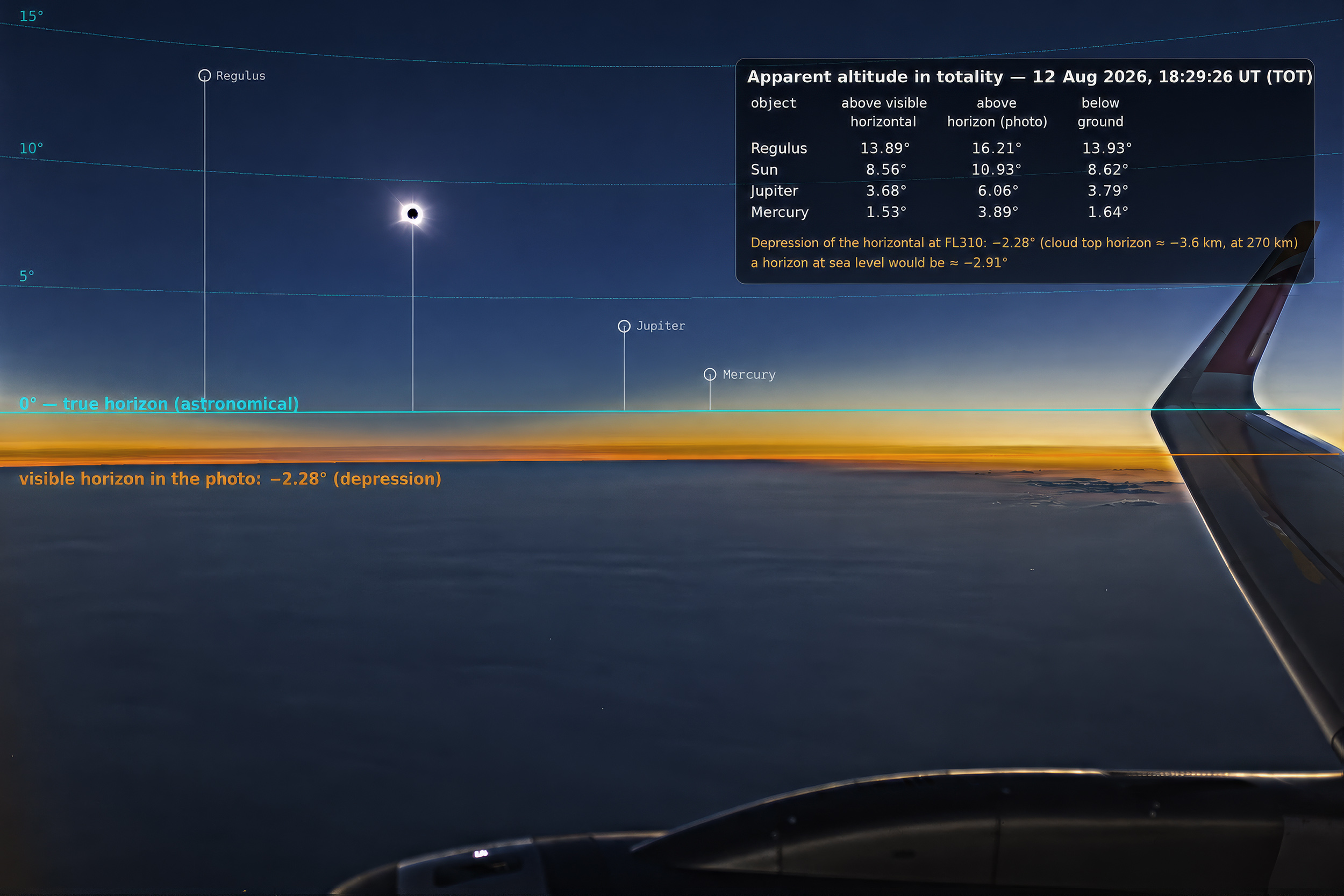
Juan Carlos Casado took the picture while the plane was 31,000 feet above Castilla y León, Spain. HIgh above the clouds and haze, he could see not only the eclipsed sun, but also Mercury, Jupiter and Regulus.
Casado compared the positions of the stars and planets to theoretical ephemerides. They agreed to within a few arcminutes. His photo, thus, formed a precise map of the sky.
"I noticed something odd about the horizon," he says. "From 31,000 feet, Earth's true horizon should dip about 2.91° below eye level--a consequence of the planet's curvature. But in the photo, the visible horizon is located at -2.28°." More than half a degree of Earth was missing.
Where did it go? It was swallowed by wildfire smoke and clouds--the very reasons Casado chartered the plane in the first place.
Realtime Space Weather Photo Gallery
Free: Space Weather Newsletter
THE GEOMETRIC BLACK CAT: This cat will never leave your side. The Geometric Black Cat flew to the edge of space on Oct. 4, 2025, floating 101,875 feet above the Sierra Nevada Mountains of central California:
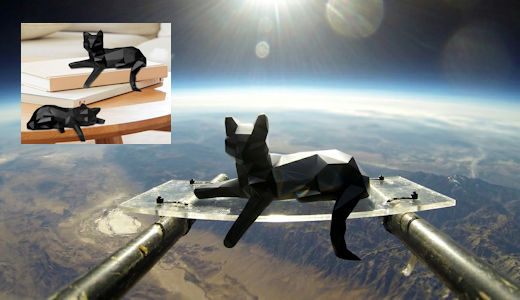
You can have it for $121.95. Hand-carved from resin, this desktop sculpture loves to hang out on bookcases or computer monitors. It comes with a keepsake card showing the cat at the top of Earth’s atmosphere, and telling the story of its flight to the edge of space onboard a cosmic ray research balloon.
Far Out Gifts: Earth to Sky Store
All sales support hands-on STEM education
Realtime Aurora Photo Gallery
Free: Spaceweather.com Newsletter
Pick the date, select Top News or Conditions, and hit View.
WAITING FOR THE CME: A CME expected to hit Earth on Aug 28th is overdue. But NOAA forecasters think it might still arrive on Aug. 29th. An impact today could spark G1/G2 geomagnetic storming with high-latitude auroras. CME Impact Alerts: SMS Text.
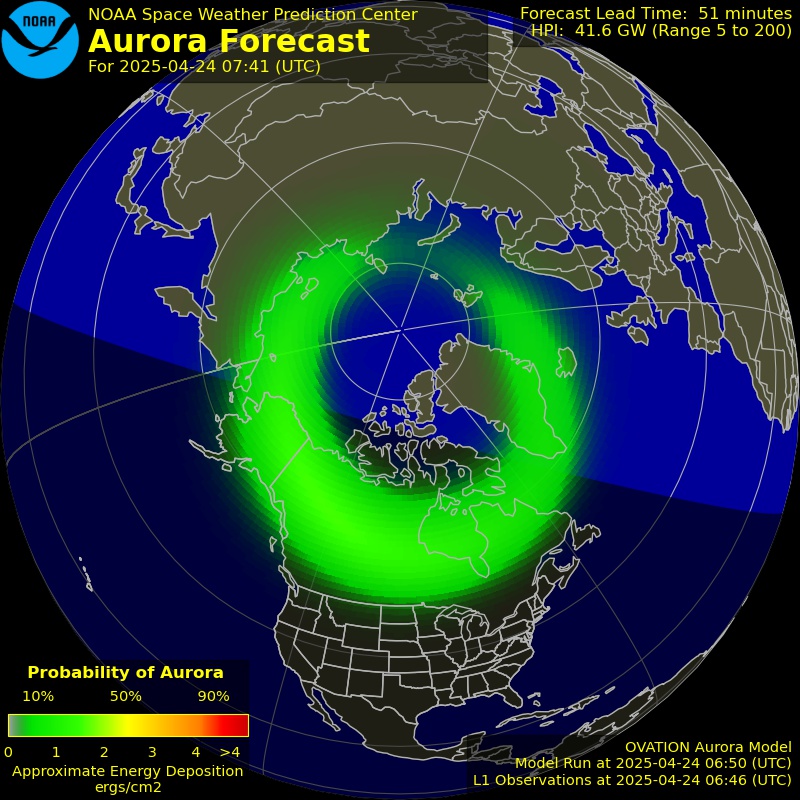
AURORAS RETURN TO TROMSO: It has been a long summer of incessant twilight in Tromsø, Norway, one of the world's premier destinations for aurora tourism. Good news for sky watchers: "The auroras are back!" says tour guide Marianne Bergli, who took this picture on August 28th:
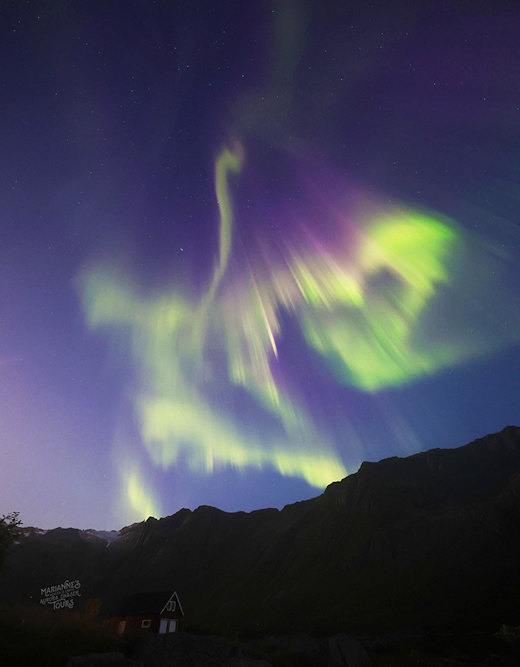
This display was caused by a corotating interaction region (CIR), which hit Earth on Aug. 28th. CIRs are like mini-CMEs. They are sandwiches of dense plasma caught between adjacent streams of solar wind. Bergli observed the aurora outburst just hours after the CIR arrived.
Soon, regular darkness will return to Tromsø. The northern autumnal equinox is only weeks away, boosting auroras with the Russell-McPherron Effect. Stay tuned for nightly photos from inside the Arctic Circle.
Realtime Space Weather Photo Gallery
Free: Space Weather Newsletter
THE GEOMETRIC BLACK CAT: This cat will never leave your side. The Geometric Black Cat flew to the edge of space on Oct. 4, 2025, floating 101,875 feet above the Sierra Nevada Mountains of central California:
You can have it for $121.95. Hand-carved from resin, this desktop sculpture loves to hang out on bookcases or computer monitors. It comes with a keepsake card showing the cat at the top of Earth’s atmosphere, and telling the story of its flight to the edge of space onboard a cosmic ray research balloon.
Far Out Gifts: Earth to Sky Store
All sales support hands-on STEM education
Realtime Aurora Photo Gallery
Free: Spaceweather.com Newsletter