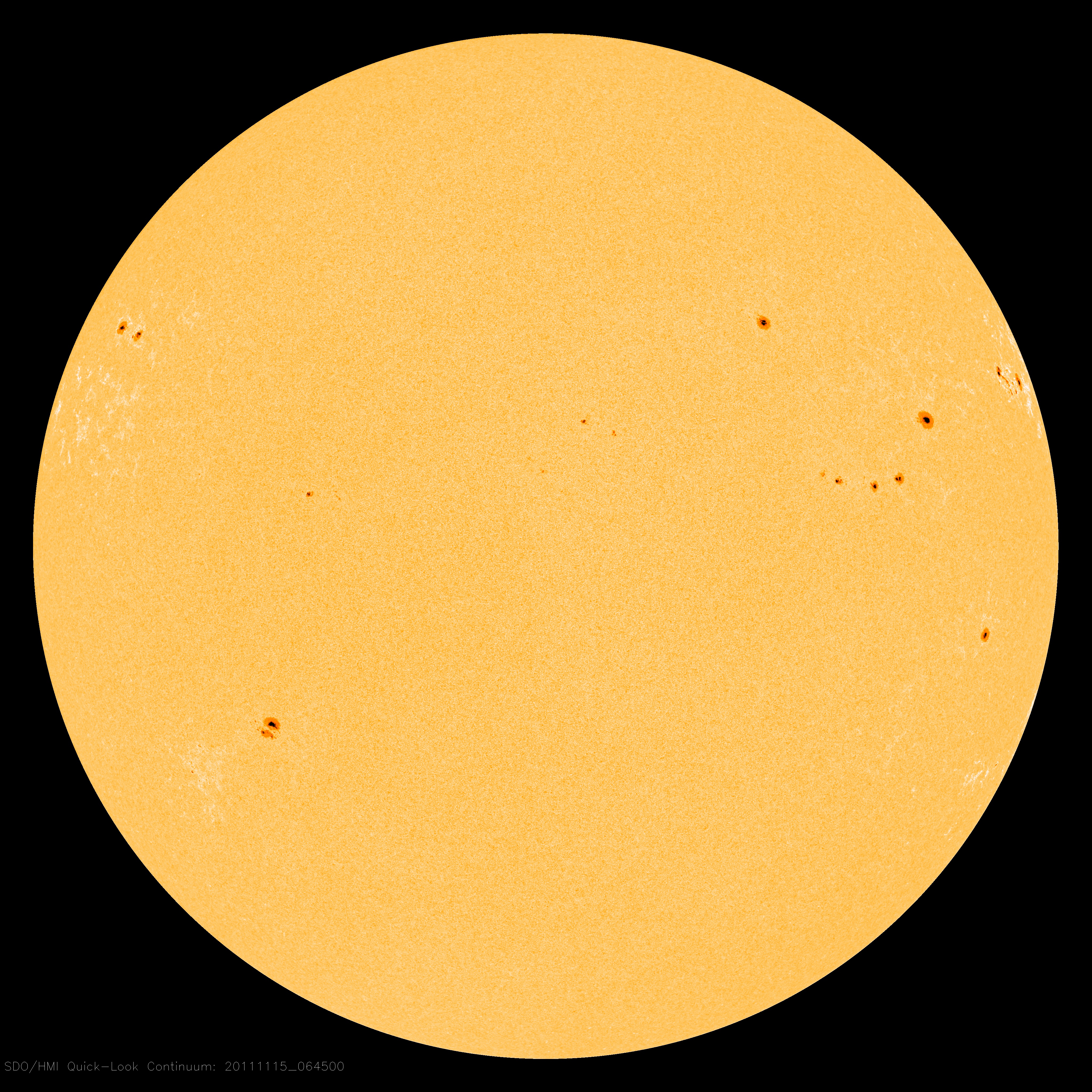
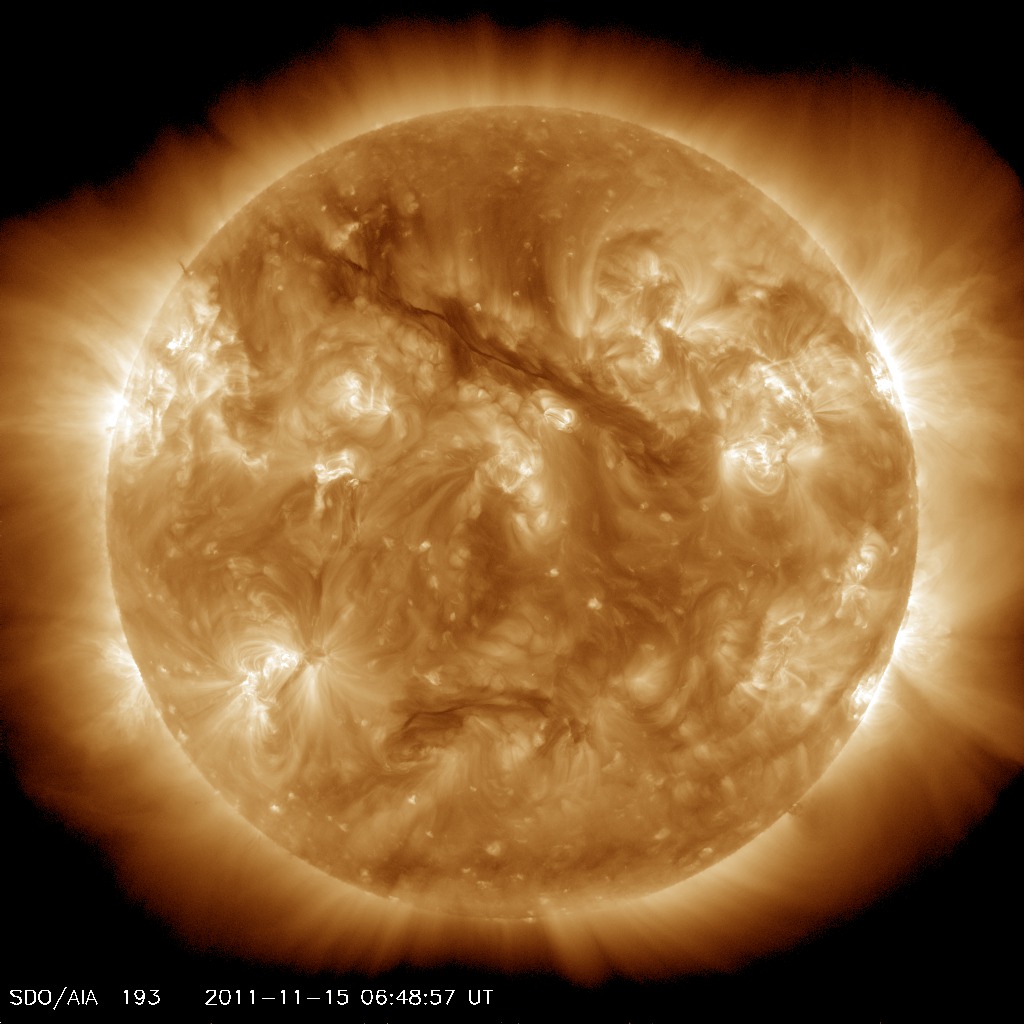
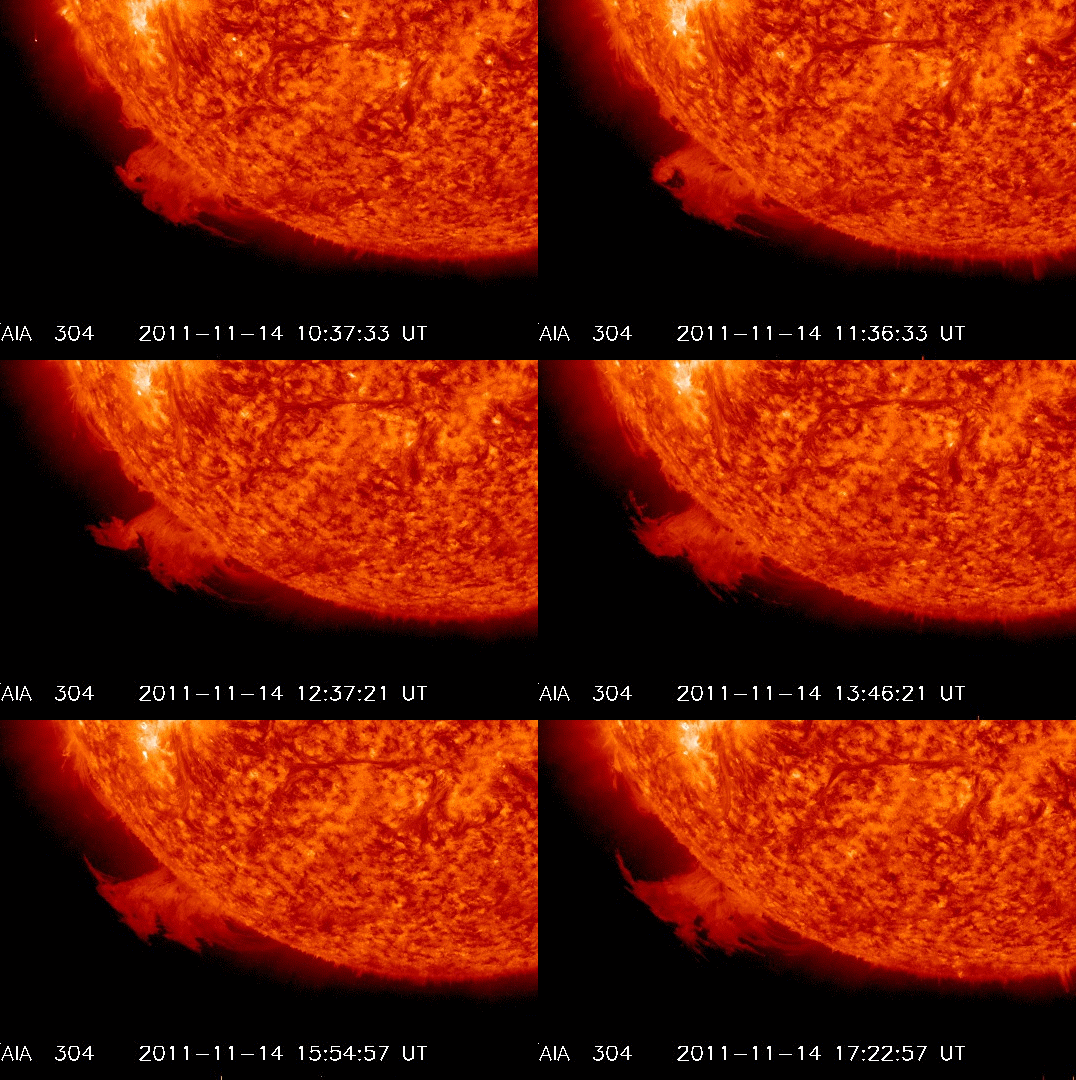
Metallic photos of the sun by renowned photographer Greg Piepol bring together the best of art and science. Buy one or a whole set. They make a stellar gift. | | |
THE LUNAR IONOSPHERE: How can a world with no air have an ionosphere? Somehow the Moon has done it. Researchers have been puzzled by the lunar ionosphere for more than 40 years. With the recent publication of a paper in Planetary and Space Science, the mystery may have been solved. Get the full story from Science@NASA.
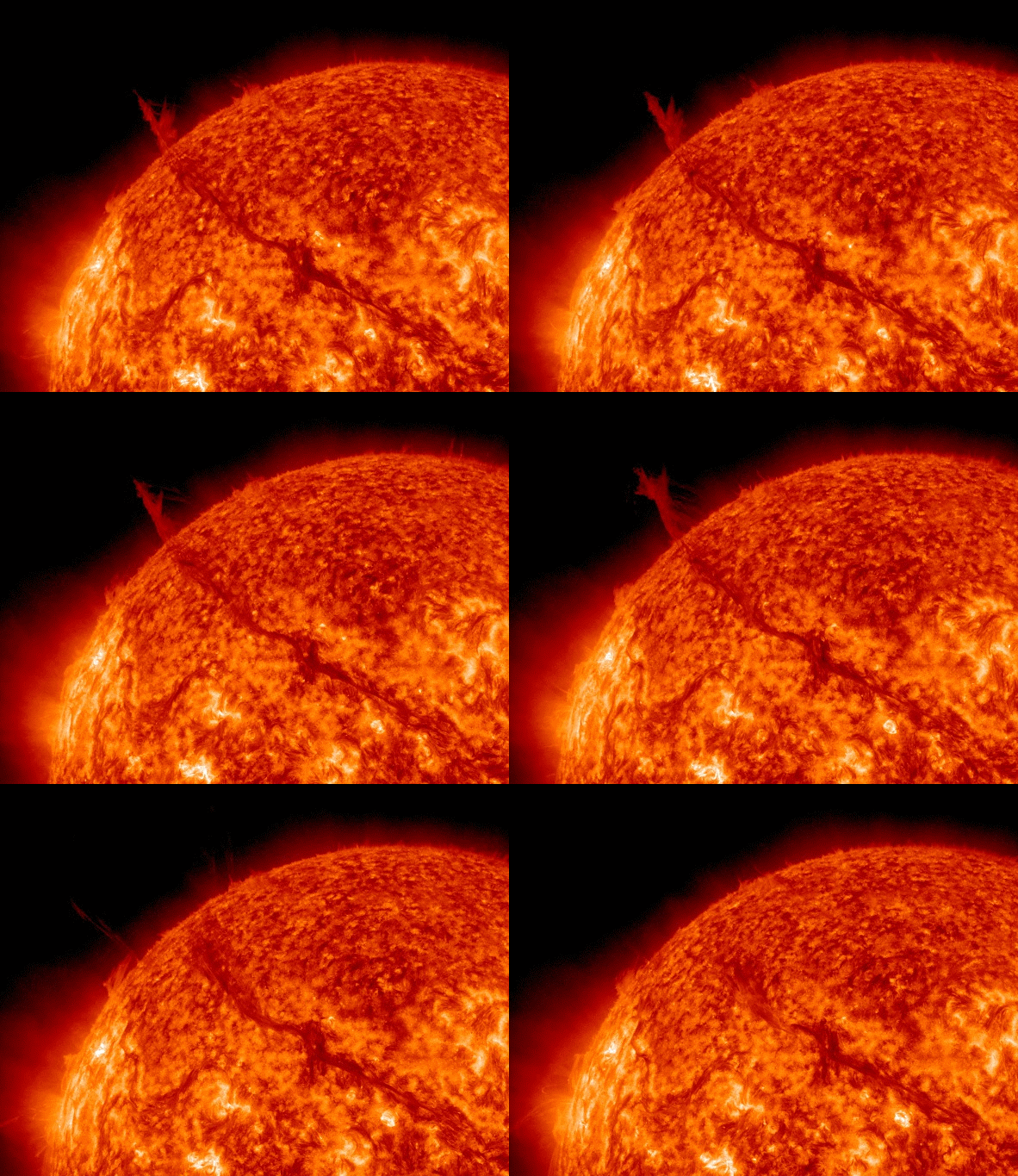
SNAP! ERUPTING FILAMENT: For the past few days, astronomers around the world have been monitoring a dark filament of magnetism sprawled more than 1,000,000 kilometers across the face of the sun. Make that 750,000 km. On Nov. 14th the filament snapped and flung a fraction of itself into space. NASA's Solar Dynamics Observatory recorded the action:
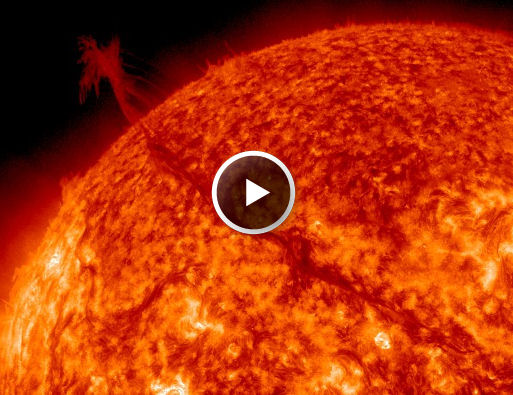
The eruption hurled a cloud of plasma into space, but not toward Earth. The only effect on our planet would be to disappoint observers hoping for a longer filament.
Meanwhile, a wall of plasma towering over the sun's SE limb is seething with activity and may be poised to erupt as well. Readers with solar telescopes are encouraged to monitor developments. Solar flare alerts: text, phone
more images: from Sylvain Weiller of Saint Rémy lès Chevreuse, France; from John Stetson of Falmouth, Maine; from Chris Hetlage of Deerlick Astronomy Village, Georgia; from David Cortner of Rutherford College, North Carolina; from Jo Dahlmans of Ulestraten The Netherlands; from Francisco A. Rodriguez of the Canary Islands; from Ron Cottrell of Oro Valley, Arizona; from Gianfranco Meregalli of Milano Italy; from Roel Weijenberg of Wilp, Gelderland, Netherlands; from Andy Burns of Chippenham, Wiltshire, UK
ASTEROID PARALLAX: "On November 9th, asteroid 2005 YU55 passed so close to Earth that viewers at separate locations saw the interloper appear in slightly different spots against the background star field," says amateur astronomer Mike Harms of San Francisco. To illustrate this parallax effect, he combined his own observations with those of Dennis di Cicco across the country in Boston:
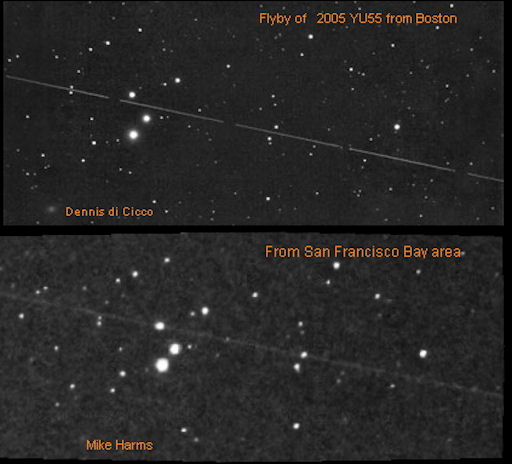
At the time of the flyby, the 400m-wide space rock was only 324,600 kilometers away, about 85% the distance from Earth to the Moon. This allowed amateur and professional astronomers alike to study the asteroid in unprecedented detail.
In Australia, where the Boston vs. Brisbane parallax effect was even greater, Dennis Simmons video-recorded the flyby: "It was quite sobering to be able to view the almost full Moon some 20 degrees away, knowing that this lump of rock was now nearer to me than our Moon," he says. "I was astonished at how bright the NEO appeared, having read that results from the Arecibo radar indicated it to be a very dark, nearly spherical object some 400 meters in diameter."
more images: from Conrad Jung of Oakland, California; from Libor Vyskocil of Observatory Upice, Czech Republic; from Rolando Ligustri of Talmassons (Italy); from William Wiethoff of Port Wing, Wisconsin; from Marco Langbroek of Markleeberg, California