They came from outer space--and you can have one! Genuine meteorites are now on sale in the Space Weather Store. | | |
SOLAR WIND: A medium-speed (500 km/s) solar wind stream is gently buffeting Earth's magnetic field. Polar sky watchers should be alert for Northern Lights tonight. Aurora alerts: text, voice.
OBAMA VISITS THE EDGE OF SPACE: After winning re-election yesterday, President Obama is on top of the world. Seriously. A group of high school students in Bishop, California, has launched a Barack Obama bobblehead to the edge of space using a suborbital helium balloon. Here is a picture of the president on Nov. 5th approximately 120,000 feet above Earth's surface:
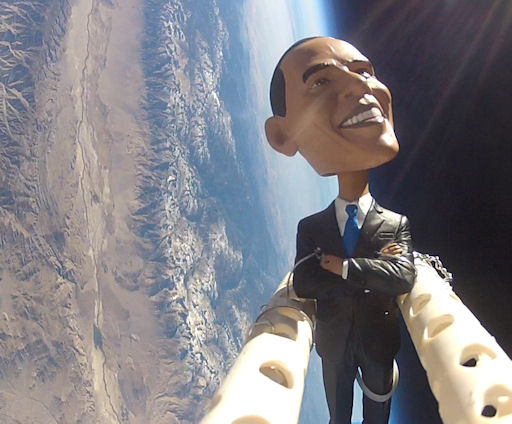
This flight was conducted by the same students who earlier this year launched NASA's rubber chicken into a solar storm to sample high protons from the sun. "Sending Obama into the stratosphere was just for fun," says team member Amelia Phillips. "But it was good practice for more serious projects, such as our flights to measure solar flares and photograph meteor showers." The group, which calls itself "Earth to Sky Calculus," has been flying suborbital helium research balloons for two years; this is the first time the President has gone for a ride.
Images and video from the flight are still being processed. Here are some first looks: Video: Obama at 120,000 feet (8 MB); the balloon pops (1.2 MB); The President's wild ride (19 MB); Still images: Fractured balloon; Obama over Mono Lake; Mitt was there, too!
SO THIS IS SOLAR MAXIMUM? Forecasters have long expected the Solar Max of 2013 to be the weakest of the Space Age. It might be even weaker than they thought. As shown in this 20-year plot of sunspot counts vs. time, the sun is underperforming:
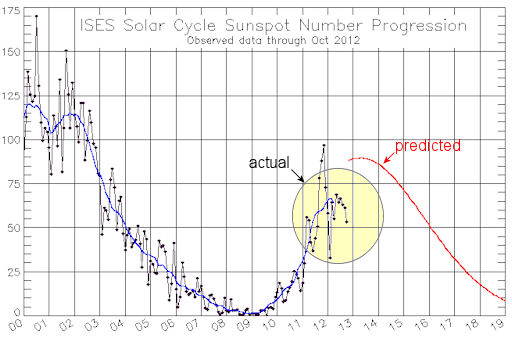
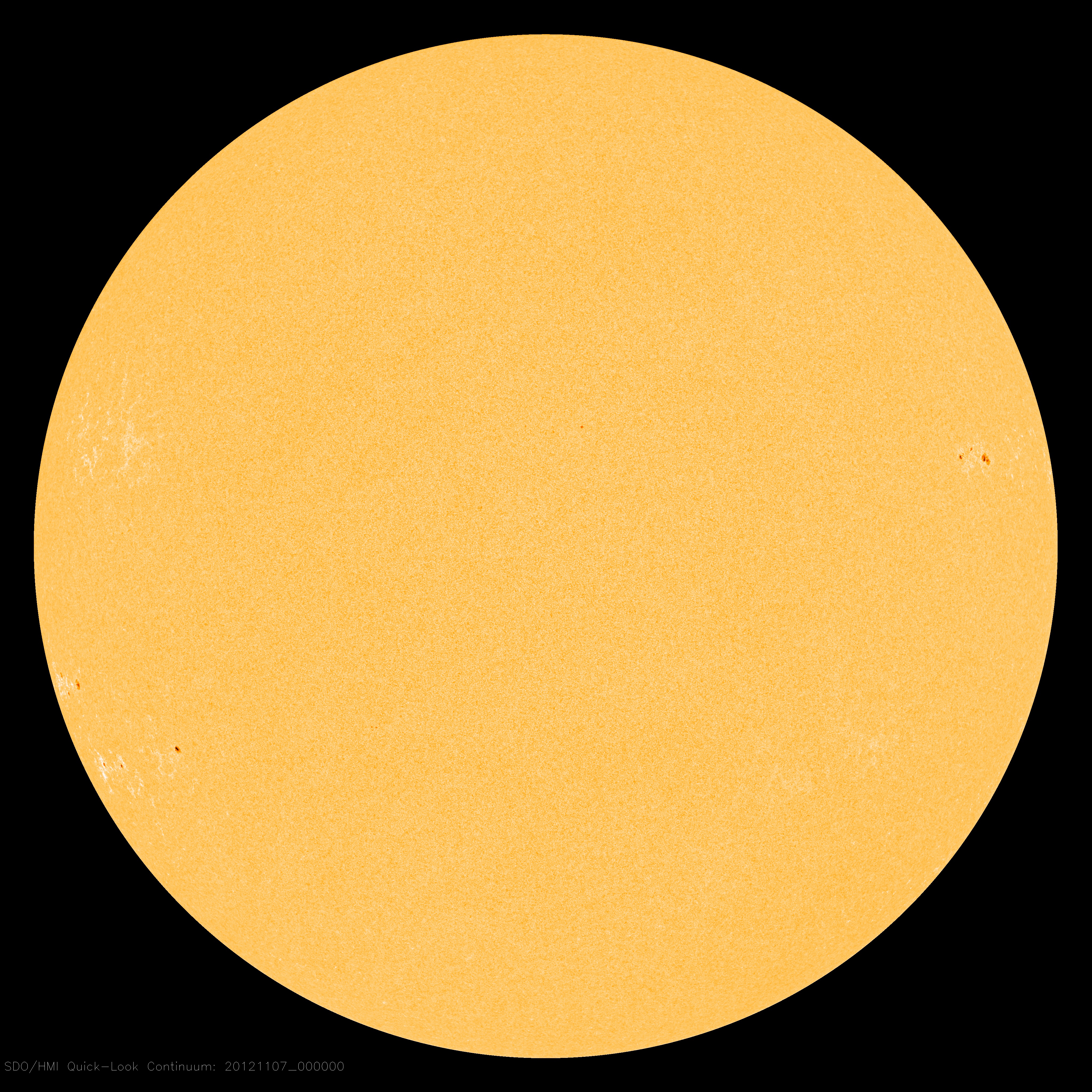
Sunspot numbers are notoriously variable, so the actual counts could rapidly rise to meet or exceed the predicted curve. For now, however, the face of the sun is devoid of large sunspots, and there have been no strong flares in more than a week. The threshold of Solar Max looks a lot like Solar Min. NOAA forecasters estimate no more than a 1% chance of X-class solar flares in the next 24 hours.
Realtime Space Weather Photo Gallery
TAURID FIREBALLS: Sky watchers should be alert for fireballs in the nights ahead. Forecasters say Earth is entering a swarm of gravelly debris from comet Encke. Meteoroids the size of pebbles and small stones hitting Earth's atmosphere at 25 km/s are producing a slow drizzle of very bright fireballs flying out of the constellation Taurus. The display is expected to peak with a few fireballs every hour during the nights of Nov. 5-12.
On Nov. 2nd, Salvador Aguirre photographed a Taurid fireball streaking over Hermosillo, Mexico. Circled, the fireball was even brighter than the nearby Moon:
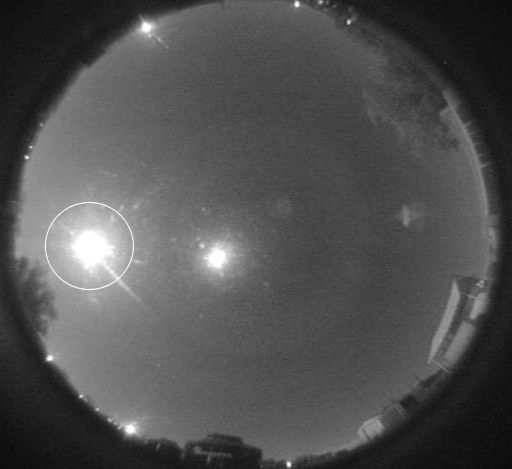
"Este fue un Gran Fireball!" says Aguirre, who estimates its astronomical magnitude to be -18. This means the fireball was 100 times brighter than a full Moon (magn. -13). To capture the Taurid, he used an All Sky Sentinel camera on loan from the Sandia National Laboratories.
"What always strikes me about the Taurids," notes Bill Cooke of NASA's Meteoroid Environment Office, "is how deeply they penetrate Earth's atmosphere. On average, they make it down to an altitude of 44 miles. Contrast this to the recent Orionids, which burn up at an average altitude of 58 miles. Part of this is due to the speed difference: Taurids are slow (27 km/s) while Orionids are fast (66 km/s). In addition, many Taurids are made up of stronger stuff than the Orionids."
Cooke encourages sky watchers to observe the Taurids and report their fireball counts to NASA using the Meteor Counter app--now available for Apple and for Android devices.
Realtime Meteor Photo Gallery
Realtime Aurora Photo Gallery
Realtime Noctilucent Cloud Photo Gallery
[previous years: 2003, 2004, 2005, 2006, 2007, 2008, 2009, 2011]