Thirty-five new items have just been added to our Meteorite Jewelry collection. Browse the Space Weather Store for something out of this world. | | |
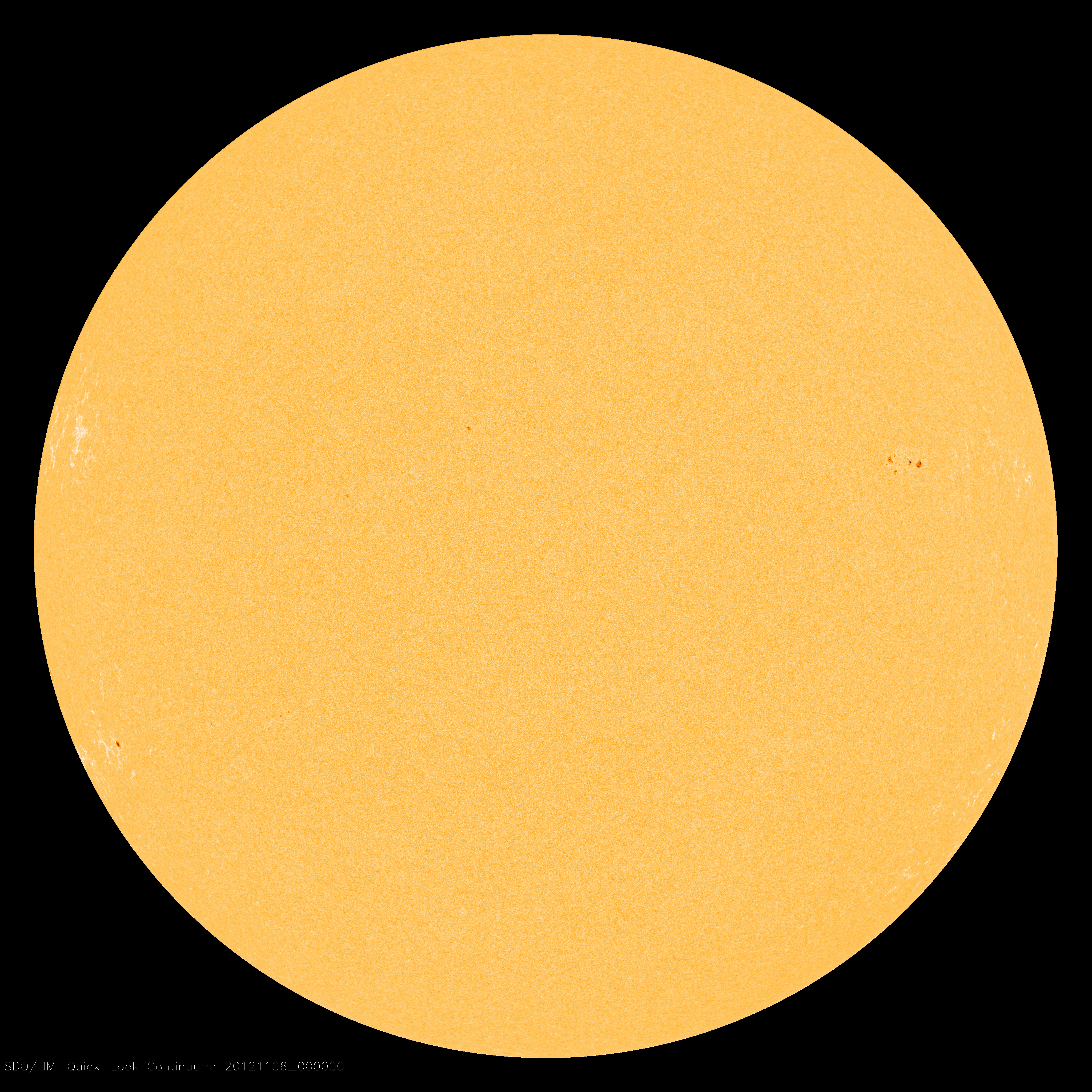
QUIET SUN: With no sunspots actively flaring, the sun's x-ray outut has nearly flatlined. Solar activity is very low and likely to remain so for the next 24 hours. Solar flare alerts: text, voice.
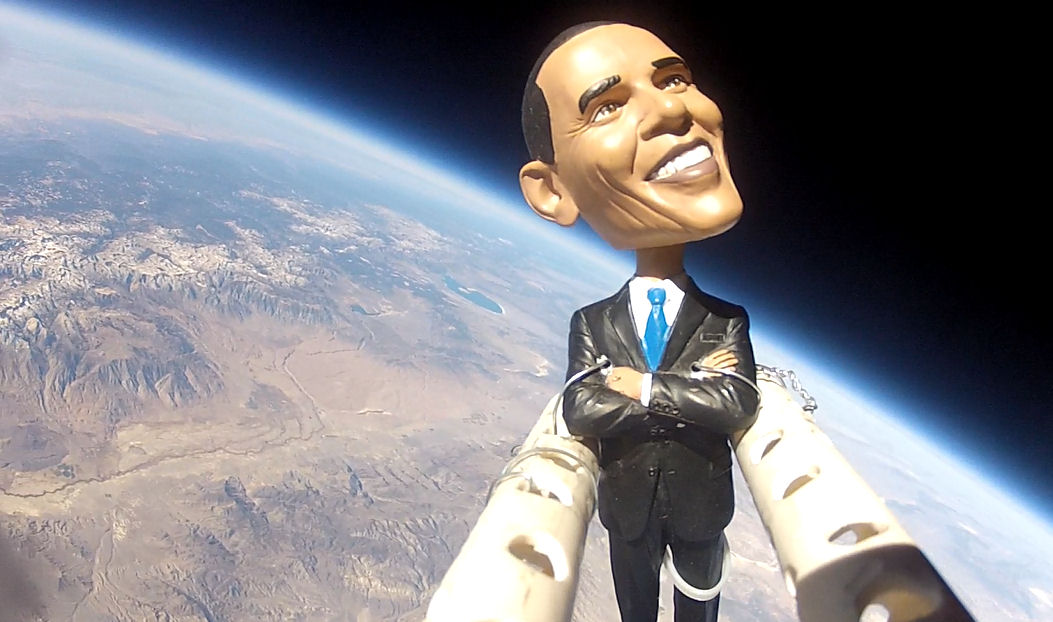
OBAMA AND ROMNEY VISIT THE EDGE OF SPACE: To commemorate the election for President of the USA, a group of high school physics students in Bishop, California, has launched a pair of Barack Obama and Mitt Romney bobbleheads to the edge of space. The payload of their helium balloon has just been recovered, and here is a first-look image of President Obama floating 120,000 feet over the California Sierras:
Stay tuned for similar pictures of Mitt, plus videos of both candidates and other data from this unusually fun suborbital space flight.
This flight was conducted by the same group of high school students who launched NASA's rubber chicken into a solar storm last March. You can learn more about them on Facebook.
SO THIS IS SOLAR MAXIMUM? Forecasters have long expected the Solar Max of 2013 to be the weakest of the Space Age. It might be even weaker than they thought. As shown in this 20-year plot of sunspot counts vs. time, the sun is underperforming:
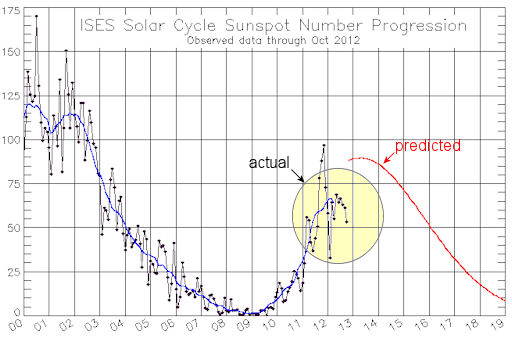
Sunspot numbers are notoriously variable, so the actual counts could rapidly rise to meet or exceed the predicted curve. For now, however, the face of the sun is devoid of large sunspots, and there have been no strong flares in more than a week. The threshold of Solar Max looks a lot like Solar Min. NOAA forecasters estimate no more than a 1% chance of X-class solar flares in the next 24 hours.
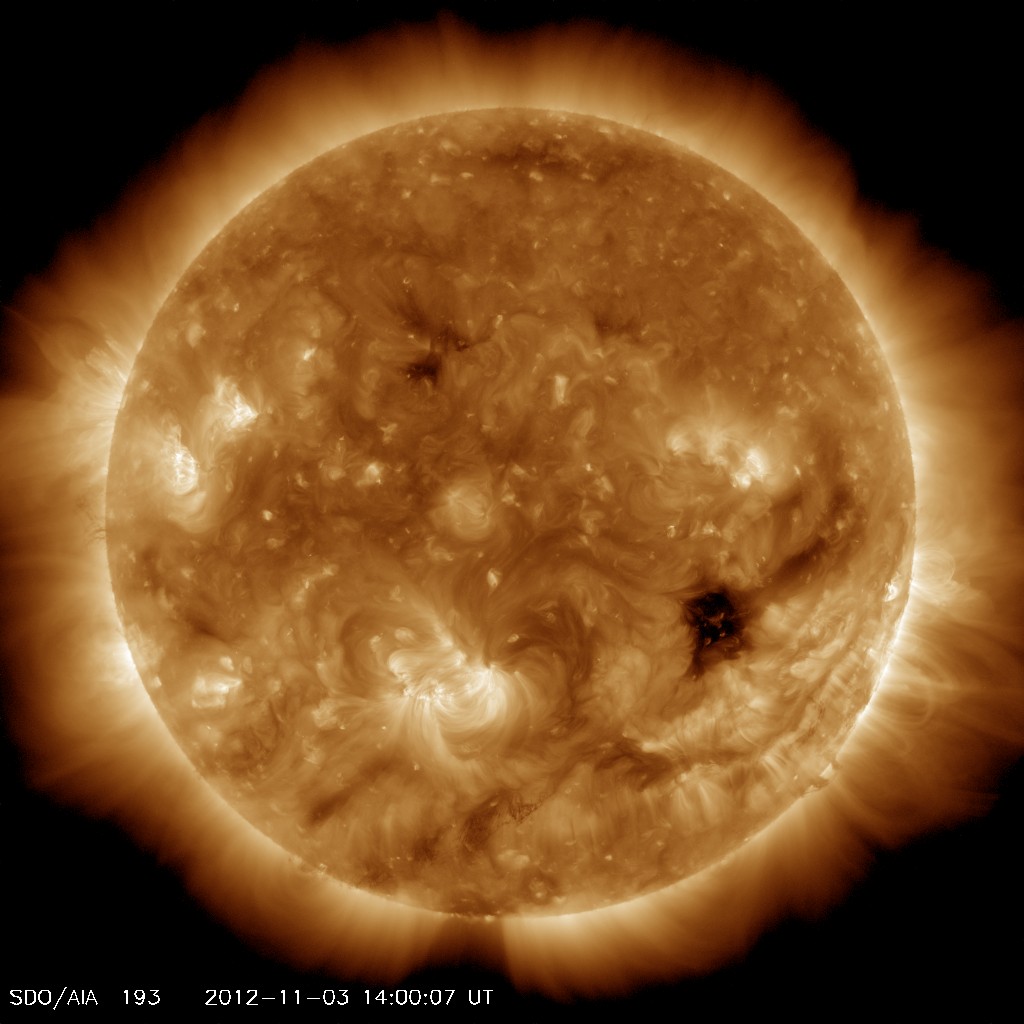
CORONAL HOLE: NASA's Solar Dynamics Observatory is monitoring a dark hole in the sun's atmosphere, a "coronal hole." It is near the sun's western limb in this extreme ultraviolet image taken during the early hours of Nov. 5th:
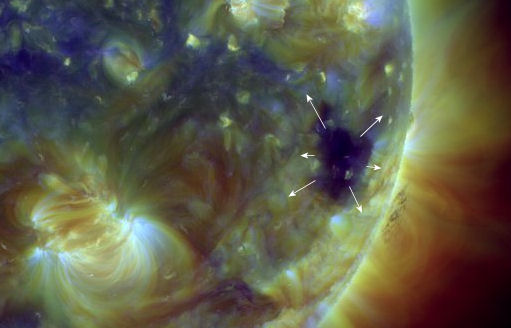
Coronal holes are places where the sun's magnetic field opens up and allows the solar wind to escape. A stream of solar wind flowing from this coronal hole is expected to reach Earth on Nov. 6th. Polar sky watchers should be alert for auroras when it arrives. Magnetic storm alerts: text, voice.
Realtime Space Weather Photo Gallery
TAURID FIREBALLS: Sky watchers should be alert for fireballs in the nights ahead. Forecasters say Earth is entering a swarm of gravelly debris from comet Encke. Meteoroids the size of pebbles and small stones hitting Earth's atmosphere at 25 km/s are producing a slow drizzle of very bright fireballs flying out of the constellation Taurus. The display is expected to peak with a few fireballs every hour during the nights of Nov. 5-12.
On Nov. 2nd, Salvador Aguirre photographed a Taurid fireball streaking over Hermosillo, Mexico. Circled, the fireball was even brighter than the nearby Moon:
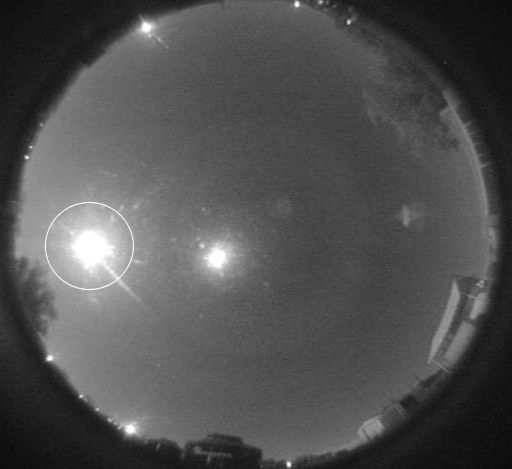
"Este fue un Gran Fireball!" says Aguirre, who estimates its astronomical magnitude to be -18. This means the fireball was 100 times brighter than a full Moon (magn. -13). To capture the Taurid, he used an All Sky Sentinel camera on loan from the Sandia National Laboratories.
"What always strikes me about the Taurids," notes Bill Cooke of NASA's Meteoroid Environment Office, "is how deeply they penetrate Earth's atmosphere. On average, they make it down to an altitude of 44 miles. Contrast this to the recent Orionids, which burn up at an average altitude of 58 miles. Part of this is due to the speed difference: Taurids are slow (27 km/s) while Orionids are fast (66 km/s). In addition, many Taurids are made up of stronger stuff than the Orionids."
Cooke encourages sky watchers to observe the Taurids and report their fireball counts to NASA using the Meteor Counter app--now available for Apple and for Android devices.
Realtime Meteor Photo Gallery
Realtime Aurora Photo Gallery
Realtime Noctilucent Cloud Photo Gallery
[previous years: 2003, 2004, 2005, 2006, 2007, 2008, 2009, 2011]