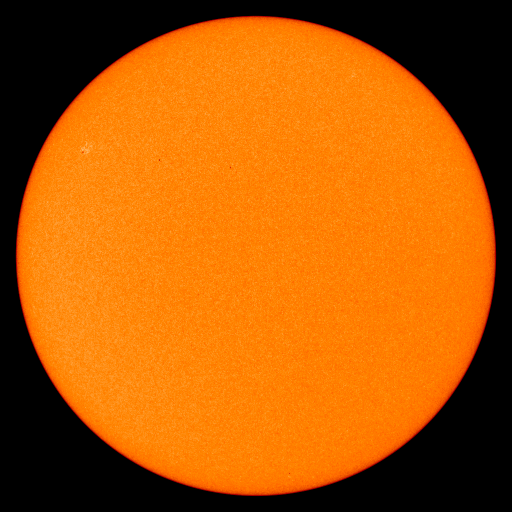
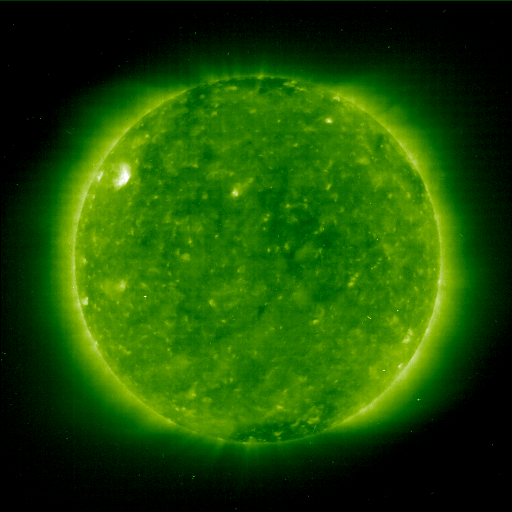
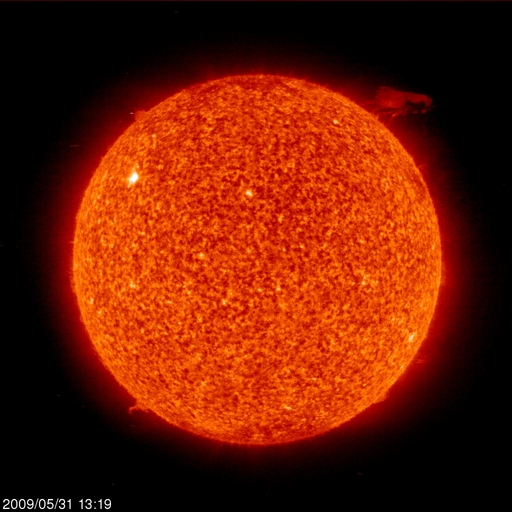
| SUPER PROMINENCE: "Wow - what a sight greeted me this morning as I set up my H-alpha telescope," reports Pete Lawrence of Selsey, UK. "There was a huge plume of plasma on the northwestern limb of the sun: photo. If you've got a solar telescope, take a look, it's changing but still visible." more images: from SOHO; from Dalouzy Jean-Christophe of Caen, Normandy, France; from Stephen Ames of Hodgenville, Kentucky; from Lecoq Etienne of Mesnil-Panneville, Normandy, France; FIRST NLCs of 2009: New data from NASA's AIM spacecraft show that noctilucent clouds (NLCs) are like a great "geophysical light bulb." They turn on every year in late spring, reaching almost full intensity over a period of no more than 5 to 10 days. News flash: The bulb is beginning to glow. The first NLCs of 2009 were sighted over Russia on May 27th, and an even brighter display appeared on May 29th over Denmark and the British Isles. Martin Mc Kenna sends these snapshots from Maghera, Northern Ireland: 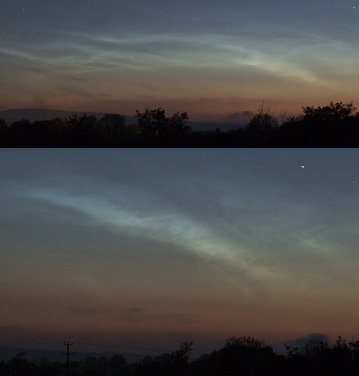
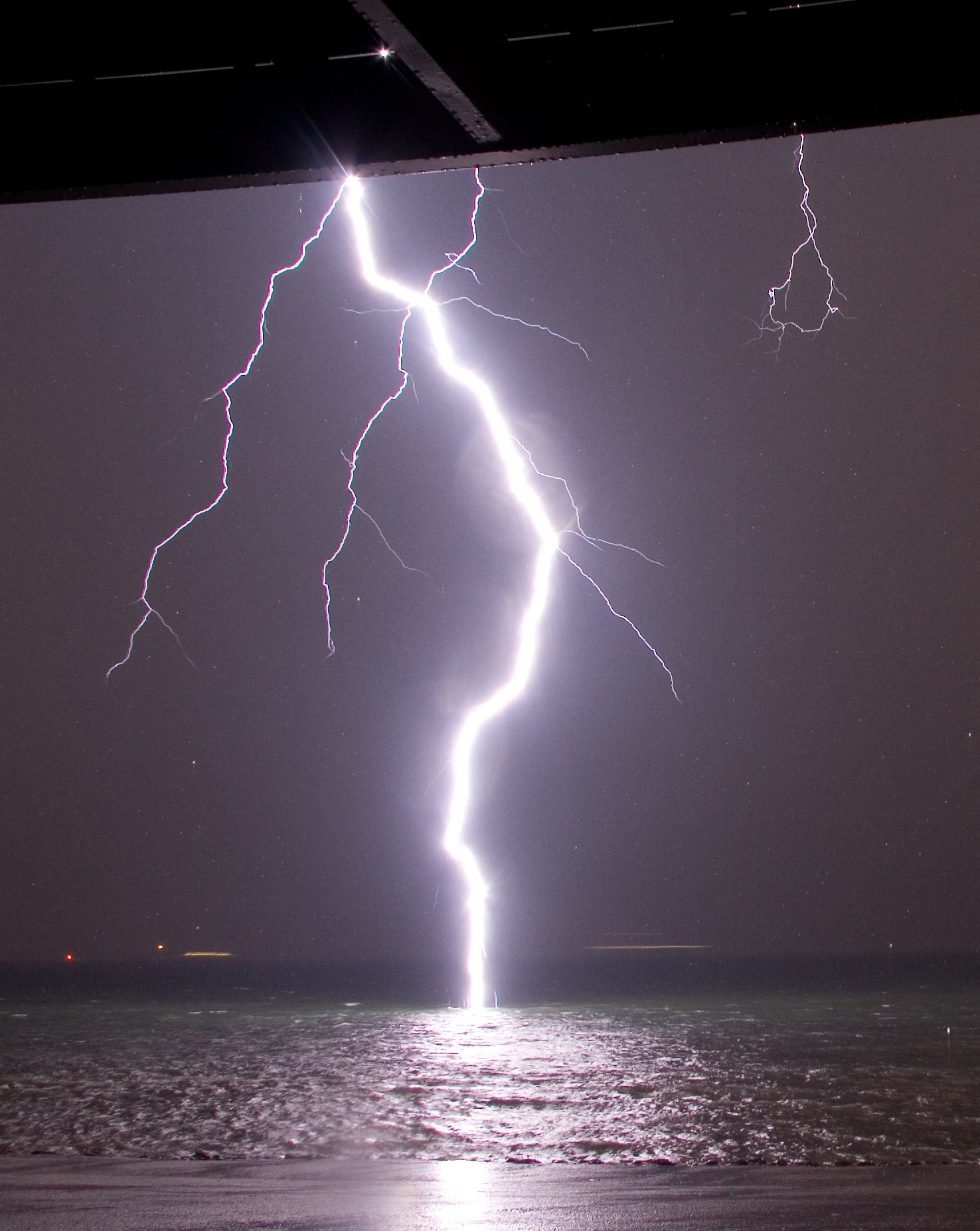
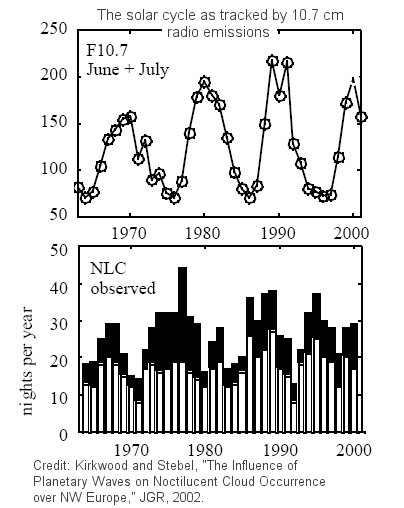
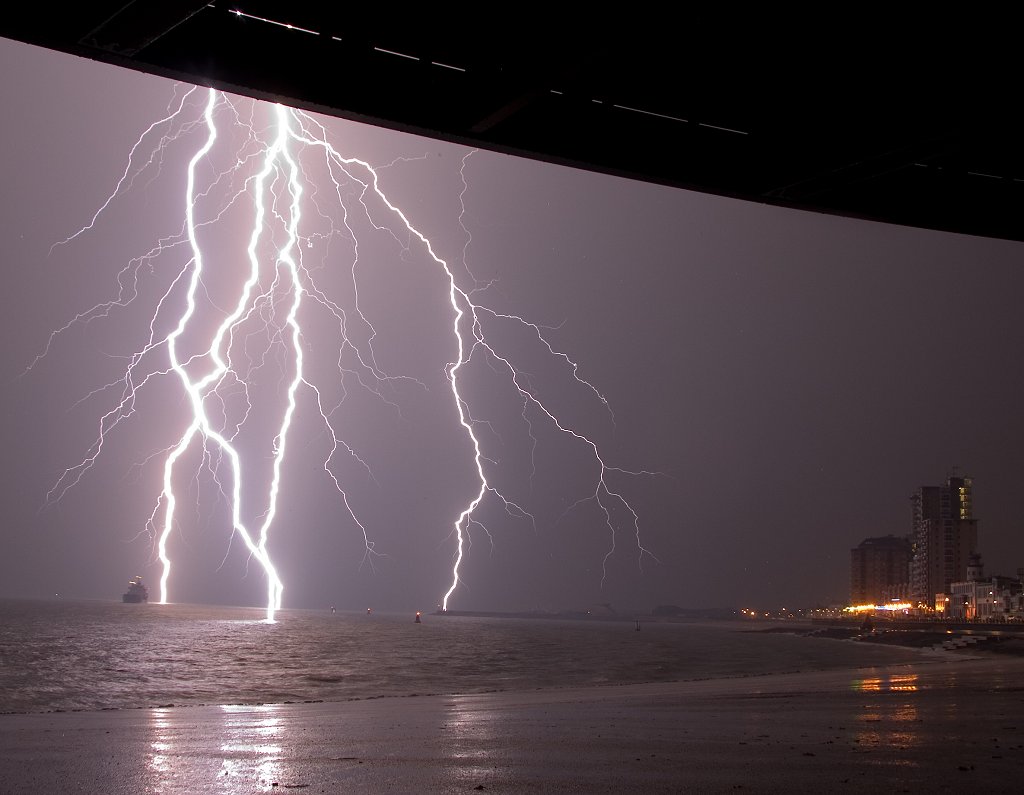
"The glowing clouds were more than 100 degrees wide with white, blue and even subtle yellow and green colours," says Mc Kenna. "It was an excellent display to start the season and a good omen of major events to come in the near future!" The May 29th display was also witnessed by John C Mcconnell of Maghaberry Northern Ireland (photos); Paul Evans of Larne, Northern Ireland (photos); and Ian Brantingham near Banff, Scotland (photos). There is a well-known correlation between noctilucent clouds and the solar cycle. NLC activity tends to peak during years of solar minimum, possibly because low solar activity allows the upper atmosphere to cool, promoting the growth of ice crystals that make up the clouds. With a century-class solar minimum underway, the stage is set for a good season of NLC watching. Typically, the first NLCs of spring are wan and pale, followed by better displays as summer unfolds. Browse the galleries from previous years to see what may be in the offing: 2008, 2007, 2006, 2005, 2004, 2003. LIGHTNING SPLASH: On May 26th, photographers Francis Schaefers and Daniel Burger were chasing a thunderstorm along a beach in Vlissingen, the Netherlands, when "the storm turned around and came a little too close for comfort," says Schaefers. "We were able to photograph lightning hitting the water just 40 meters away." Here is the view through their Canon 400D: 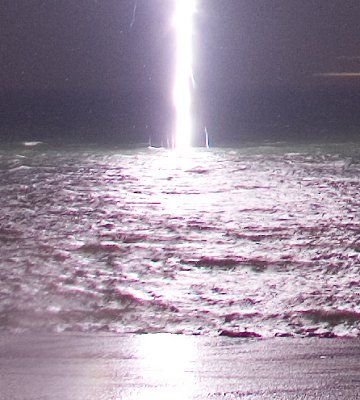
Look closely where the lightning meets the water. Tiny bolts appear to be dancing around the impact site. "Those are called 'upward streamers,'" says lightning expert Richard Blakeslee of the NASA Marshall Space Flight Center. "In a typical cloud-to-ground lightning strike, as the leader approaches the ground, the large electric field at the leader tip induces these upward propagating streamers. The first one that connects to the downward propagating leader initiates the bright return stroke that we see with our eye. Upward streamers are often observed on photographs of lightning hitting the ground." Now we know they can be seen when lightning hits the water, too. Schaefers and Burger took many pictures that night, mostly from underneath a balcony where they figured the lightning wouldn't reach. This favorite is called The Cruise You Don't Want to Take.
April 2009 Aurora Gallery
[previous Aprils: 2008, 2007, 2006, 2005, 2004, 2003, 2002]
Explore the Sunspot Cycle |