Listen to radar echoes from satellites and meteors, live on listener-supported Space Weather Radio. | | |
CHANCE OF STORMS: NOAA forecasters estimate a 55% chance of polar geomagnetic storms today, Nov. 30th, when a coronal mass ejection (CME) is expected to hit Earth's magnetic field. High-latitude sky watchers should be alert for auroras. Geomagnetic storm alerts: text, voice.
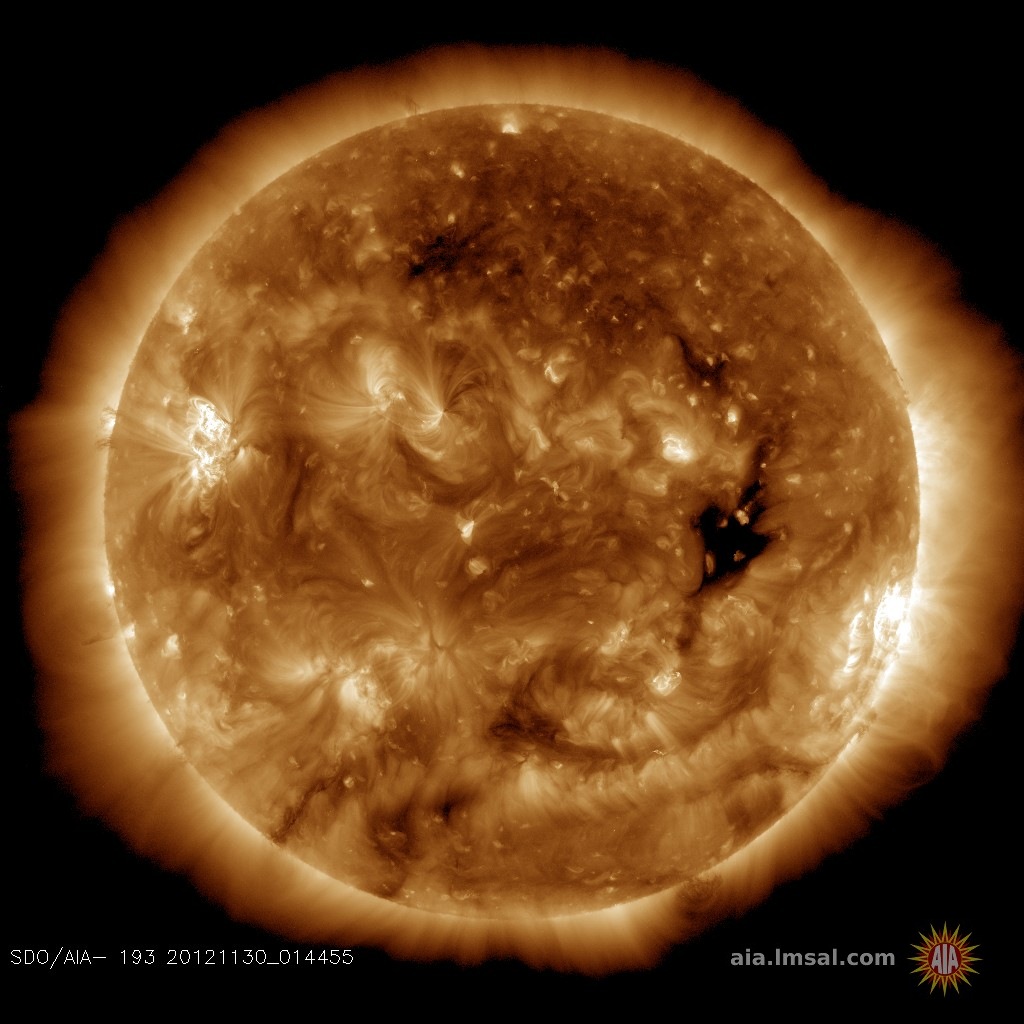
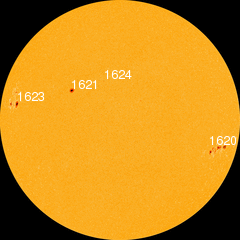
SOLAR ACTIVITY: The most active region on the solar disk today is emerging sunspot AR1625. It is crackling with C-class solar flares, like this one (C4.6) recorded on Nov. 29th by NASA's Solar Dynamics Observatory:
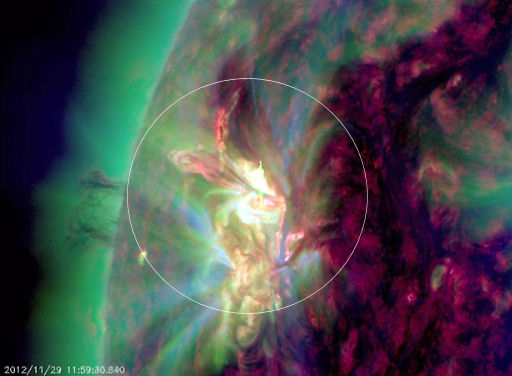
The eruption did not hurl a CME into space. Neither Earth nor any other planet will be affected.
More flares could be in the offing as AR1625 emerges in close proximity to another active sunspot, AR1623. If the magnetic canopies of the two sunspots intermingle, they could reconnect and erupt, producing something stronger than a C-flare. Stay tuned for updates. Solar flare alerts: text, voice.
Realtime Space Weather Photo Gallery
ASPHALT RAINBOW: Usually rainbows are seen near storm clouds. A few days ago, Geoff Chester was riding his bike in Arlington, Virginia, when he looked down and found one in the asphalt. "Here's a picture from my cellphone camera," says Chester. "You can see the rainbow arc to the right."
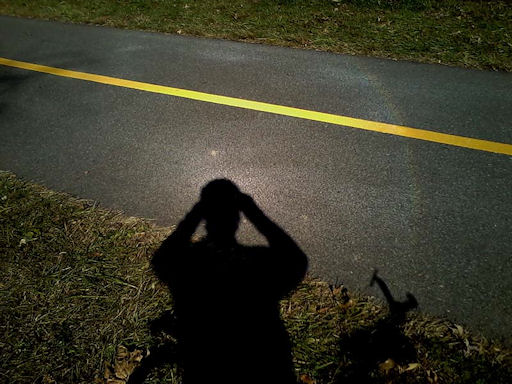
According to atmospheric optics expert, this is not a rainbow, but rather a glass bead bow. He explains: "Crews marking paint lines on roads often scatter small glass beads onto the paint. The glass beads retro-reflect light and this enhances the visibility of the markings at night. The glass beads - if sufficiently spherical - also produce rainbows. The difference is that the refractive index of glass is greater than that of water and the bow is only about 21° in radius compared to the rainbow's 42°. The glow around the shadow of Geoff's head is an antisolar point phenomenon - a heigenschein - produced by refraction through the glass spheres."
"Looks like the mystery is solved," adds Chester. "Although technically the trail is closed dusk to dawn, I know of many folks who use it as a bike commuter route after dark, especially this time of year. The beads enhance visibility. I got plenty of strange looks from passersby as I was taking the pictures!"
Realtime Space Weather Photo Gallery
Realtime Aurora Photo Gallery
Realtime Eclipse Photo Gallery
Realtime Noctilucent Cloud Photo Gallery
[previous years: 2003, 2004, 2005, 2006, 2007, 2008, 2009, 2011]
Potentially Hazardous Asteroids (
PHAs) are space rocks larger than approximately 100m that can come closer to Earth than 0.05 AU. None of the known PHAs is on a collision course with our planet, although astronomers are finding
new ones all the time.
On November 30, 2012 there were potentially hazardous asteroids.
Notes: LD means "Lunar Distance." 1 LD = 384,401 km, the distance between Earth and the Moon. 1 LD also equals 0.00256 AU. MAG is the visual magnitude of the asteroid on the date of closest approach. | | The official U.S. government space weather bureau |
| | The first place to look for information about sundogs, pillars, rainbows and related phenomena. |
| | Researchers call it a "Hubble for the sun." SDO is the most advanced solar observatory ever. |
| | 3D views of the sun from NASA's Solar and Terrestrial Relations Observatory |
| | Realtime and archival images of the Sun from SOHO. |
| | from the NOAA Space Environment Center |
| | the underlying science of space weather |