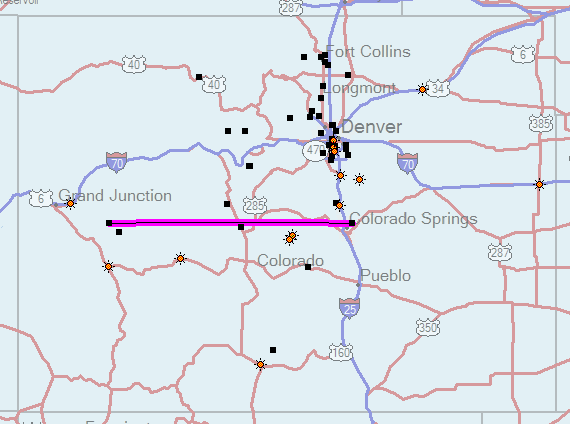
| BEHOLD THE SUN: Would you like to see fiery prominences and new-cycle sunspots with your own eyes? On sale now: Personal Solar Telescopes. | | | SPOOKY SKIES: As Halloween approaches, the heavens are getting in the spirit of things. A solar wind stream is buffeting Earth's magnetic field, stirring up ghostly auroras around the Arctic Circle. Meanwhile, Venus and the Moon are converging for a sunset sky show on Halloween itself. It's a boo-utiful view; don't miss it! COLORADO FIREBALL: What are the odds? On Oct. 28th at 7:29 pm Mountain Daylight Time, a random meteoroid hit Earth's atmosphere and disintegrated with the luminosity of a full Moon. The impact, which could've happened anywhere, took place directly above an all-sky video camera in Guffey, Colorado. 
Click to view videos of the fireball
"I've received more than 100 eyewitness reports," says astronomer Chris Peterson, who operates the camera as part of a nightly fireball monitoring program. Combining the data at hand, he estimates that "the meteor had a ground path about 170 miles long and traveled from east to west at 34 km/s (76,000 mph)." "I was lucky enough to see it myself from inside my house through a window," adds Thomas Ashcraft. What's amazing about that is he was located 300 miles away in New Mexico. "It was brilliant turquoise and green and lasted more than nine seconds." Ashcraft is an amateur radio astronomer and his receivers picked up echoes of distant TV transmitters bouncing off the fireball's ionized trail: listen. Using a computer model of Earth's meteoroid environment, Bill Cooke of the Marshall Space Flight Center calculates that fireballs this bright come along once every five months or so. Rarely, however, are they witnessed. About 70% of all fireballs streak over uninhabited ocean while half appear during the day, invisible in sunny skies. To catch one in the crosshairs of a meteor camera on a dark albeit cloudy night is good luck indeed. AT THE MERCY OF MARS: Last night on Mars, the temperature at Phoenix's arctic landing site dropped to -141 F (-96 C). The lander is equipped with heaters to withstand such cold, but there's a problem. Winter is coming, days are shortening, and solar panels aren't generating enough power. This week NASA made it official: Phoenix's days are numbered. To conserve power, mission controllers are now shutting down some of Phoenix's systems. First to go: a heater that kept the lander's digging arm warm and limber. Mission controllers turned it off on Oct. 28th, effectively disabling the arm and saving 250 watt-hours per day. With a pair of 3D glasses, you can peer into Phoenix's last trench: 
Over the next several weeks, three more survival heaters will be shut down, one at a time, in an effort to save energy and extend the mission as long as possible. Keeping Phoenix's stereo camera in action is a priority, and the camera's heater will be second to last turned off, say planners. The final heater shut down will be one of two that warm the core of the spacecraft and its batteries. This would leave one remaining survival heater to run out on its own. "At that point, Phoenix will be at the mercy of Mars," says mission manager Chris Lewicki of JPL. Stay tuned for (just a few more) updates.
2008 Orionid Meteor Gallery
[IMO meteor counts] [2006 Orionids] |