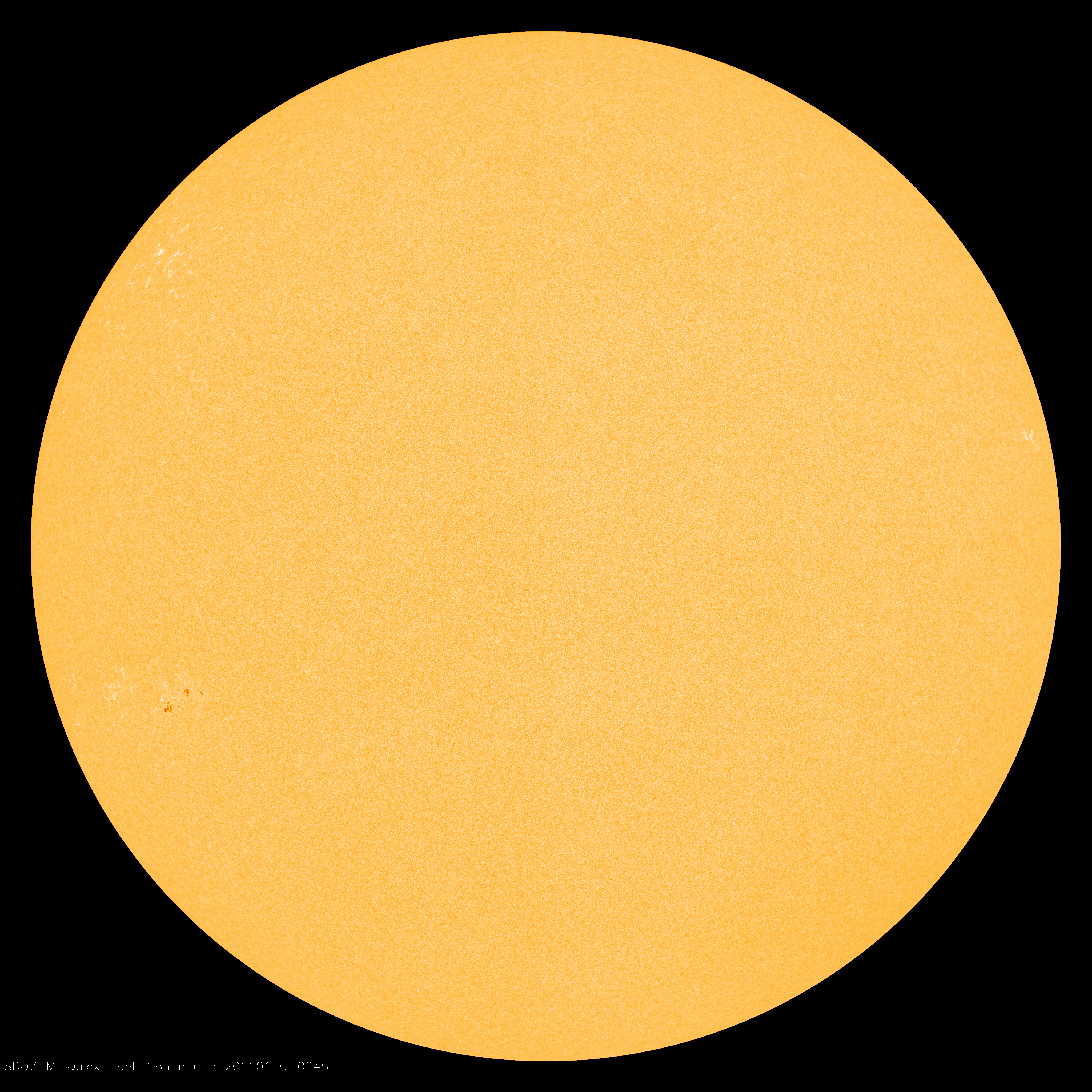
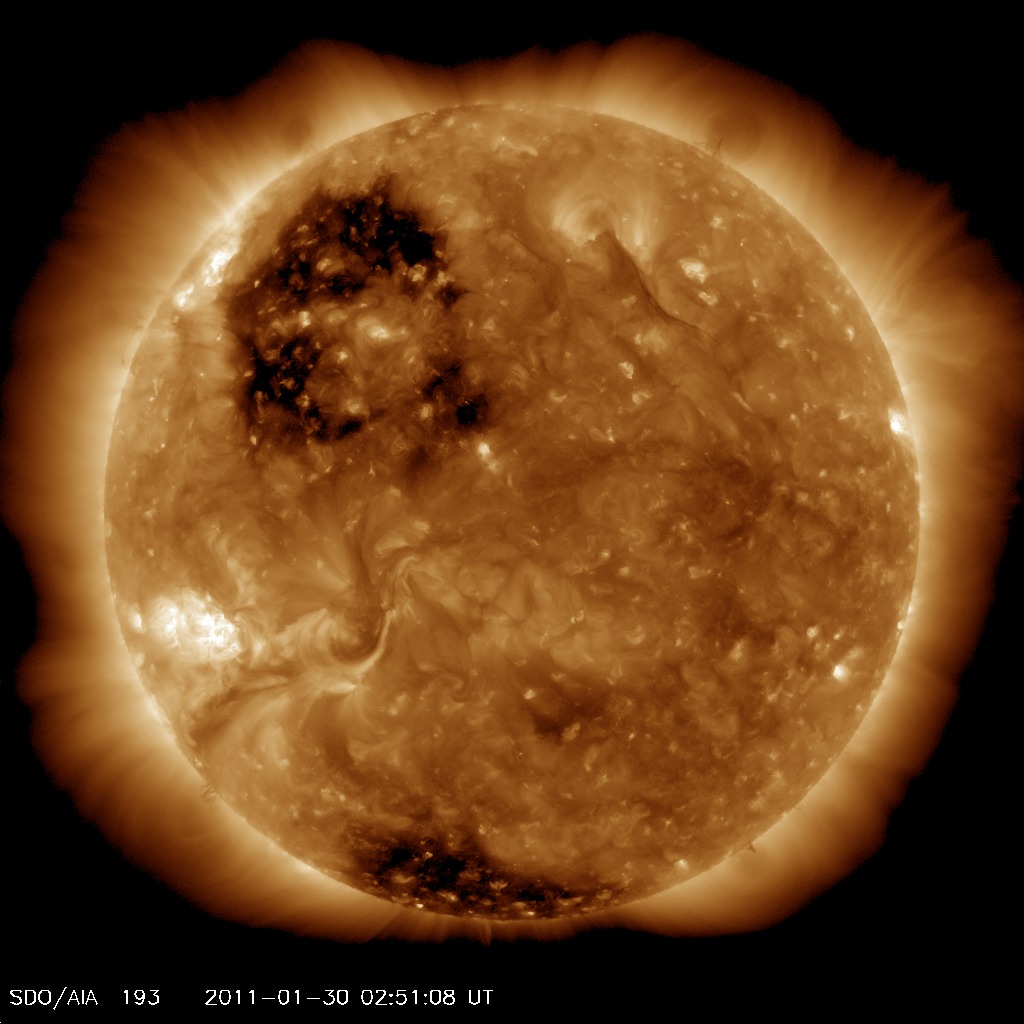
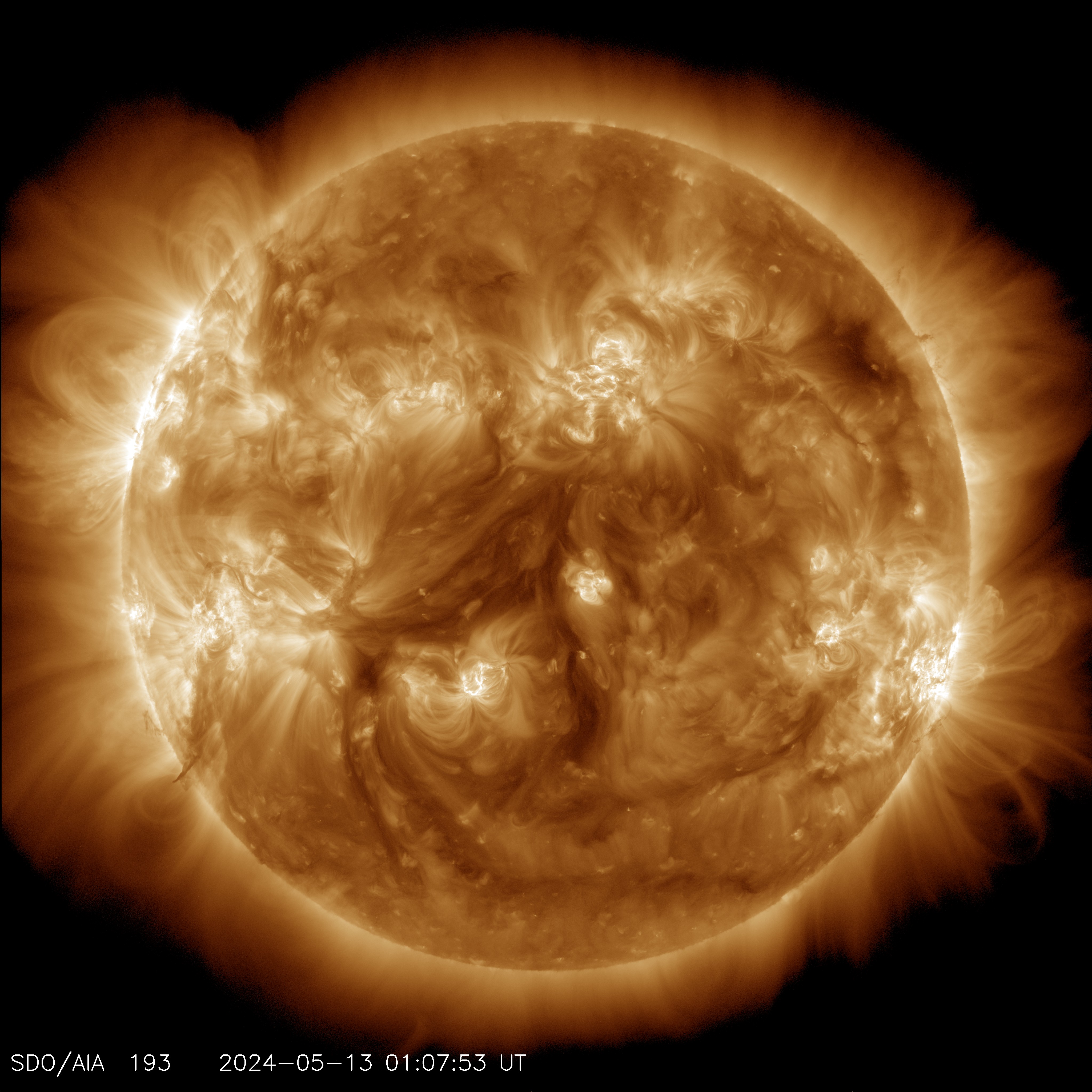
Metallic photos of the sun by renowned photographer Greg Piepol bring together the best of art and science. Buy one or a whole set. They make a stellar gift. | | |
NANOSAIL-D PHOTO CONTEST: NASA and Spaceweather.com have joined forces to launch ... a photo contest. The target is NanoSail-D, the first solar sail to orbit Earth. Cash prizes for the best photos range from $100 to $500. Visit nanosail.org for details.
CORONAL HOLE: A dark croissant-shaped hole has opened up in the sun's atmosphere, and it is spewing a stream of solar wind into space. NASA's Solar Dynamics Observatory took this picture of the vast opening during the early hours of Jan. 30th:
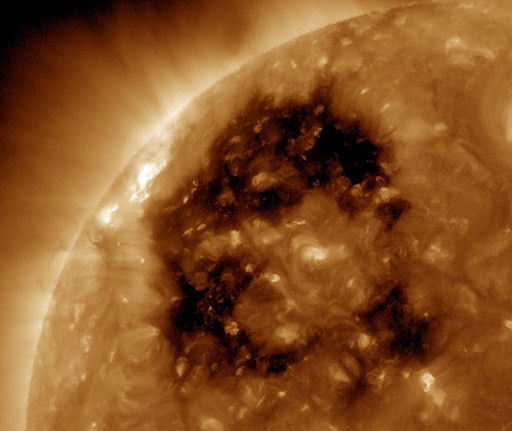
Click to view a high-resolution image. Credit: SDO
Researchers call this a "coronal hole." Solar rotation is turning the coronal hole toward Earth. The stream of solar wind pouring from it will swing around and hit our planet in early February, possibly sparking polar magnetic storms. High-latitude sky watchers should be alert for auroras between Feb. 2nd and 4th.
January 2011 Aurora Photo Gallery
[previous Januaries: 2010, 2009, 2008, 2007, 2005, 2004]
V-TOPPED LIGHT PILLARS: Light pillars are a common sight around cities in winter. Urban lights bounce off ice crystals in the air, producing tall luminous columns sometimes mistaken for auroras. But the light pillars Mike Hollingshead saw on Jan. 26th near a corn mill in Blair, Nebraska, were decidely uncommon. "They had V-shaped tops," he explains, "and some of the Vs were nested." Here is what he saw:

"These light pillars are not just rare, they are exceptional!" declares atmospheric optics expert Les Cowley. "Ordinary pillars are produced by plate-shaped ice crystals roughly half way between you and the light source. These are different. Their rarely seen flared tops show that they were made by column-shaped crystals drifting slowly downwards and aligned horizontal by air resistance."
"The flares are a form of the upper tangent arcs that we sometimes see in daytime halo displays," he continues. "But even more exotic, some flares have a second one nested within them! Some ice crystal columns do not rotate but instead keep two of their prism faces improbably horizontal to give us the very uncommon Parry arcs of solar halo displays. The nested flares here are amazing and probably the light halo equivalent of Parry arcs."
Solar Eclipse Photo Gallery
[NASA: Hinode Observes Annular Solar Eclipse]
Potentially Hazardous Asteroids (
PHAs) are space rocks larger than approximately 100m that can come closer to Earth than 0.05 AU. None of the known PHAs is on a collision course with our planet, although astronomers are finding
new ones all the time.
On January 30, 2011 there were 1185 potentially hazardous asteroids.
Notes: LD means "Lunar Distance." 1 LD = 384,401 km, the distance between Earth and the Moon. 1 LD also equals 0.00256 AU. MAG is the visual magnitude of the asteroid on the date of closest approach. | | The official U.S. government space weather bureau |
| | The first place to look for information about sundogs, pillars, rainbows and related phenomena. |
| | Researchers call it a "Hubble for the sun." SDO is the most advanced solar observatory ever. |
| | 3D views of the sun from NASA's Solar and Terrestrial Relations Observatory |
| | Realtime and archival images of the Sun from SOHO. |
| | from the NOAA Space Environment Center |
| | the underlying science of space weather |