They came from outer space--and you can have one! Genuine meteorites are now on sale in the Space Weather Store. | | |
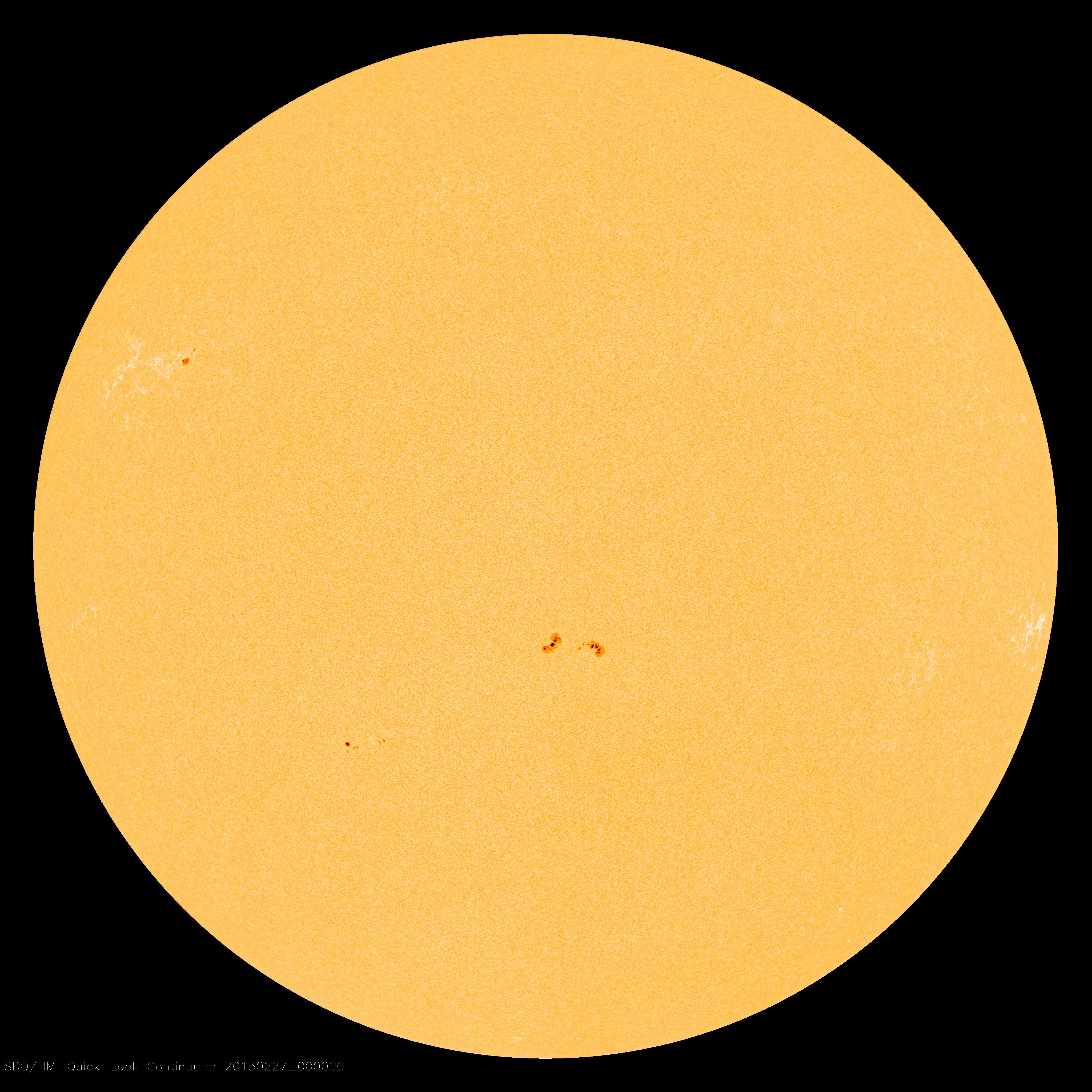
CHANCE OF EARTH-DIRECTED FLARES: Sunspot AR1682 has a 'beta-gamma' magnetic field that harbors energy for M-class solar flares. Because the sunspot is squarely facing Earth, any eruptions today would be geoeffective. NOAA forecasters estimate a 15% chance of M-flares. Solar flare alerts: text, voice.
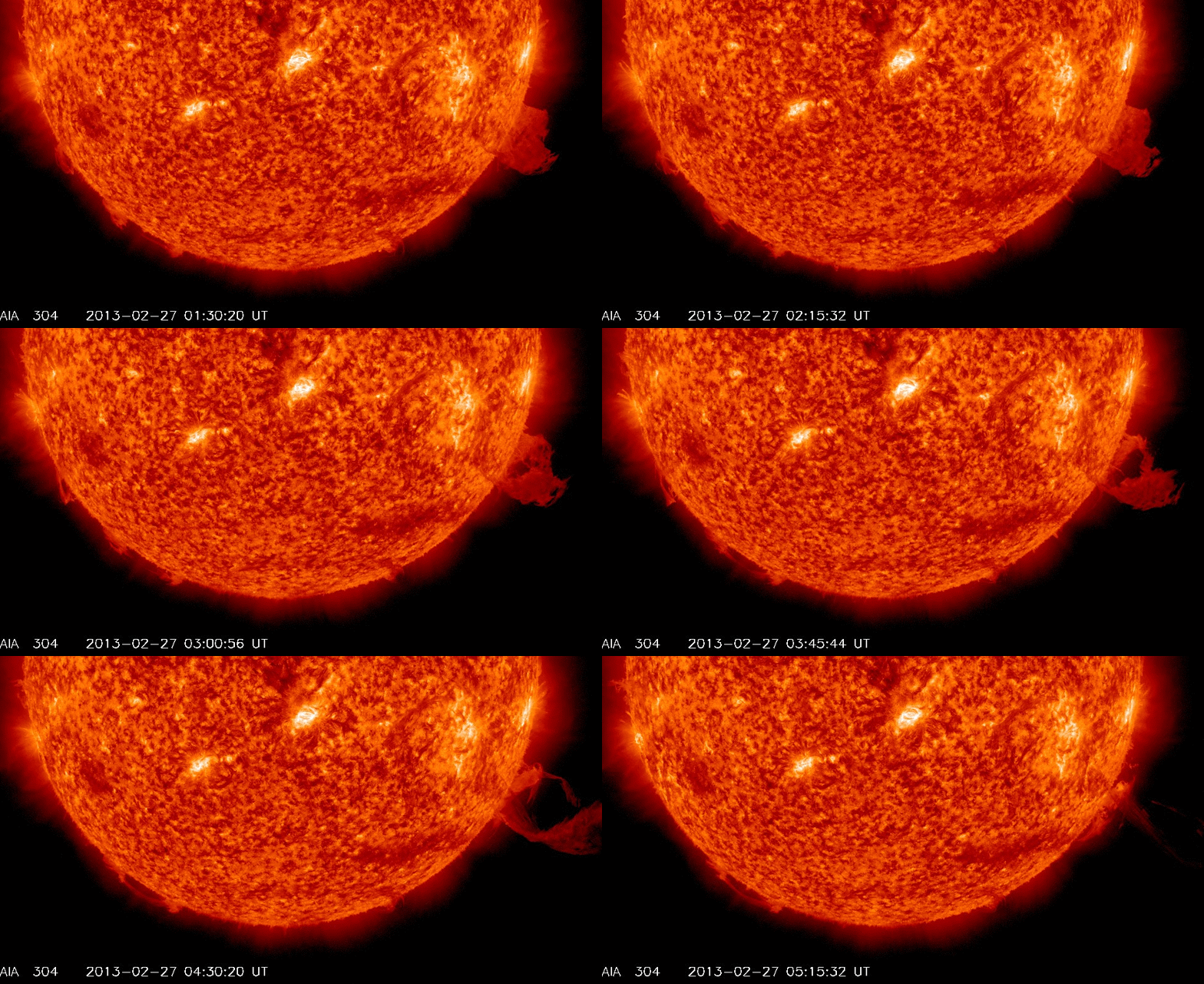
JUPITER-SIZED HOLE: A magnetic filament curling around the sun's southwestern limb erupted during the early hours of Feb. 27th. As it flew away, it formed a loop of plasma big enough to pass the entire planet Jupiter. (Croquette anyone?) Click on the image to set the scene in motion:

This eruption brings to an end a stunningly beautiful prominence that amateur astronomers had been monitoring for days. Hopefully, they'll continue looking because a new prominence appears to be forming from the debris. Check the realtime gallery for new images.
Realtime Space Weather Photo Gallery
COMET PAN-STARRS UPDATE: Comet Pan-STARRS is brightening as it plunges toward the sun just outside the orbit of Mercury. Amateur astronomer Ian Cooper sends this report from Glen Oroua, New Zealand: "Despite lingering evening twilight and the glare from a nearly full Moon, Comet Pan-STARRS is a 3rd-magnitude object with a fine orange dust tail visible in both binoculars and small telescopes." A 30-second exposure with his Canon 450D digital camera easily revealed the comet:
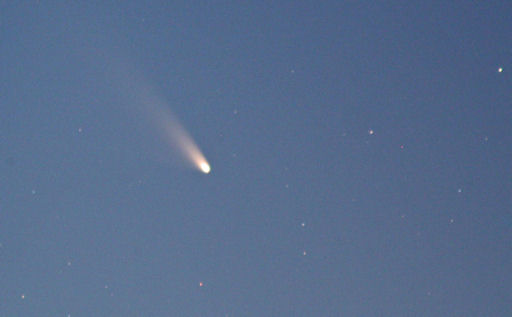
In early March, the comet will pass about 100 million miles from Earth as it briefly dips inside the orbit of Mercury. At that time it is expected to brighten another two- or three-fold. Whether Pan-STARRS will be visible to the naked eye through the glow of the nearby sun remains to be seen; this NASA video explores the possibilities. Whatever happens, northern hemisphere observers will have a front row seat as the comet crosses the celestial equator before the middle of March. Stay tuned!
More about Comet Pan-STARRS: 3D orbit, ephemeris, light curves.
Realtime Comet Photo Gallery
Realtime Aurora Photo Gallery
Realtime Noctilucent Cloud Photo Gallery
[previous years: 2003, 2004, 2005, 2006, 2007, 2008, 2009, 2011]
Potentially Hazardous Asteroids (
PHAs) are space rocks larger than approximately 100m that can come closer to Earth than 0.05 AU. None of the known PHAs is on a collision course with our planet, although astronomers are finding
new ones all the time.
On February 27, 2013 there were 1381 potentially hazardous asteroids.
Notes: LD means "Lunar Distance." 1 LD = 384,401 km, the distance between Earth and the Moon. 1 LD also equals 0.00256 AU. MAG is the visual magnitude of the asteroid on the date of closest approach. | | The official U.S. government space weather bureau |
| | The first place to look for information about sundogs, pillars, rainbows and related phenomena. |
| | Researchers call it a "Hubble for the sun." SDO is the most advanced solar observatory ever. |
| | 3D views of the sun from NASA's Solar and Terrestrial Relations Observatory |
| | Realtime and archival images of the Sun from SOHO. |
| | from the NOAA Space Environment Center |
| | the underlying science of space weather |