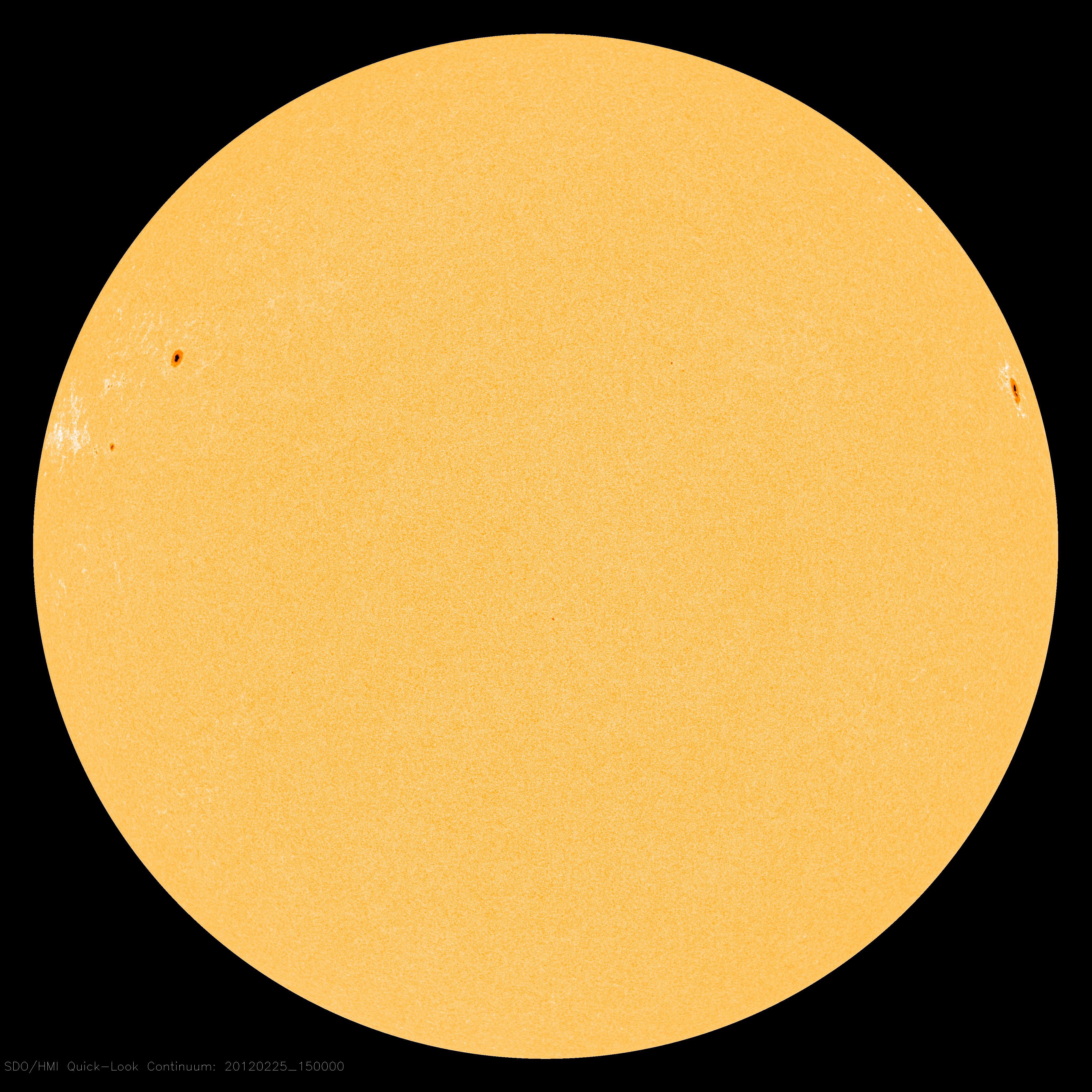
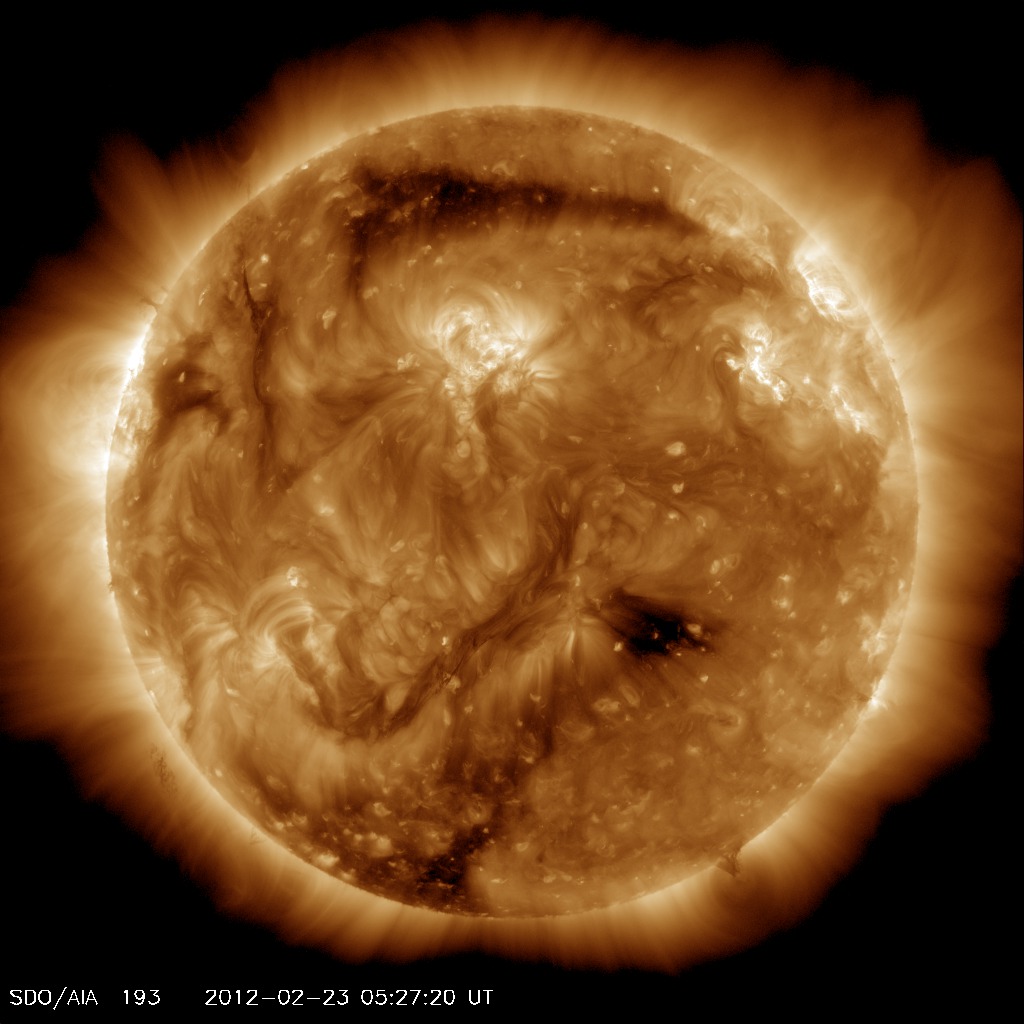
Metallic photos of the sun by renowned photographer Greg Piepol bring together the best of art and science. Buy one or a whole set. They make a stellar gift. | | |
WEAK IMPACT: A CME hit Earth's magnetic field on Feb. 26th at ~2100 UT. The impact was weak and does not appear set to cause a strong geomagnetic storm.
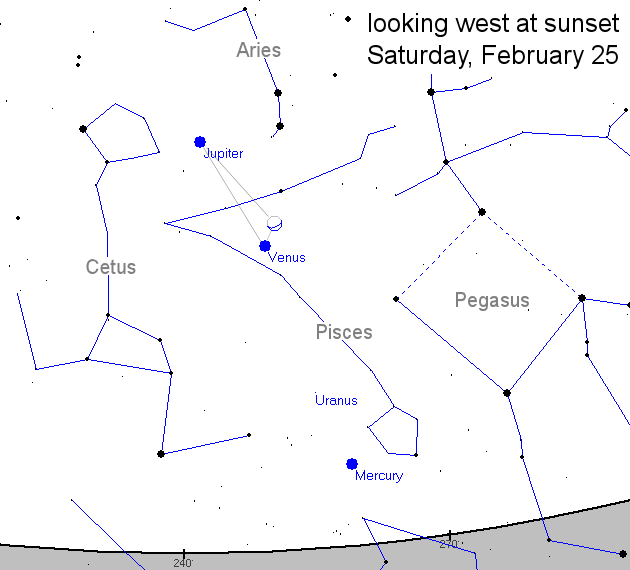
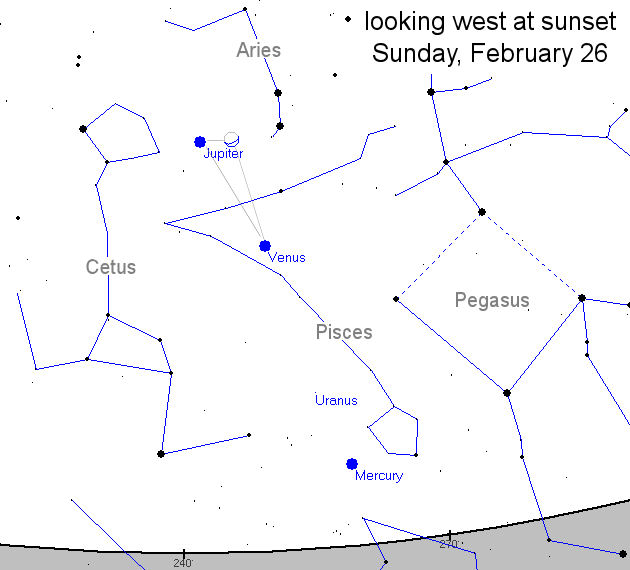
LOOK WEST AT SUNSET: Venus, Jupiter and the crescent Moon are beaming through the evening twilight, forming a bright triangle visible through city lights and even thin clouds. Try to catch them before the sky fades completely black. The trio surrounded by twilight blue is an especially beautiful sight. This is such a nice event, NASA has issued a news release and video about it. Sky maps: Feb. 25, Feb. 26.
Pavel Kantsurov sends this picture taken just hours ago from Norilsk, Russia:
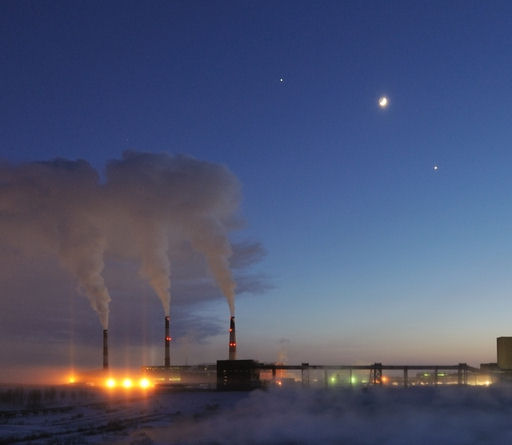
"Even the industrial landscape looked beautiful with the planets shining above," says Kantsurov.
more images: from Charlie Bates Solar Astronomy Project of Atlanta, GA; from Stan Richard of Urbandale, Iowa; from Enrique Torres of Mérida, Venezuela; from Tamas Abraham of Biatorbagy, Hungary; from Brian Klimowski of Flagstaff, Arizona; from Dirk Obudzinski of San Francisco, California; from Amirreza Kamkar of Qayen-Iran; from Paul Andrew of Dover, Kent, UK; from Clay Quarterman of Odessa, Ukraine; from Francisco Diego of Tower Bridge, London; from Jeff Berkes of Philadelphia, Pennsylvania; from Kiss Csongor of Derecske, Hungary; from Thomas Achermann of Toras-Sieppi, Muonio, Finnish Lapland; from Quentin Déhais of France; from Pete Glastonbury of Devizes, Wiltshire, UK; from Stefano De Rosa of Turin (Italy); from Stephan Brügger of Lübeck, Germany; from Paulo Casquinha of Costa da Caparica, Almada, Portugal; from Gregg Alliss of Marion, Iowa; from Robert Snache of Rama First Nation, Ontario
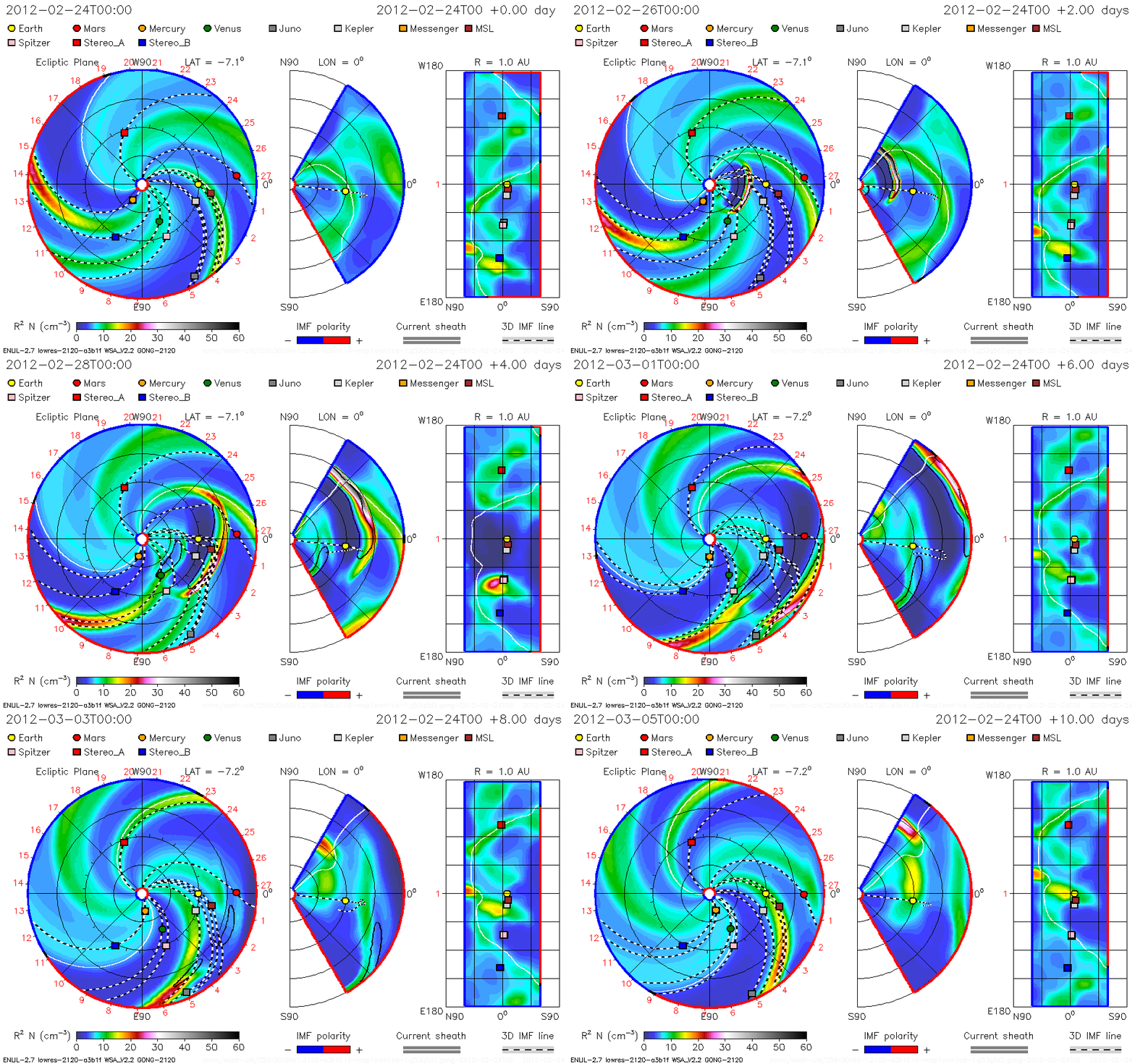
CME TARGETS EARTH, MARS: A coronal mass ejection (CME) launched from the sun on Feb. 24th appears set to hit both Earth and Mars. According to analysts at the Goddard Space Weather Lab, the cloud should reach Earth today, Feb. 26th around 1330 UT (+/- 7 hr), followed by Mars two days later. Click to view the CME's animated forecast track:
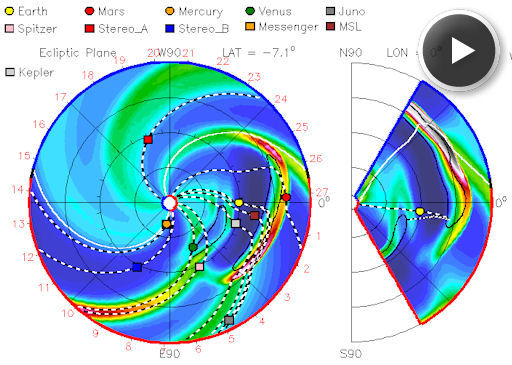
The cloud's impact could spark a G2-class geomagnetic storm, so high latitude sky watchers should be alert for auroras. Aurora alerts: text, voice.
If the forecast is correct, the CME could also hit NASA's Mars rover Curiosity on Feb. 27th. The rover, en route to the red planet onboard the Mars Science Lab spacecraft, is equipped with a radiation sensor that could detect energetic particles accelerated by the CME's passage. Indeed, this has happened before.
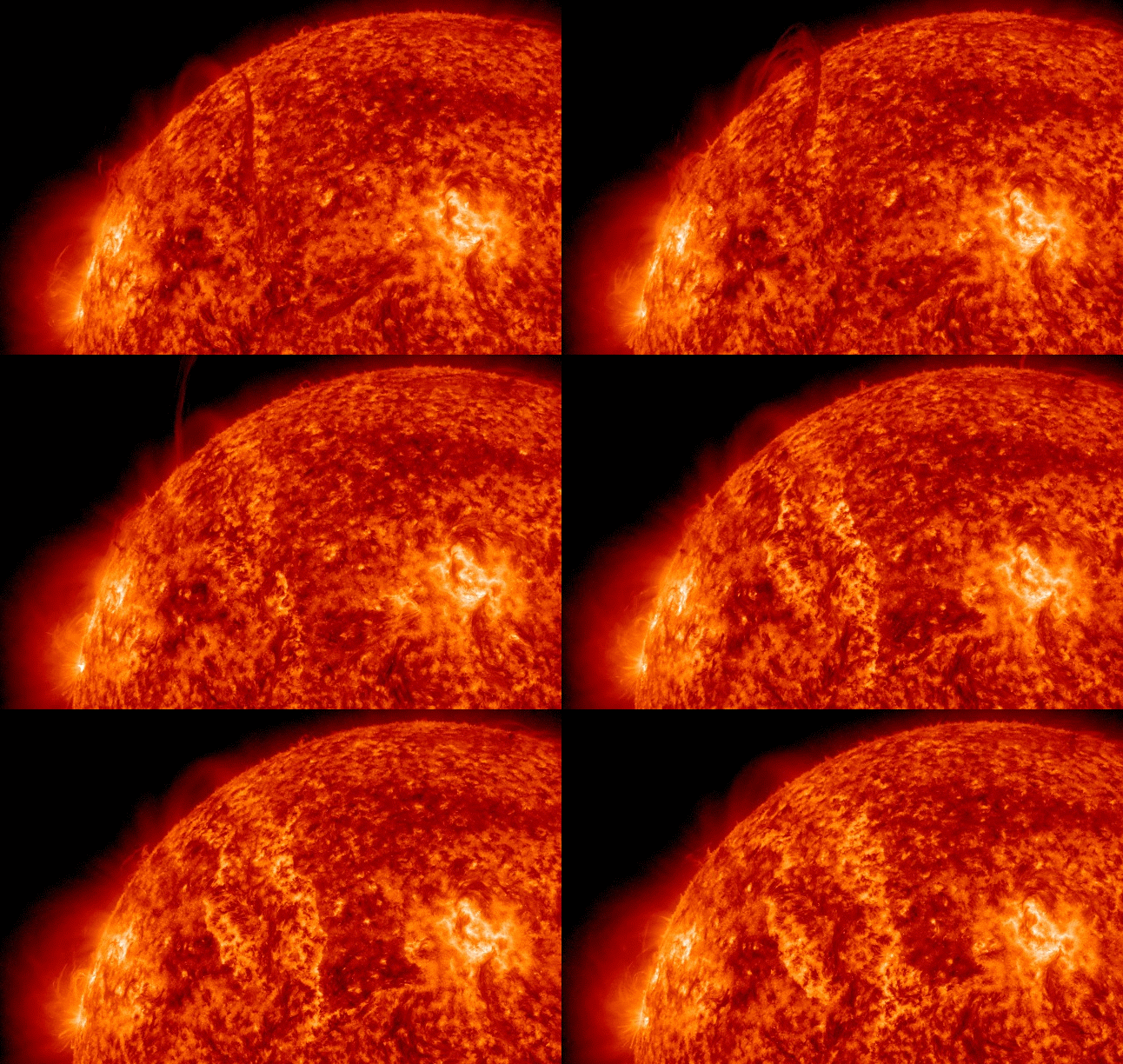
The CME was hurled into space by a filament of magnetism, which rose up from the sun's northestern limb and erupted on Feb. 24th: SDO movie. Although much of the cloud headed north, out of the plane of the planets, the cloud's lower edge will dip down low enough to intersect Earth, Curiosity, and Mars.
February 2012 Aurora Gallery
[previous Februaries: 2011, 2010, 2009, 2008, 2007, 2006, 2004, 2003, 2002]
VENUS IN BROAD DAYLIGHT: As the brightest planet in the heavens, Venus can be seen in broad daylight. The trick is knowing where to look. On Feb. 24th, the crescent Moon provided some guidance. "The Moon told us where Venus was in the sky, allowing us to see her in daylight with the naked eye," says Nerissa-Cesarina Urbani, who sends this picture from Serra San Quirico, Italy:
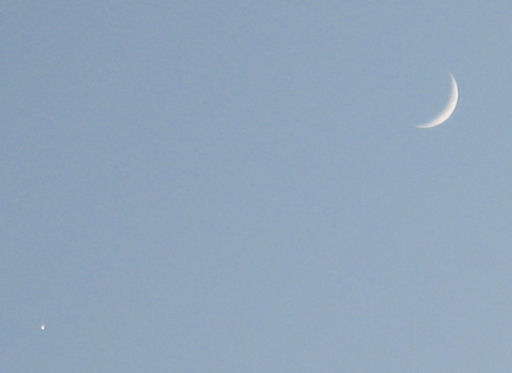
Even among veteran observers, it is always a bit of a surprise to see Venus pop out of the blue sky when you look straight at the planet. Many observers had this experience on Feb. 25th as the helpful Moon glided only 3o away from the goddess of love.
more images: from Thomas Faller of Newnan, GA; from Alan C Tough of Elgin, Moray, Scotland; from Sam Barricklow of Garland, Texas; from Pete Strasser of Tucson, AZ; from Doug Zubenel of Kansas City, Missouri