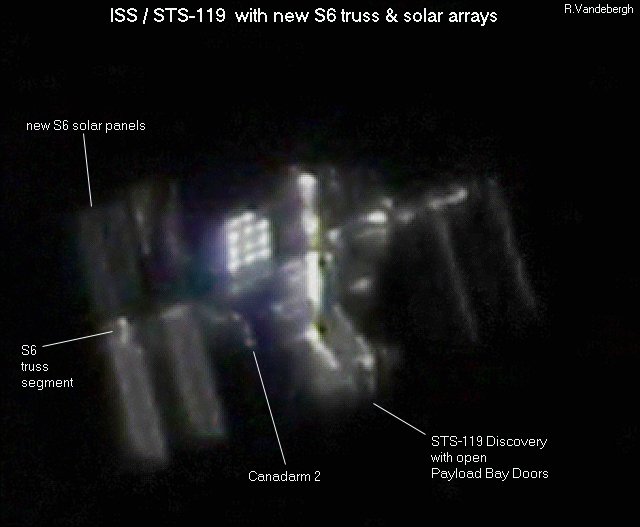
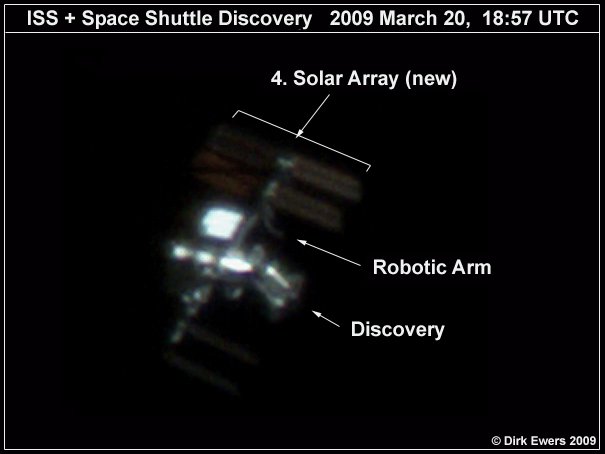
| ASTEROID FLYBY: On March 20th, asteroid 2009 DO111 flew past Earth about 288,000 miles away--just beyond the orbit of the Moon. About the size of a football field, the dangerous space rock was visible in backyard telescopes as it raced through the constellation Cassiopeia shining like a 13th magnitude star. March has been a busy month for flybys with at least nine asteroids passing within a million miles of Earth. Stay tuned for more. images: from David Strange of Branscombe, Devon, UK; from Mathew Marulla of Nashua, New Hampshire; from Ernesto Guido & Giovanni Sostero of Italy; ISS GETS NEW WINGS: The International Space Station's solar arrays are the largest deployable space assemblies ever built. Yesterday, astronauts unfurled a pair on the starboard side of the outpost, adding enough power to double the size of the station's future crew. Amateur astronomers are already noticing a change in the station's profile: 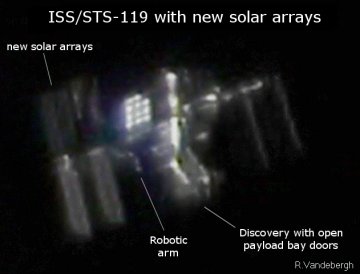
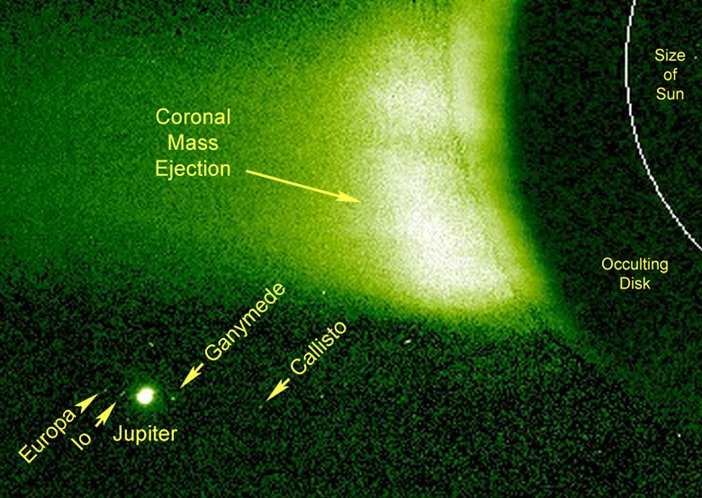
Ralf Vandebergh took the picture from his backyard observatory in the Netherlands. "As the ISS flew overhead, I manually tracked it using my 10-inch Newtonian reflector. Note the shuttle with its payload bay doors open. The Canadian robotic arm, which helped install the arrays, is also visible." Dirk Ewers of Germany also photographed the new wings. "I caught them only one hour deployment," he says. "It is a great addition to the station - not only for the power, but also for viewers on Earth." The movie he made using a 5-inch telescope is a must-see. (DivX required.) more images: from Martin Wagner of Sonnenbuehl, Germany; from Rob Carew of Melbourne Australia; from Mike Tyrrell of Northwich, Cheshire, UK; from Dave Gallant of Thunder Bay, Ontario, Canada; NEAR THE EDGE OF THE SUN: Imagine looking up at noon and seeing a planet with four moons just 0.1o from the edge of the blinding sun. Impossible? NASA's STEREO-B spacecraft did it this week. Click on the image below to launch a movie of Jupiter and the Galilean satellites in close "solar conjunction." 
5 MB Quicktime movie | labeled still frame | Zoom in on Jupiter
During the 30-hour movie, Io, Europa, Ganymede and Callisto circle Jupiter as a massive CME billows overhead. STEREO-B recorded the action on March 15th and 16th using an occulting disk to block the solar glare. This arrangment allowed STEREO's cameras to photograph moons of Jupiter eight thousand billion (8x10¹²) times dimmer than the adjacent sun. STEREO's coronagraph (occulting disk+camera) is designed to monitor faint but powerful activity in the sun's outer atmosphere. The CME is a good example. With a limiting magnitude of +6.5, it can also see stars, planets, moons and comets so close to the edge of the sun, it seems impossible. In fact, it happens all the time. Browse the STEREO gallery for examples.
March 2009 Aurora Gallery
[previous Marches: 2008, 2007, 2006, 2005, 2004, 2003, 2002]
Comet Lulin Photo Gallery
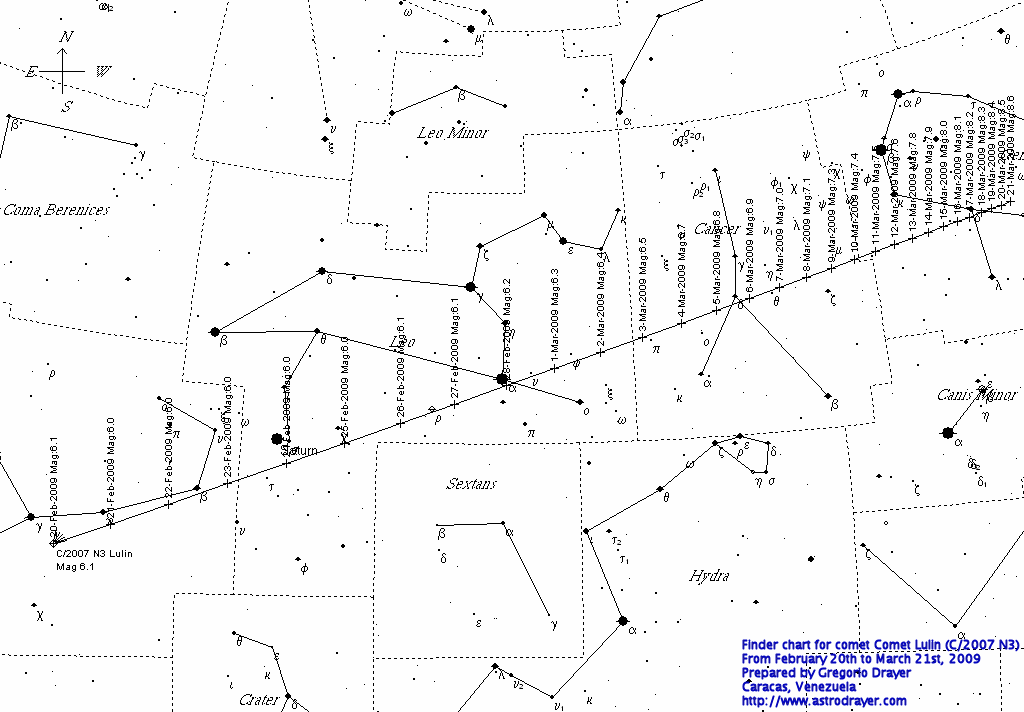
[Comet Hunter Telescope: review] [Comet Lulin finder chart]
Explore the Sunspot Cycle |