| Where's Saturn? Is that a UFO--or the ISS? What's the name of that star? Get the answers from mySKY--a fun new astronomy helper from Meade. | |  |  SPY-SAT HIT: Last night, the US Navy successfully hit spy satellite USA 193 with a missile over the Pacific Ocean: video. The strike occured at 10:26 p.m. EST on Feb. 20th. "Due to the relatively low altitude of the satellite at the time of the engagement, debris will begin to re-enter Earth's atmosphere immediately," says the US Dept. of Defense. "Nearly all of the debris will burn up on reentry within 24-48 hours." [comment] SPY-SAT HIT: Last night, the US Navy successfully hit spy satellite USA 193 with a missile over the Pacific Ocean: video. The strike occured at 10:26 p.m. EST on Feb. 20th. "Due to the relatively low altitude of the satellite at the time of the engagement, debris will begin to re-enter Earth's atmosphere immediately," says the US Dept. of Defense. "Nearly all of the debris will burn up on reentry within 24-48 hours." [comment]
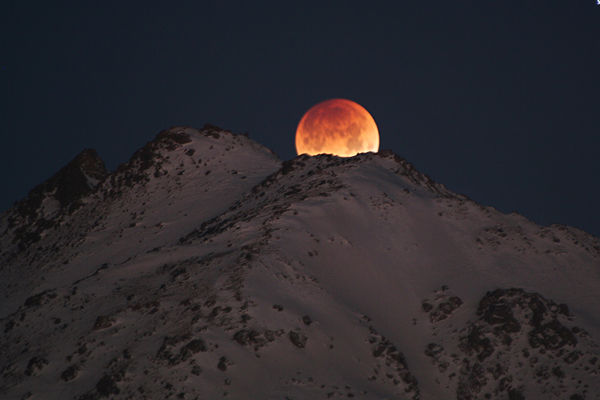
SIGHTING: From the summit of Maui's Haleakala volcano, not far from the Navy ships that struck USA 193, Rob Ratkowski may have photographed fragments of the shattered satellite. Read his report. TOTAL LUNAR ECLIPSE: Last night, the shadow of Earth fell across the full Moon producing a lovely red lunar eclipse. Mohammad Taher Pilevar sends this stunning photo comes from Hamedan, Iran: 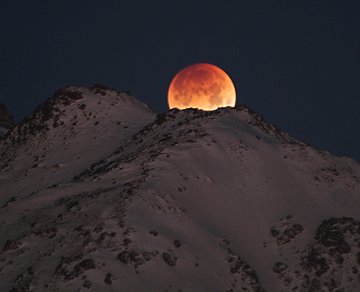
Sky watchers from Persia to Hawaii witnessed the spectacle, which won't repeat itself for nearly three years. The next total eclipse of the Moon comes in Dec. 2010. Clouded out? Browse the gallery to see what you missed: Lunar Eclipse Photo Gallery
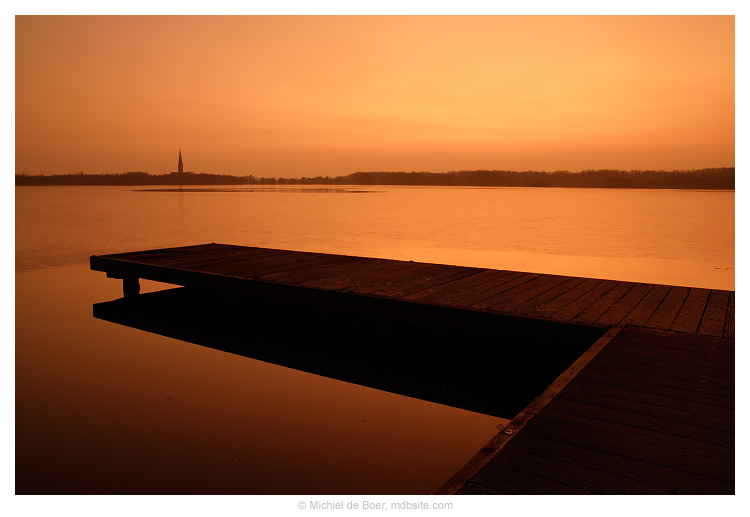
[Interactive World Map of Eclipse Photos] ACID IN THE SKIES: The UK, Netherlands, Germany and Scandinavia are experiencing a series of unusually bright and colorful sunsets. "It looks very mysterous," reports Michiel de Boer of the Netherlands. "The sky does not turn the usual twilight-blue. Instead, it remains yellow even after sunset and only slowly fades." He offers this snapshot taken Feb. 18th: 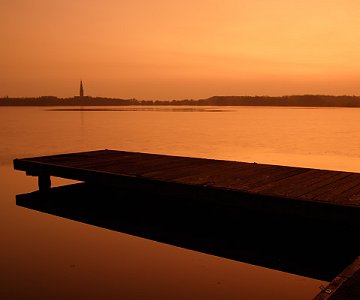
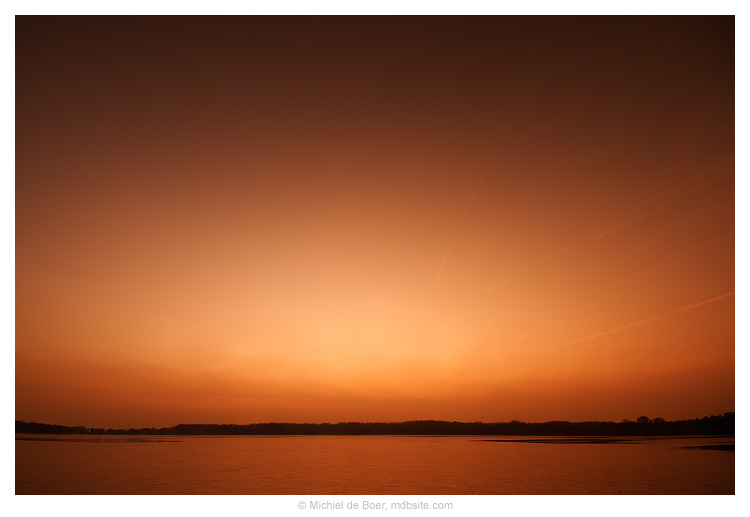
"I took the picture using my Canon 350D," he says. "Here's another showing the sky 50 minutes after sunset." What is going on? Atmospheric optics expert Les Cowley explains: "Volcanic ash high in the stratosphere can give us similar twilights but is not the cause this time. A more likely explanation is Type1 polar stratospheric clouds (PSCs). These clouds are located 15-25km (9-16 miles) above the earth and they can be illuminated by the sun even after 'sunset.' The exceptionally low temperatures needed to form Type 1 PSCs have existed over Europe for the last day or so." "Type1 PSCs are composed of nitric acid compounds and are less colourful and bright than the better known Type2 or nacreous clouds made of ice crystals. Sometimes we see nacreous clouds embedded in their less colourful acidic neighbors." More images: from Rob Stewart at Mull loch na keal, Western Scotland; from Jacob Kuiper of De Bilt, The Netherlands; from Martin Mc kenna of Maghera, Co. Derry, N. Ireland; from Eva Seidenfaden of Trier, Germany; from Graeme Whipps of Aberdeenshire, Scotland, UK; from Jeremy Housman of Ramsgate, Kent, United Kingdom; from Vincent Phillips of Hale Village (Near Liverpool) England; from Reinhard Nitze of Barsinghausen, North Germany; React: Comment on this story
|