Turn your cell phone into a field-tested satellite tracker. Works for Android and iPhone. | | |
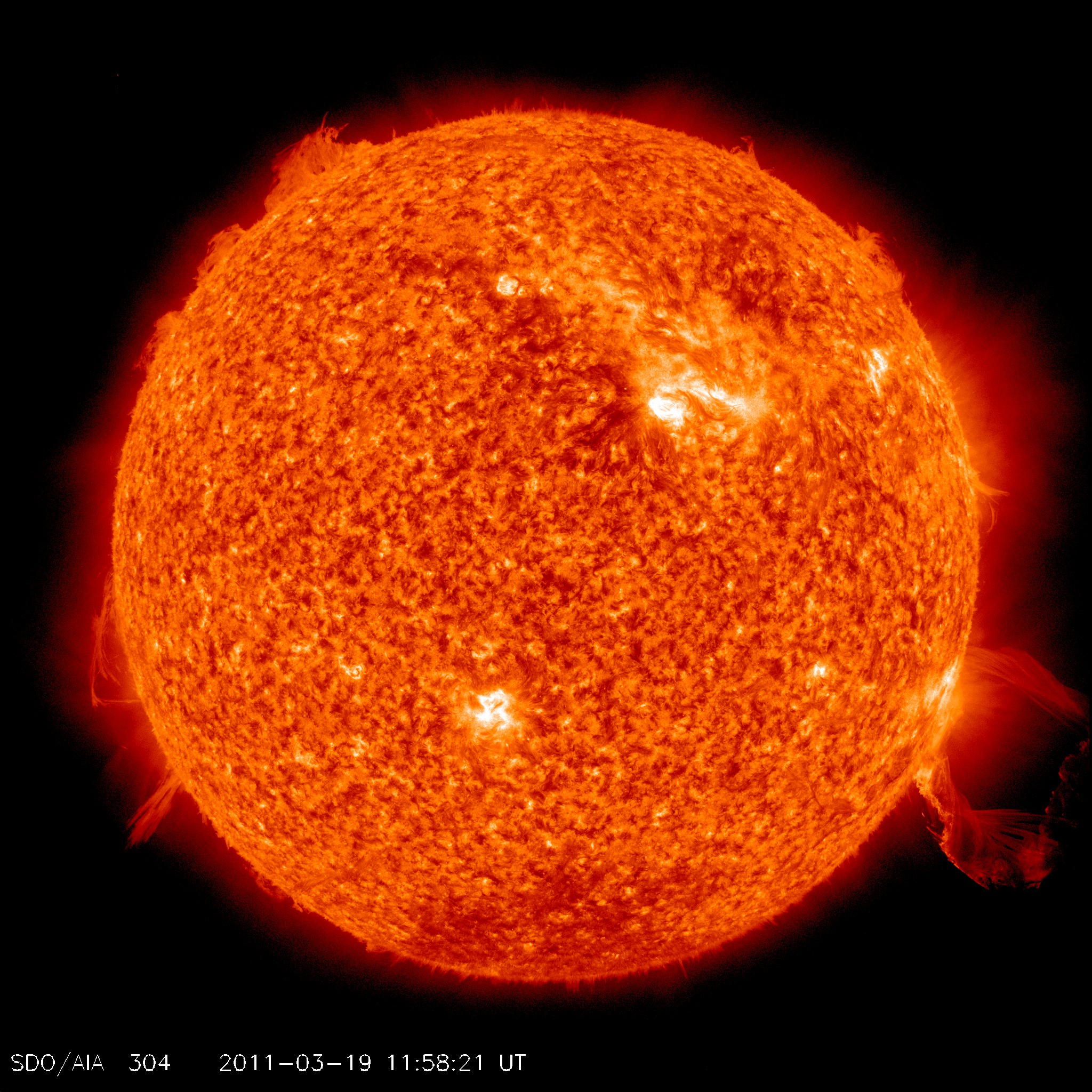
ICONIC ERUPTION: A huge filament of magnetism and hot plasma blasted off the sun's southwestern limb today, March 19th, at around 1200 UT. The eruption was not Earth-directed, but it was iconic. Just look at this snapshot recorded by NASA's Solar Dynamics Observatory:
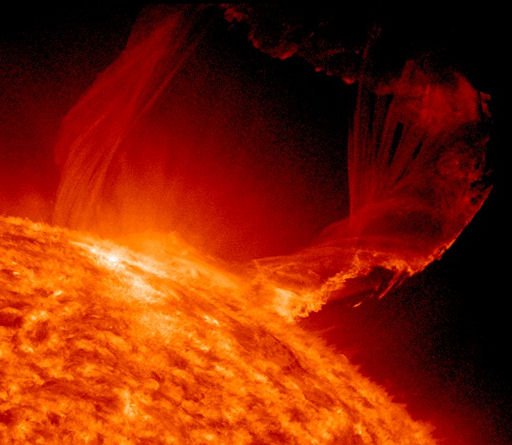
Click to view a full-disk, high-resolution image
Many amateur astronomers in Europe witnessed the blast and said it was the biggest one they'd ever seen. This event continues the recent trend of increasing solar activity, and shows anew that Solar Cycle 24 is gaining steam after a long period of relative quiet.
more images: from P-M Hedén of Vallentuna, Sweden; from Sebastien Kersten of Le Cocq, Belgium; from Steve Wainwright of Gower S.Wales UK; from Strikis Iakovos - Marios of Athens Greece; from Günther Strauch of Borken, NRW, Germany; from Peter Desypris of Athens,Greece; from Emiel Veldhuis of Zwolle, the Netherlands;
SUPER MOON: Watch out for the Moon on Saturday night. It's the biggest full Moon in 18 years. Astronomers call it a "perigee Moon," and it raises extra-high perigean tides. Contrary to some reports, however, this event will not trigger any natural disasters. Science@NASA has the full story.
On March 18th, "Supermoon's Eve," something told Tom Wagner he should stop for a quick photo of the waxing lunar disk:
"I can't wait to see the real thing on March 19th," he says.
more moonshots: from Rick Ellis of Toronto, Canada; from Anthony Ayiomamitis of Athens, Greece; from David Dickinson of Hudson, Florida; from John Stetson of Fort Williams Park, Cape Elizabeth, Maine; from Martin McKenna of Maghera, Co. Derry, Ireland; from Mark Seibold of Sandy, Oregon;
March 2011 Aurora Photo Gallery
[previous Marches: 2010, 2009, 2008, 2007, 2006, 2005, 2004, 2003, 2002]
Potentially Hazardous Asteroids (
PHAs) are space rocks larger than approximately 100m that can come closer to Earth than 0.05 AU. None of the known PHAs is on a collision course with our planet, although astronomers are finding
new ones all the time.
On March 19, 2011 there were 1204 potentially hazardous asteroids.
Notes: LD means "Lunar Distance." 1 LD = 384,401 km, the distance between Earth and the Moon. 1 LD also equals 0.00256 AU. MAG is the visual magnitude of the asteroid on the date of closest approach. | | The official U.S. government space weather bureau |
| | The first place to look for information about sundogs, pillars, rainbows and related phenomena. |
| | Researchers call it a "Hubble for the sun." SDO is the most advanced solar observatory ever. |
| | 3D views of the sun from NASA's Solar and Terrestrial Relations Observatory |
| | Realtime and archival images of the Sun from SOHO. |
| | from the NOAA Space Environment Center |
| | the underlying science of space weather |
| | for out-of-this-world printing and graphics |