iPHONE VS ANDROID! Actually, it doesn't matter which phone you carry. Our cool, new app turns both smartphones into field-tested satellite trackers. Learn more. | | |
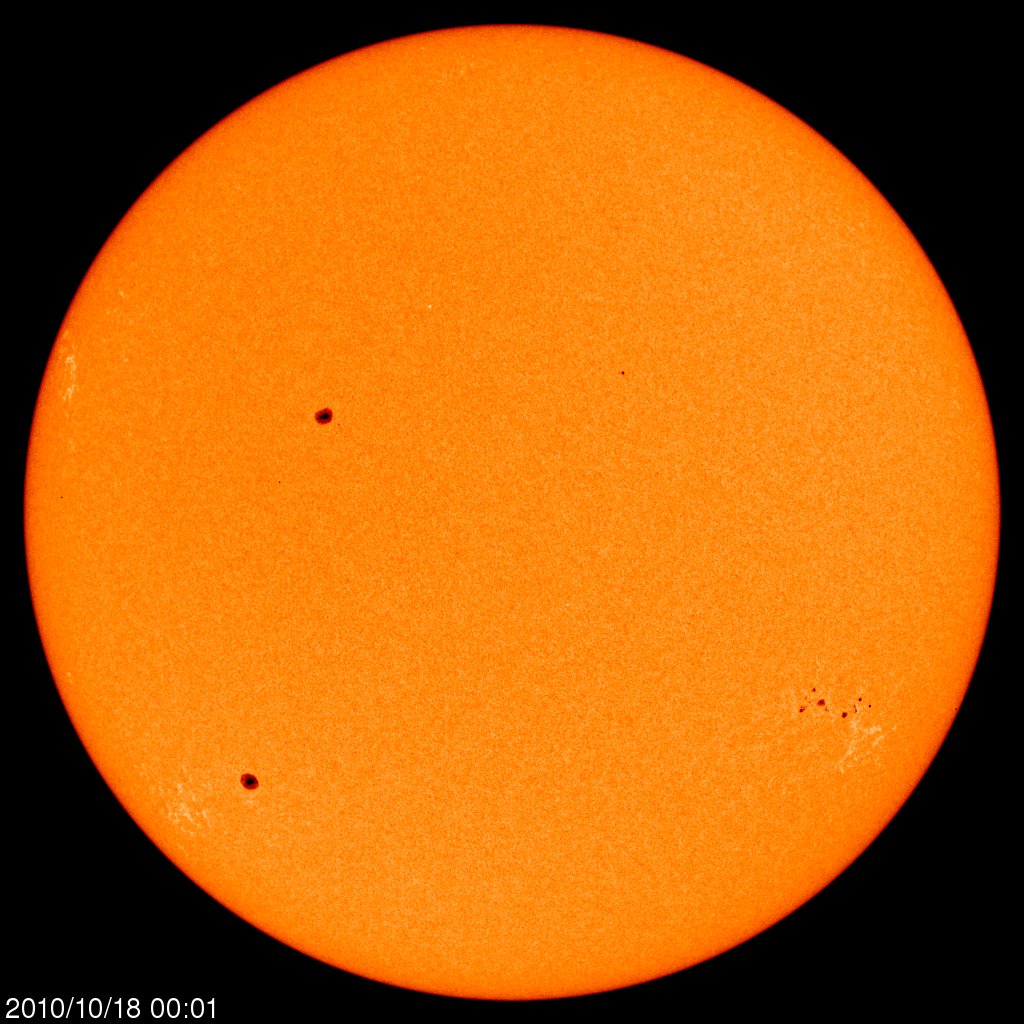
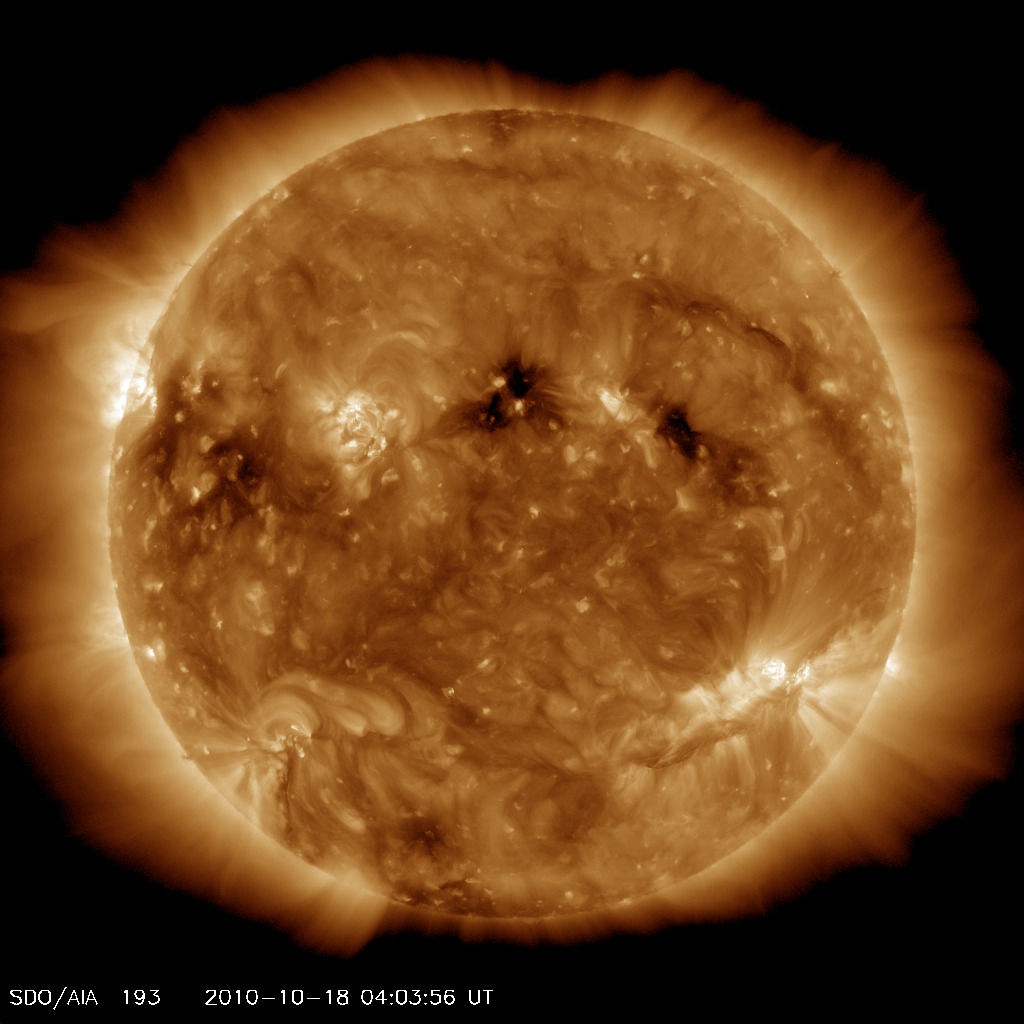
MEGA SOLAR FILAMENT: An awesome, monstrous, jaw-dropping, 400,000 km long filament of magnetism is stretched across the sun's southern hemisphere. If it collapses or erupts, as filaments often do, the result could be an Earth-directed coronal mass ejection. Meanwhile it is a fine target for backyard solar telescopes.
FILAMENT UPDATE: Magnetic instabilities in the filament caused an eruption today around 1600 UT. The filament was not destroyed, nor was material hurled toward Earth. SDO movies: mpeg, m4v.
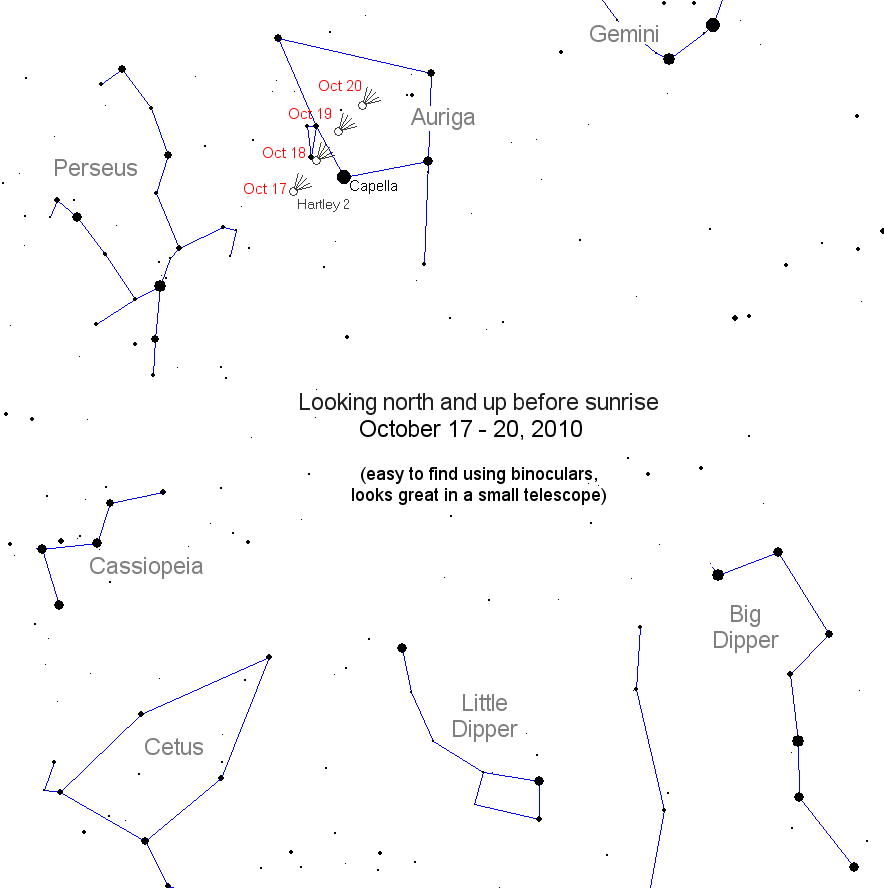
TIME TO SEE COMET HARTLEY: For backyard stargazers, the next few nights are the best time to see green Comet 103P/Hartley 2 as it approaches Earth for an 11-million-mile close encounter on Oct. 20th. Set your alarm for the dark hours before dawn, go outside, and look straight up. You will find Hartley 2 not far from the bright star Capella: sky map. Although the comet is barely visible to the unaided eye, it is easy to find in binoculars and looks great through a backyard telescope.
Last night, Filipe Alves of Portalegre, Portugal, obtained the following long-exposure image using an 8-inch telescope and a KAF-8300 refrigerated CCD camera. It shows the comet's vast green atmosphere and an auburn tail of dust:
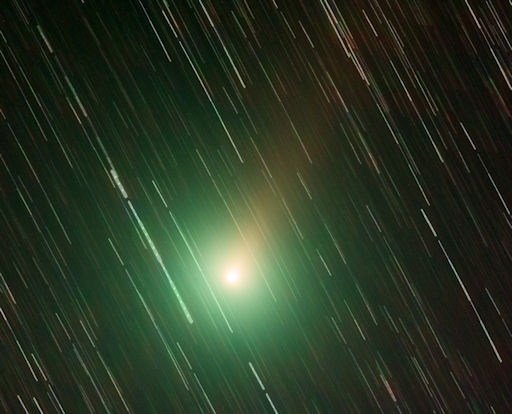
Many readers have asked, why is the comet green? Answer: Hartley 2's green color comes from the gases that make up its Jupiter-sized atmosphere. Jets spewing from the comet's nucleus contain cyanogen (CN: a poisonous gas found in many comets) and diatomic carbon (C2). Both substances glow green when illuminated by sunlight in the near-vacuum of space.
NASA scientists say 103P/Hartley 2 is one of the most active comets they've seen, with copious outgassing from jets in the nucleus. Amateur astronomers are encouraged to monitor the action and submit their images here.
more images: from Tom Jorgenson of Neenah, Wisconsin; from Yandong Hu of Mt. Wawushan, Jiangsu, China; from Rolando Ligustri using a robotic telescope in New Mexico; from Marian Urbaník of Staškov, Slovak republic; from John Chumack of Dayton, Ohio; from Jan Koeman of Kloetinge, the Netherlands; from Jodi and Roy McCullough of Salem Ohio; from Mike Broussard of Maurice, Louisiana; from Mike Holloway of Van Buren, Arkansas; from Norm Klekoda and Al Bell near Grand Rapids, MI; from Doug Zubenel of Monument Rocks, Gove County, Kansas; from Gregg Ruppel of Ellisville, Missouri
WEEKEND AURORAS: A surprise display of Northern Lights spread across Greenland, Canada, and even parts of the United States on Oct. 17th. "There was only a 20% chance of geomagnetic activity in my area, but the auroras took off," reports Zoltan Kenwell who took this picture just north of Edmonton, Alberta:
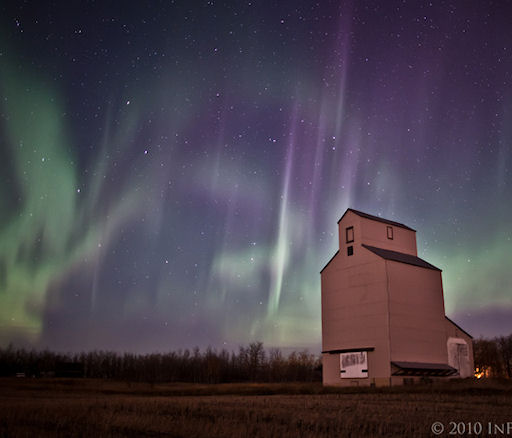
Photo details: Canon 5D Mark II, EF 24mm lens, f1.4, ISO 1250, 20s
"It was a cool -3C outside, but no wind," he says. "A beautiful night!"
The auroras were sparked by a fluctuation in the IMF: the interplanetary magnetic field tipped south, opening a hole in Earth's magnetosphere. Solar wind poured in and fueled the display. More auroras are possible on Oct. 19th and 20th when a solar wind stream is due to brush past Earth. Get your aurora alerts here.
UPDATED: October 2010 Aurora Gallery
[previous Octobers: 2009, 2008, 2007, 2006, 2004, 2003, 2002, 2001]
Potentially Hazardous Asteroids (
PHAs) are space rocks larger than approximately 100m that can come closer to Earth than 0.05 AU. None of the known PHAs is on a collision course with our planet, although astronomers are finding
new ones all the time.
On October 18, 2010 there were 1155 potentially hazardous asteroids.
Notes: LD means "Lunar Distance." 1 LD = 384,401 km, the distance between Earth and the Moon. 1 LD also equals 0.00256 AU. MAG is the visual magnitude of the asteroid on the date of closest approach. | | The official U.S. government space weather bureau |
| | The first place to look for information about sundogs, pillars, rainbows and related phenomena. |
| | Researchers call it a "Hubble for the sun." SDO is the most advanced solar observatory ever. |
| | 3D views of the sun from NASA's Solar and Terrestrial Relations Observatory |
| | Realtime and archival images of the Sun from SOHO. |
| | from the NOAA Space Environment Center |
| | the underlying science of space weather |