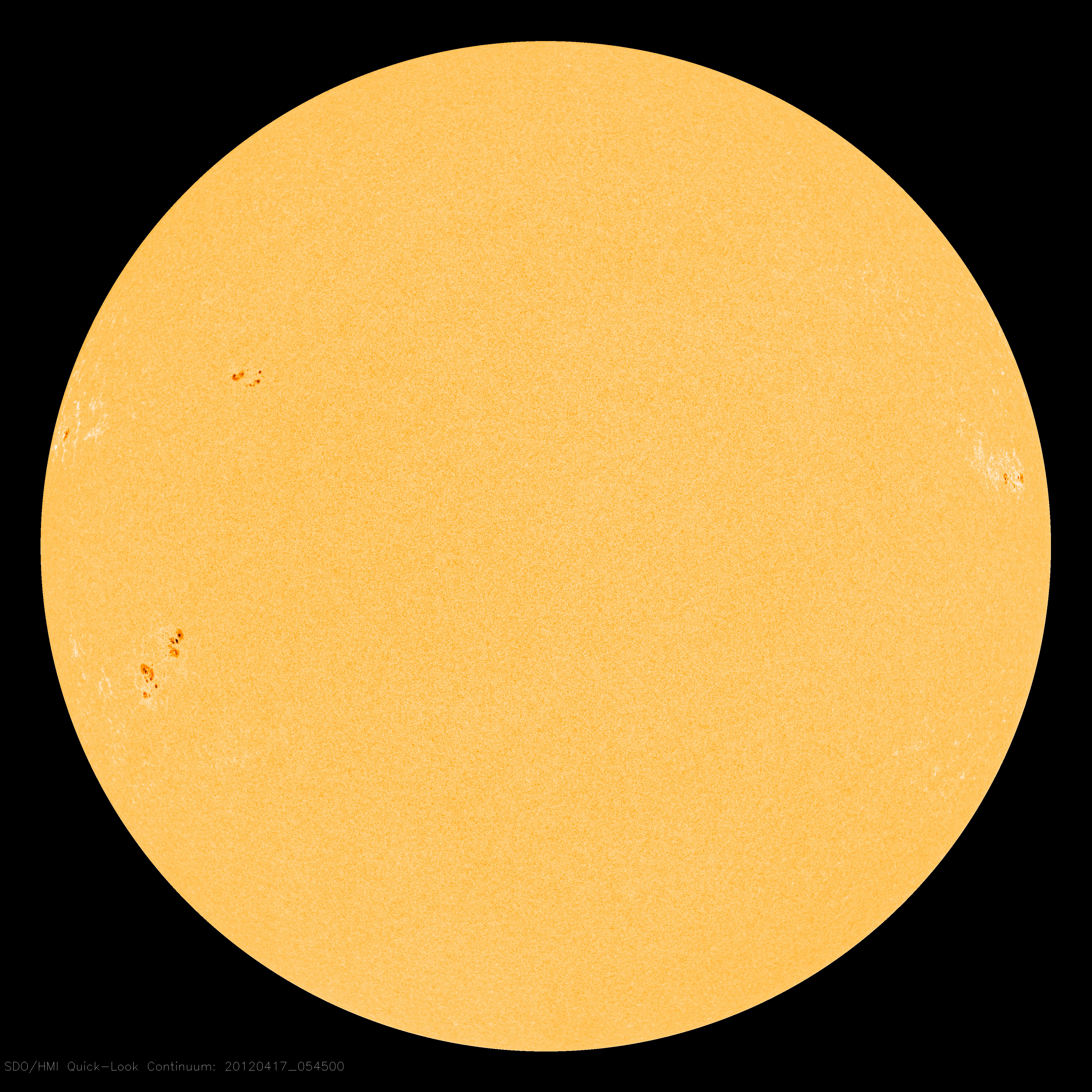
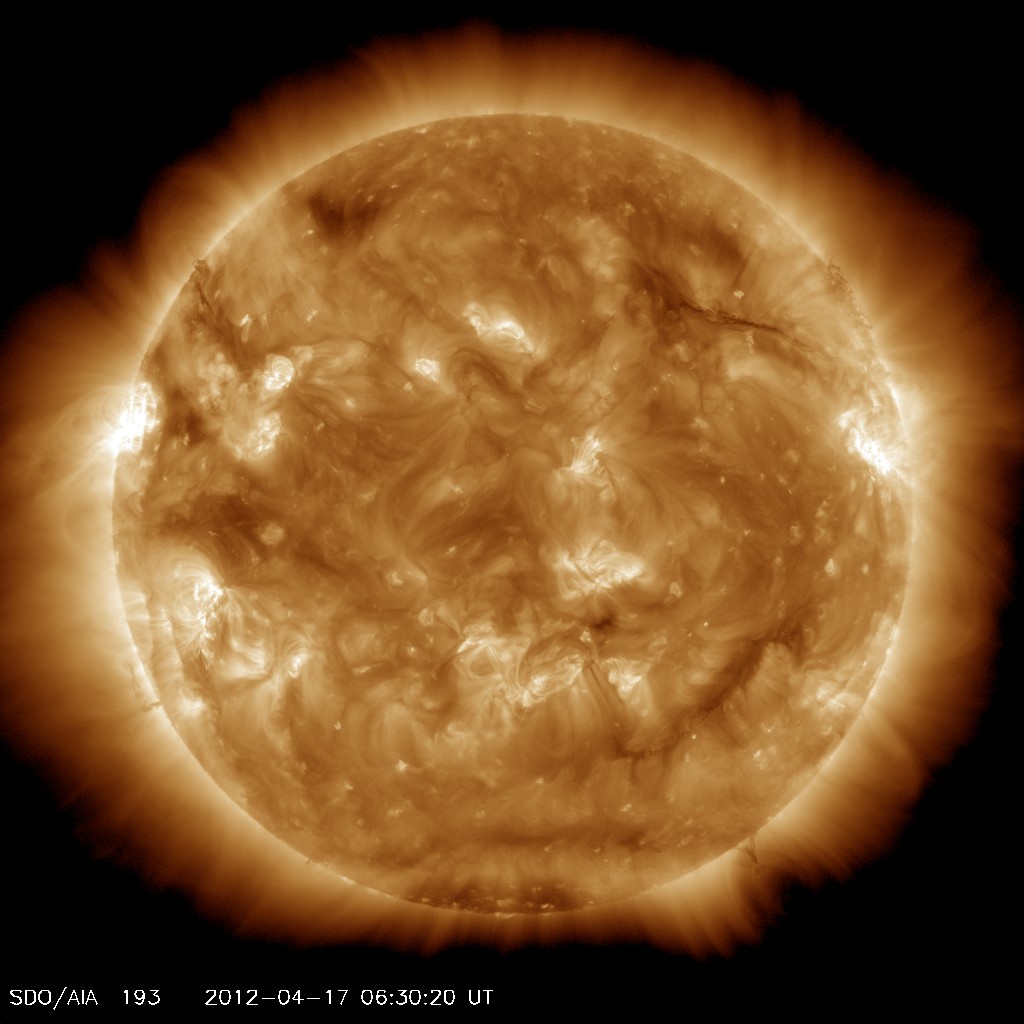
Metallic photos of the sun by renowned photographer Greg Piepol bring together the best of art and science. Buy one or a whole set. They make a stellar gift. | | | LYRID METEOR SHOWER: Earth is approaching the debris field of ancient Comet Thatcher, source of the annual Lyrid meteor shower. Forecasters expect the shower to peak on April 21-22; a nearly-new moon on those dates will provide perfect dark-sky conditions for meteor watching. Usually the shower is mild (10-20 meteors per hour) but unmapped filaments of dust in the comet's tail sometimes trigger outbursts 10 times stronger. [video] [Lyrid chat] SPECTACULAR EXPLOSION (UPDATED): Magnetic fields on the sun's northeastern limb erupted around 17:45 UT on April 16th, producing one of the most visually-spectacular explosions in years. NASA's Solar Dynamics Observatory (SDO) recorded the blast at extreme ultraviolet wavelengths: 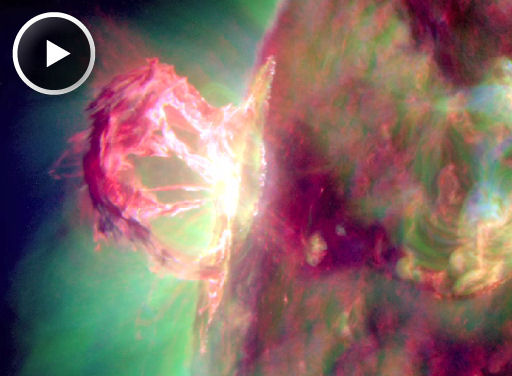 . .
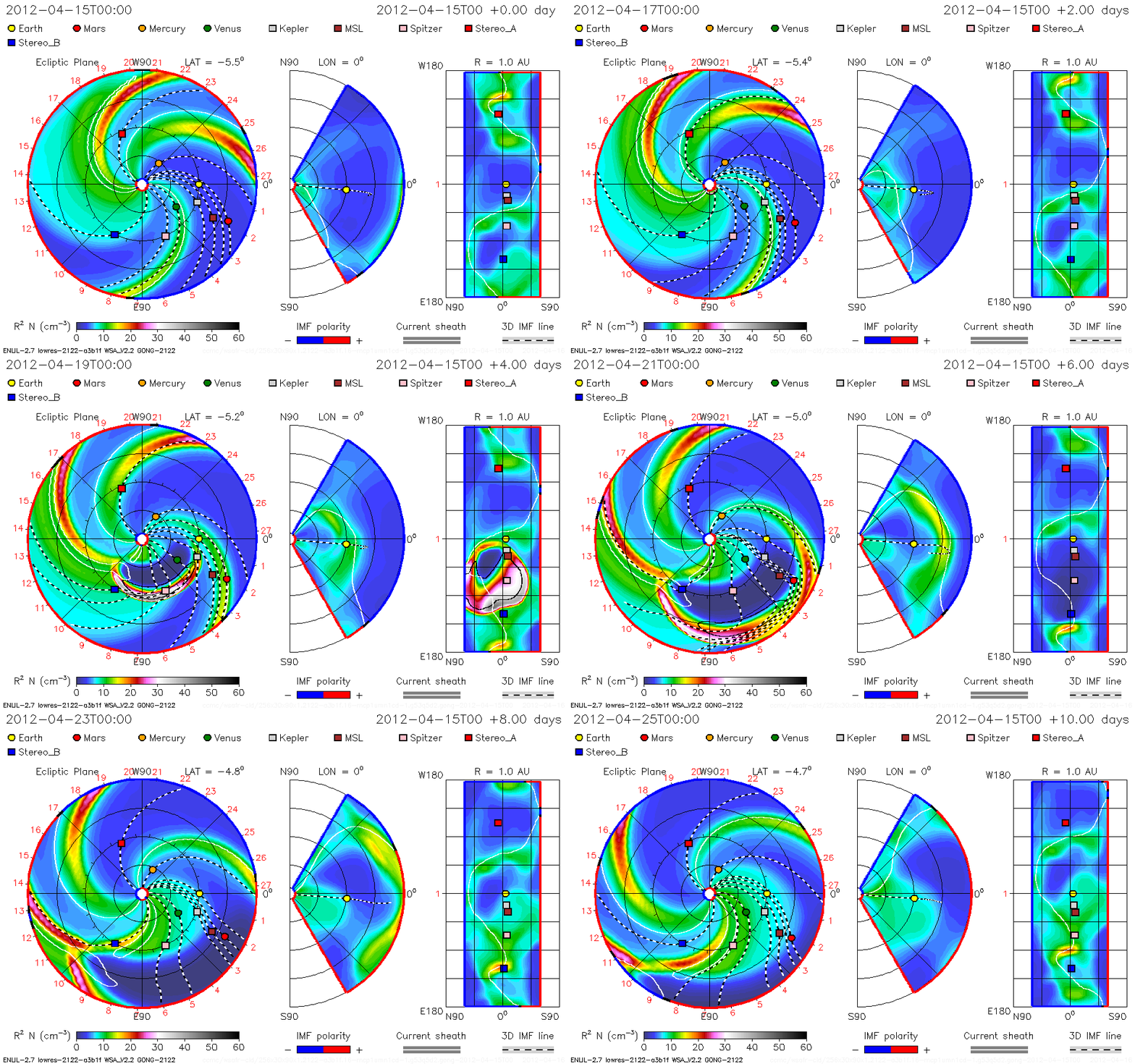
The explosion, which registered M1.7 on the Richter Scale of solar flares, was not Earth-directed, but it did hurl a CME into space. Analysts at the Goddard Space Weather Lab have analyzed the trajectory of the cloud and found that it will hit NASA's STEREO-B spacecraft, the Spitzer space telescope, and the rover Curiosity en route to Mars. Planets Venus and Mars could also receive a glancing blow. Using data from SDO, Steele Hill of NASA's Goddard Space Flight Center assembled a must-see movie of the event. It shows the explosion unfolding at 304Å, a wavelength which traces plasma with a temperature around 80,000 K. Coverage of the blast was not limited to space telescopes. Amateur astronomers saw it, too. Jim Lafferty sends this picture from his backyard observatory in Redlands, California: 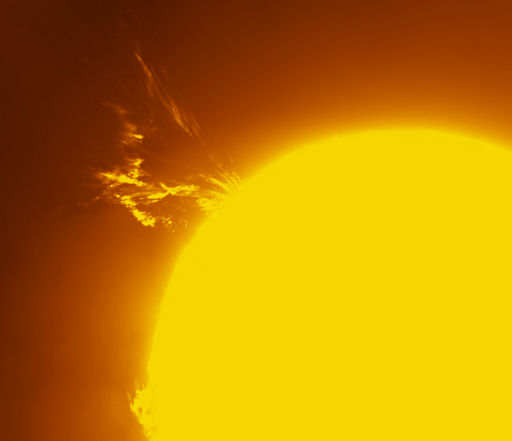
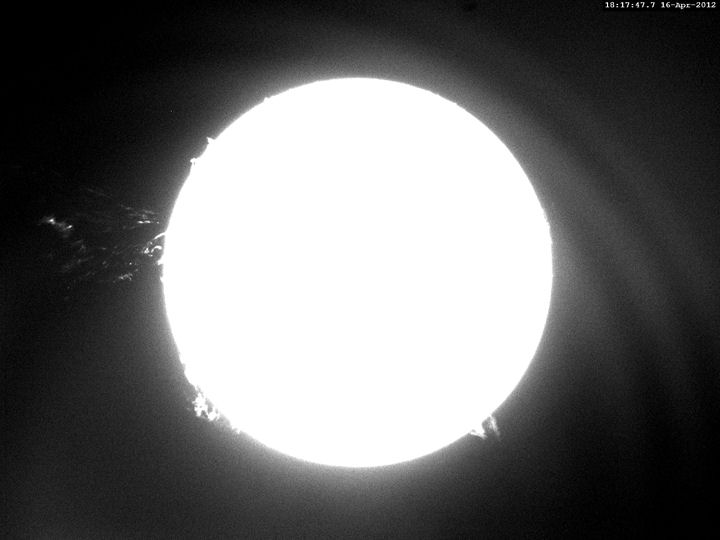
"Yesterday's prominence on the sun's eastern limb was was one of the largest in years---short lived, it was mostly gone in a few hours," says Lafferty. "It was a wonderful sight in the eyepiece and in the camera!" more images: from Vahan Yeterian of Lompoc California; from John Minnerath of Crowheart, Wyoming; from John Stetson of Falmouth, Maine; from Thomas Ashcraft of New Mexico; Potentially Hazardous Asteroids ( PHAs) are space rocks larger than approximately 100m that can come closer to Earth than 0.05 AU. None of the known PHAs is on a collision course with our planet, although astronomers are finding new ones all the time. On April 17, 2012 there were 1287 potentially hazardous asteroids. Notes: LD means "Lunar Distance." 1 LD = 384,401 km, the distance between Earth and the Moon. 1 LD also equals 0.00256 AU. MAG is the visual magnitude of the asteroid on the date of closest approach. | | The official U.S. government space weather bureau | | | The first place to look for information about sundogs, pillars, rainbows and related phenomena. | | | Researchers call it a "Hubble for the sun." SDO is the most advanced solar observatory ever. | | | 3D views of the sun from NASA's Solar and Terrestrial Relations Observatory | | | Realtime and archival images of the Sun from SOHO. | | | from the NOAA Space Environment Center | | | the underlying science of space weather | |