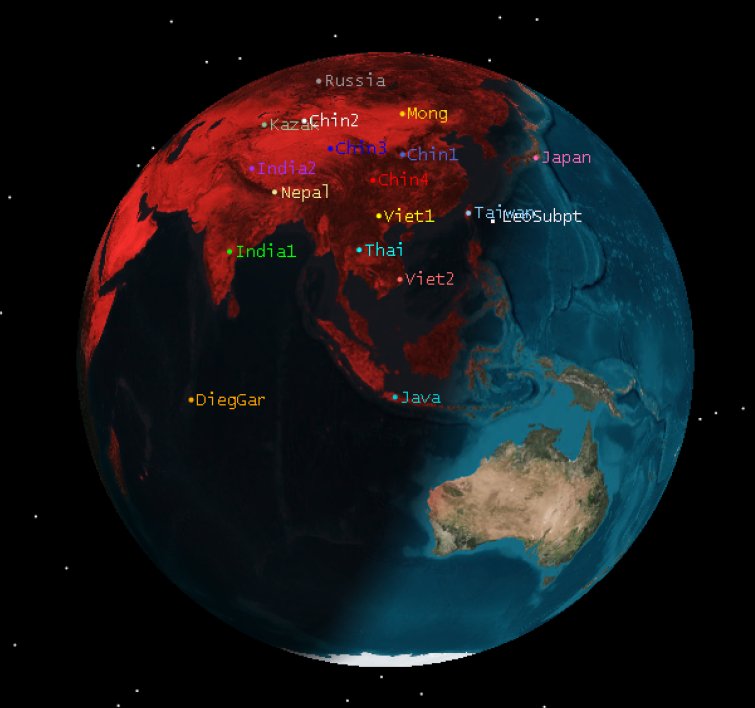
| SHUTTLE LAUNCH: Carrying a crew of six astronauts and tons of supplies, space shuttle Atlantis lifted off from the Kennedy Space Center today at 2:28 pm EST. The picture-perfect launch kicks off an 11-day mission to the International Space Station. Check the Simple Satellite Tracker for viewing opportunities. LEONID METEOR SHOWER: The Leonid meteor shower peaks this year on Nov. 17th. The shower begins on Tuesday morning around 0900 UT (4 a.m. EST; 1 a.m. PST) with a sprinkling of 20 to 30 meteors per hour over North America. The new Moon provides ideally dark conditions for viewing this initial flurry. The best place to be, however, is Asia, where forecasters expect as many as 300 Leonids per hour. The predicted outburst occurs between 2100 - 2200 UT, just before local dawn in that part of the world: 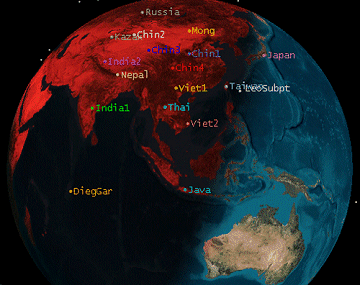
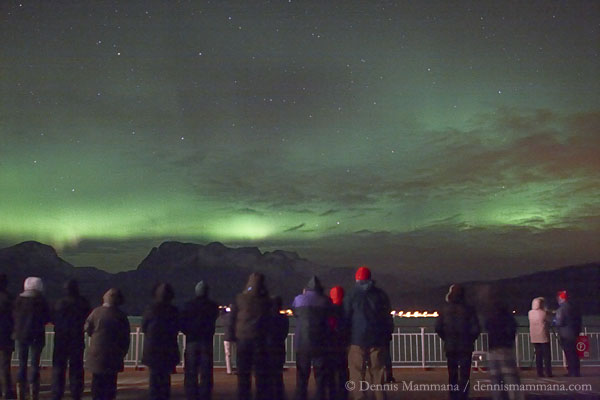
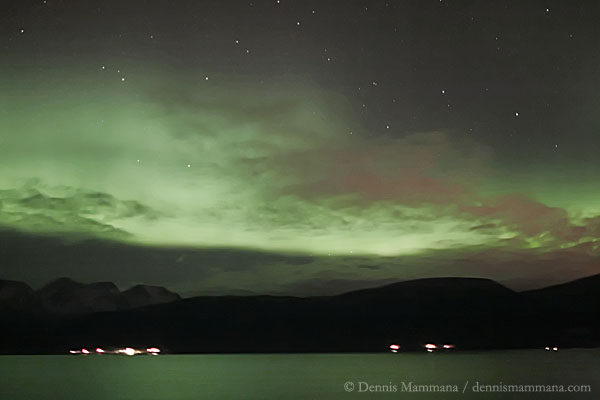
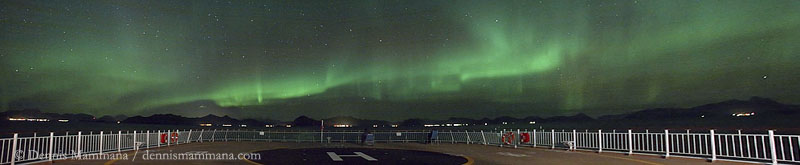
Got clouds? If you can't see the show, you can try listening to it instead. The Air Force Space Surveillance Radar is scanning the skies above Texas. When a Leonid passes over the facility--ping!--there is an echo. Tune into Spaceweather Radio for a live audio feed. more Leonid resources: AURORAS AHOY! "Who says one can't photograph the aurora from a moving ship? Digital photography has made things possible of which film shooters can only dream!" says traveling photographer Dennis Mammana. To prove it, he snapped this picture from the deck of the MS Midnatsol off the coast of Tromsø, Norway, on Nov. 12th: 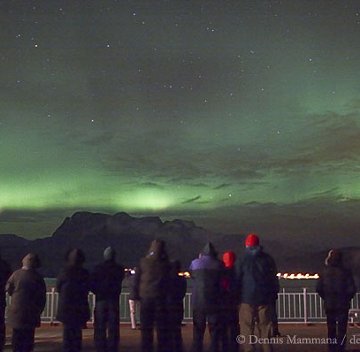
When the auroras appeared, "I pulled out a 24mm f/1.4L lens, opened it up all the way, kicked up the camera's ISO to 3200 and shot 2 second exposures for the faintest lights, 1 second exposures for the brightest," Mammana explains. "I also made a panorama of four 1 second exposures at ISO 1600." "Digital noise is, of course, present in all images at such high ISO settings, but thermal noise was minimized by the cold ambient temperatures and could be reduced easily by software." So, readers, if you find yourself on a ship after dark off the coast of Norway, now you know what to do. November Northern Lights Gallery
[previous Novembers: 2008, 2007, 2006, 2004, 2003, 2002, 2001]
Explore the Sunspot Cycle |