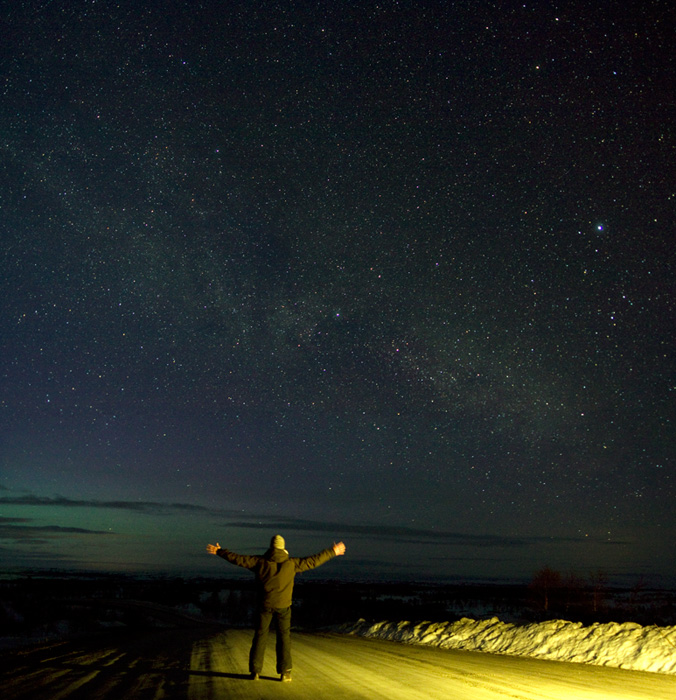
| FEROCIOUS CROISSANTS: For the first time, NASA spacecraft have traced the 3D shape of solar storms known as coronal mass ejections (CMEs). It turns out the most ferocious CMEs resemble something from a French bakery. Get the full story from Science@NASA. SUMMONING THE AURORAS: Last night, photographer P-M Hedén pulled to the side of a snowy road in Mittådalen, Sweden, raised his arms to the stars and summoned the auroras. Lo and behold, they came: 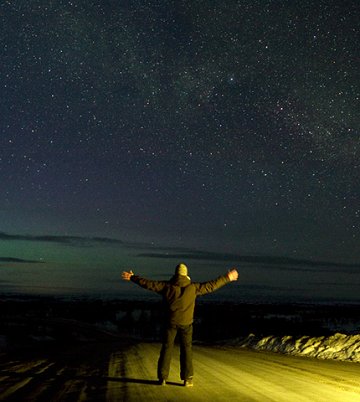
"Seeing the faint but beautiful Northern Lights together with the shining Milky Way--it was fantastic," he says. "Just around the corner from where I took the picture is a wilderness inhabited by fox, bears and wolves." Perhaps they enjoyed it, too. More lights are in the offing. A solar wind stream is en route to Earth, due to arrive on April 16th or 17th, and its impact could spark geomagnetic activity around the Arctic Circle. Sky watchers in Scandinavia, Canada, and Alaska, raise your arms to the stars. You might summon some auroras of your own. April 2009 Aurora Gallery
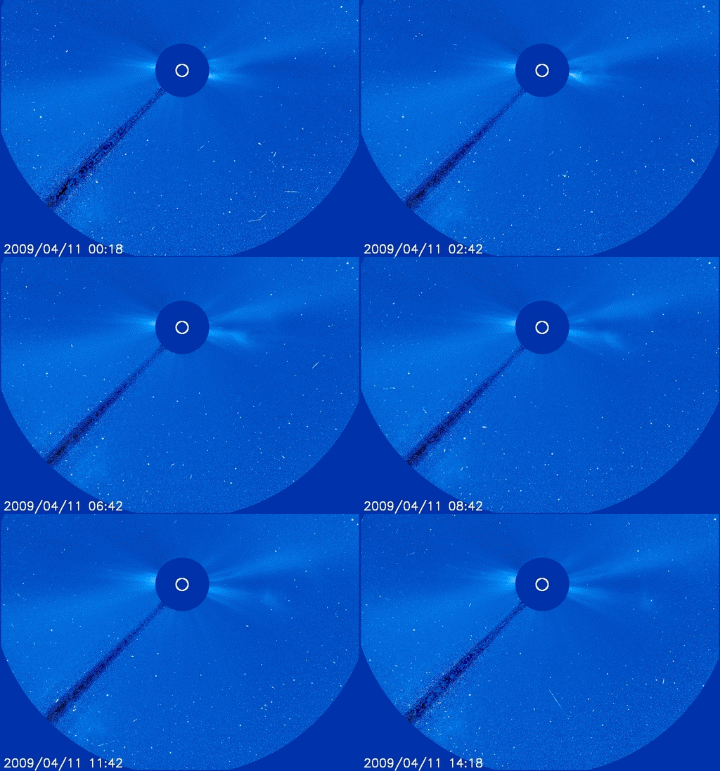
[previous Aprils: 2008, 2007, 2006, 2005, 2004, 2003, 2002] SLOW-MOTION EXPLOSIONS: How deep is solar minimum? Consider this: The most powerful solar explosions are now moving in slow motion. "Lately, coronal mass ejections (CMEs) have become very slow, so slow that they have to be dragged away from the sun by the solar wind," says researcher Angelos Vourlidas of the Naval Research Lab. Here is an example from April 11th: 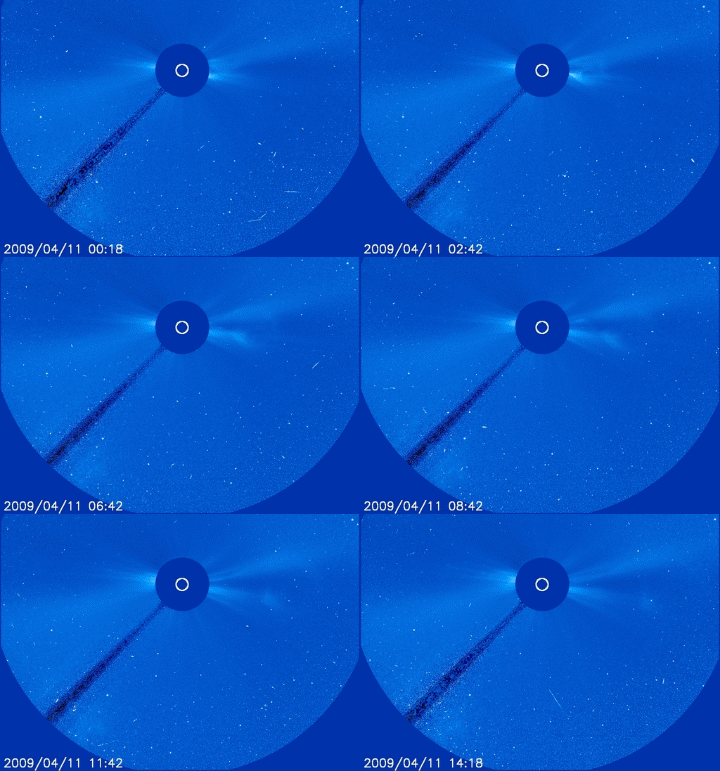
Each second in the SOHO animation corresponds to an hour or more of real time. "The speed of the CME was only 240 km/s," says Vourlidas. "The solar wind speed is about 300 km/s, so the CME is actually being dragged." Vourlidas has examined thousands of CMEs recorded by SOHO over the past 13 years, and he's rarely seen such plodding explosions. In active times, CMEs can blast away from the sun faster than 1000 km/s. Even during the solar minimum of 1996, CMEs often revved up to 500 or 600 km/s. "Almost all the CMEs we've seen since the end of April 2008, however, are very slow, less than 300 km/s." Is this just another way of saying "the sun is very quiet?" Or do slow-motion CMEs represent a new and interesting phenomena? The jury is still out. One thing is clear: solar minimum is more interesting than we thought.
Explore the Sunspot Cycle |