Hang the Transit of Venus on your wall! Hubble-quality images from NASA's Solar Dynamics Observatory are now available as metallic posters in the Space Weather Store. | | |
THE UN BRACES FOR STORM SPACE WEATHER: Forecasters say solar maximum is due in 2013. To prepare, the United Nations is taking steps to organize an international response to stormy space weather. Get the full story from Science@NASA.
FILAMENT ERUPTION: Solar activity is low, but not zero. During the early hours of Feb. 13th, a magnetic filament erupted near the sun's SW limb. NASA's Solar Dynamics Observatory recorded the blast (click to set the scene in motion):
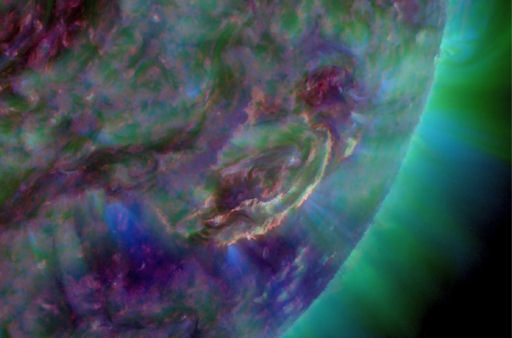
The extreme UV movie shows the filament flinging itself into space followed by the formation of a "canyon of fire" marking the channel formerly occupied by the filament. The glowing walls of the canyon are formed in a process closely related to that of arcade loops, which appear after many solar flares.
As erupting magnetic filaments often do, this one launched a coronal mass ejection (CME) into space. NASA's STEREO-A spacecraft spotted the expanding cloud, which does not appear to be heading for Earth or any other planet. Solar flare alerts: text, voice.
Realtime Space Weather Photo Gallery
SUNDOGS: How many dogs can you count in this picture? Hint: Don't forget the sundogs. Scroll down past the sled for a total:

Answer: Six, four huskies plus two parhelia--a.k.a. "sundogs." They are bright splashes of light to the left and right of the sun caused by sunlight shining through ice crystals in the air.
"They appeared to result from snowmobiles and dogs kicking snowdust up into the Artic air," says Ian Collins, who took the picture on February 9, 2013 from Jukkasjarvi, Sweden.
With northern winter entering its coldest, snow-dustiest phase, now is a great time to be alert for the phenomenon. The Iditarod is coming in March. Can you say photo-op?
Realtime Space Weather Photo Gallery
Realtime Comet Photo Gallery
Realtime Aurora Photo Gallery
Realtime Noctilucent Cloud Photo Gallery
[previous years: 2003, 2004, 2005, 2006, 2007, 2008, 2009, 2011]
Potentially Hazardous Asteroids (
PHAs) are space rocks larger than approximately 100m that can come closer to Earth than 0.05 AU. None of the known PHAs is on a collision course with our planet, although astronomers are finding
new ones all the time.
On February 13, 2013 there were potentially hazardous asteroids.
Notes: LD means "Lunar Distance." 1 LD = 384,401 km, the distance between Earth and the Moon. 1 LD also equals 0.00256 AU. MAG is the visual magnitude of the asteroid on the date of closest approach. | | The official U.S. government space weather bureau |
| | The first place to look for information about sundogs, pillars, rainbows and related phenomena. |
| | Researchers call it a "Hubble for the sun." SDO is the most advanced solar observatory ever. |
| | 3D views of the sun from NASA's Solar and Terrestrial Relations Observatory |
| | Realtime and archival images of the Sun from SOHO. |
| | from the NOAA Space Environment Center |
| | the underlying science of space weather |