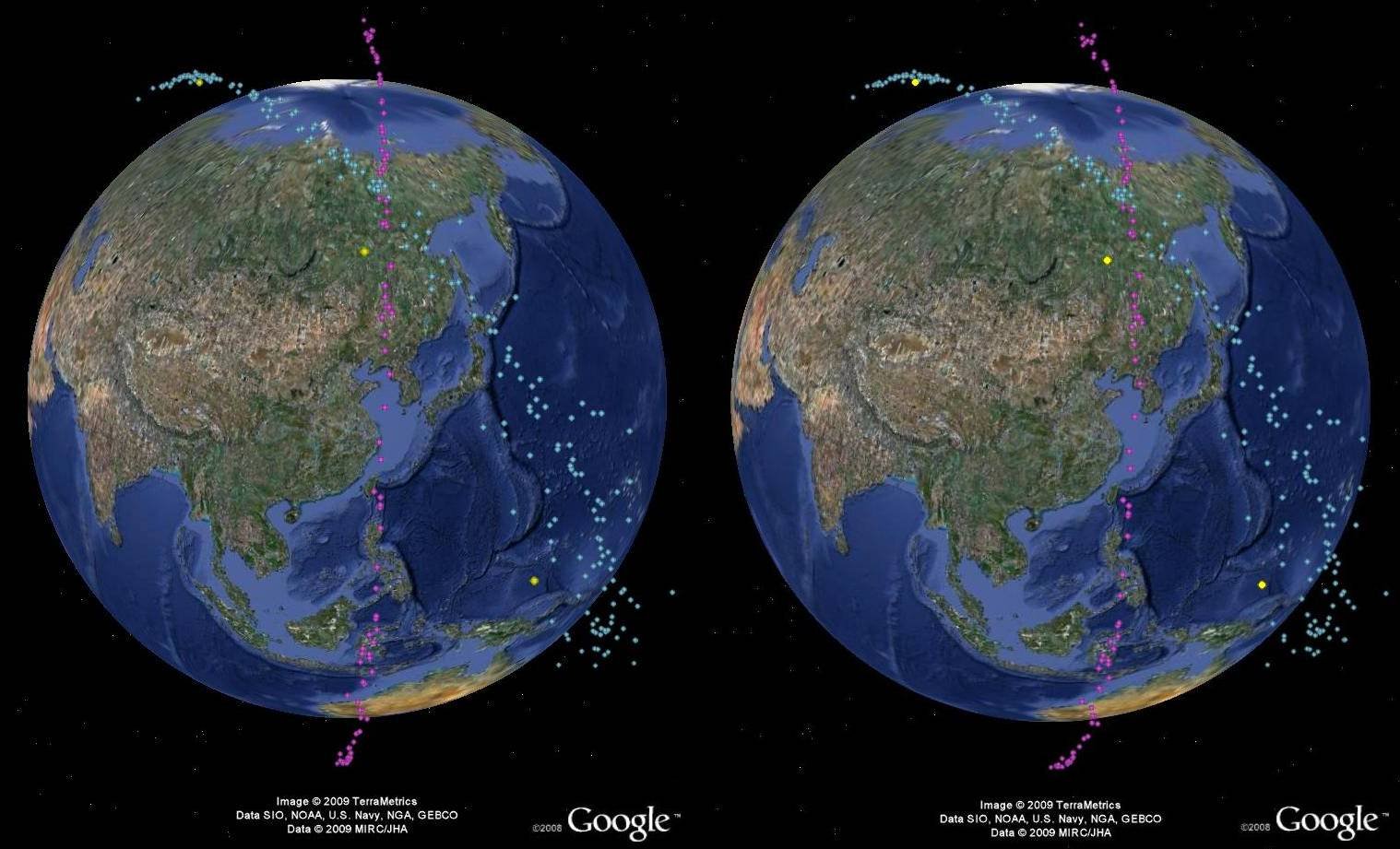
| CLOSE CALL: A piece of space junk about the size of a small marble zipped past the International Space Station today at a relative speed of ~20,000 mph. As a safety precaution, the crew sheltered themselves in the station's Soyuz landing craft. If the debris had hit the ISS, puncturing its hull, the crew could have quickly closed the hatches of the Soyuz and returned to Earth. It missed, and ISS operations have returned to normal. More: from NASA, from CNN. 3D SATELLITE DEBRIS: Regard the maps below. Cross your eyes until the two globes merge and voila!--you can see the remains of Cosmos 2251 and Iridium 33 in spellbinding 3D. (Having trouble? A larger pair may help.) 
Tom Wagner of Waterloo, Iowa, created the graphics. "John Burns supplied a KML file that in Google Earth shows where 217 pieces of Iridium 33 and 455 pieces of Cosmos 2521 were located on March 11th at 12:00 UT. Using Google Earth, I produced stereo pairs for cross-eyed viewing and also a red-blue anaglyph for 3D glasses." "Note the three yellow dots," he points out. "Those are the pieces of Cosmos 2251 predicted to reenter the atmosphere [on March 12th, 28th and 30th]."
VIDEO UPDATE: Iridium 33 was not completely shattered by its collision with Cosmos 2251. A substantial "chunk" of the satellite's body held together, and it is now being seen in Earth orbit. Kevin Fetter video recorded the object as it tumbled across the sky over Brockville, Ontario, on March 11th: movie. An intact satellite, Iridium 28, follows Iridium 33 in the video. Note how one flashes and the other does not. WORM MOON: The early bird catches the worm, but it takes a Night Owl to catch the Worm Moon. Emy Schade was out after dark on March 10th when she alertly captured the Moon in a bed of clouds over Rio Dulce, Guatemala: 
Hal Schade took the picture from a dock on the river's bank. "Dulce suenos, Luna Lombriz (Sweet dreams, Worm Moon)," he says. The full Moon of March is called the "Worm Moon" because it heralds the coming of northern spring and the first stirrings of earthworms in dormant winter gardens. Robins benefit most from this turn of events, but the Night Owls seem to be enjoying it, too. Click on the links below for more examples. Worm Moon images: from P. Nikolakakos of Sparta, Greece; from Mark Seibold of Portland, Oregon; from Keith Breazeal of Amador County, California; from Mark and Nancy Staples of Santa Fe, New Mexico; from Doug Zubenel of Cedar Creek near De Soto, Kansas; from Tamas Ladanyi of Veszprem, Hungary; from Elias Chasiotis of Markopoulo, Greece; from Abraham Tamas of Zsámbék, Hungary; from Lord Akela of Ráckeve, Hungary; from Jean-Marc Lecleire of Torcy, France
March 2009 Aurora Gallery
[previous Marches: 2008, 2007, 2006, 2005, 2004, 2003, 2002]
Explore the Sunspot Cycle |