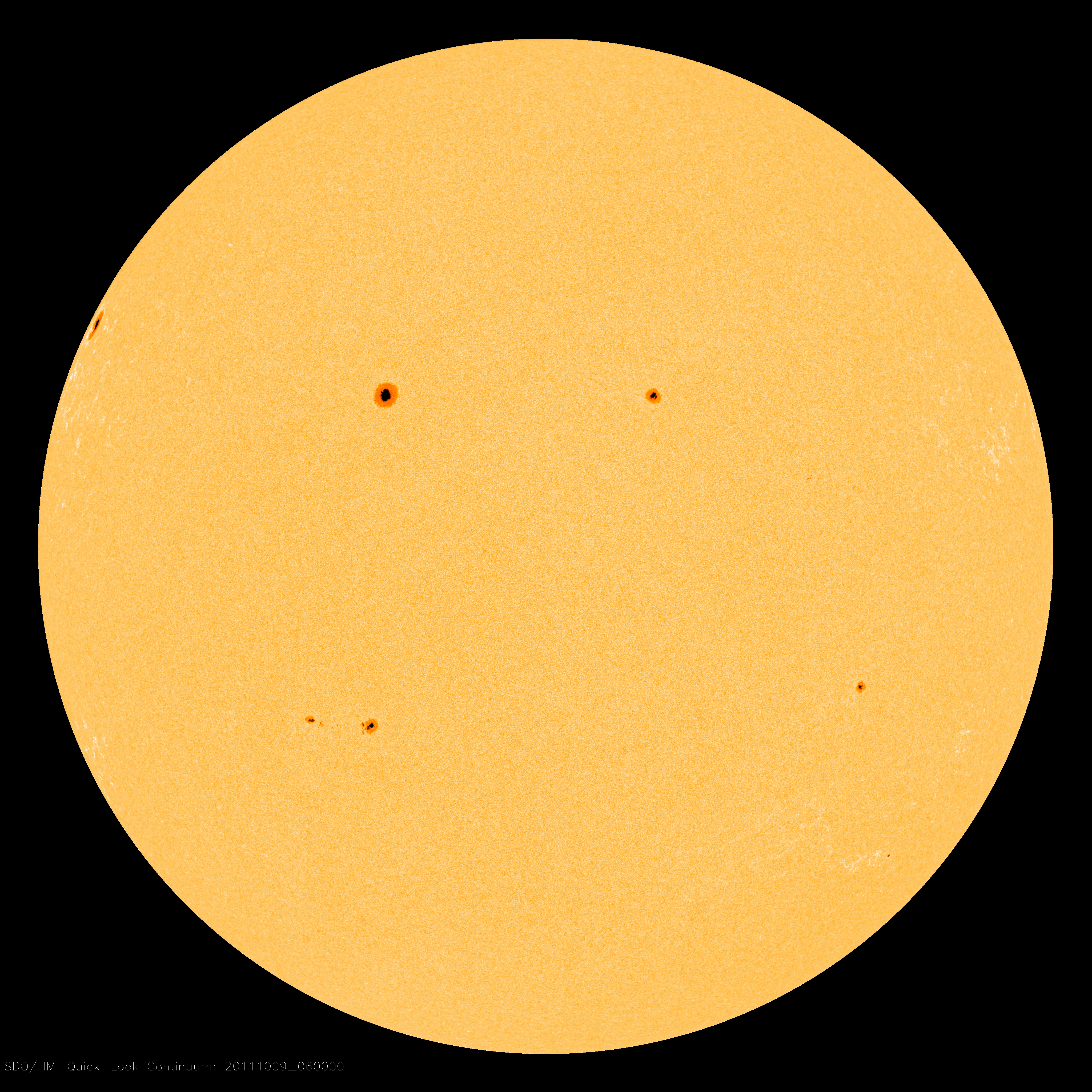
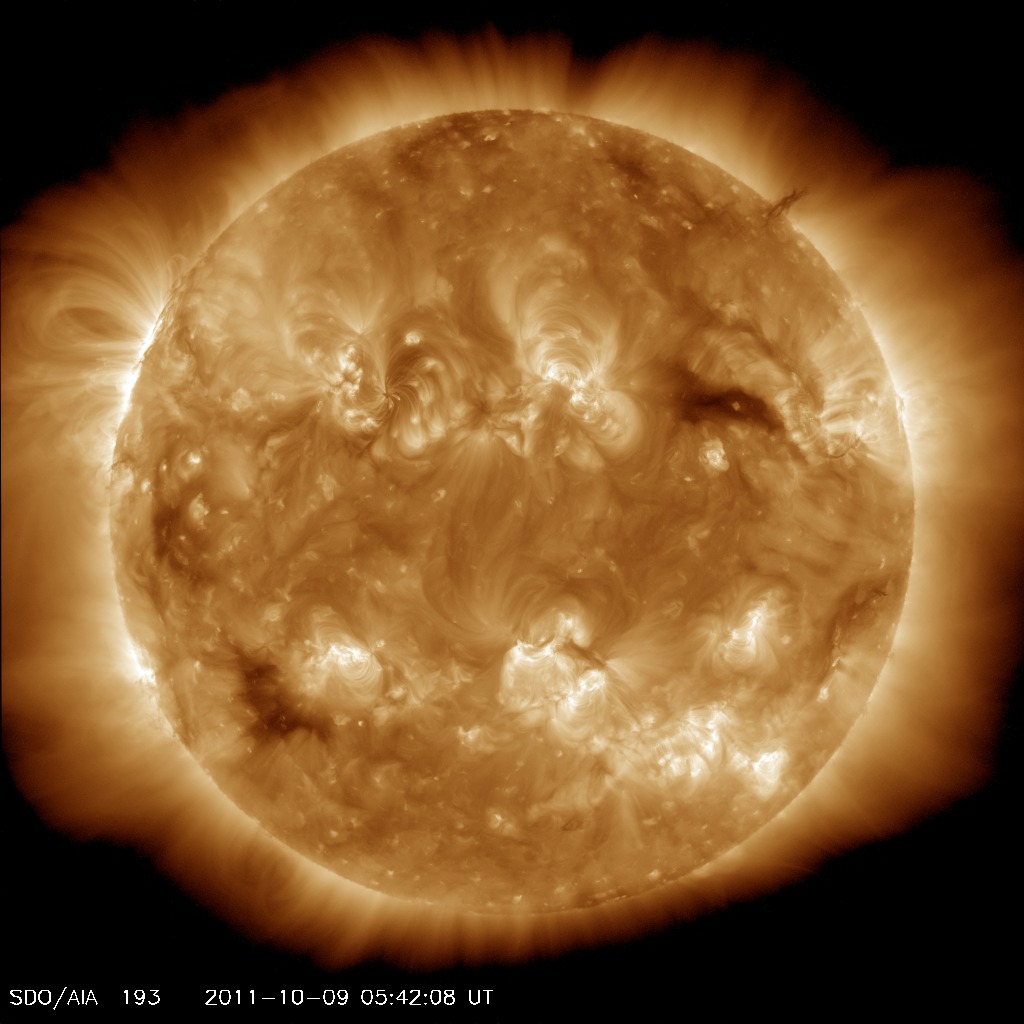
Metallic photos of the sun by renowned photographer Greg Piepol bring together the best of art and science. Buy one or a whole set. They make a stellar gift. | | | DRACONID METEOR UPDATE: According to worldwide observers reporting to the International Meteor Organization, there was indeed an outburst of Draconid meteors on October 8th. Preliminary counts suggest a peak rate of 660 meteors per hour at 2010 UT (4:10 pm EDT). Most Draconids in the outburst were faint, but not all. Göran Fredriksson photographed this fireball splitting the evening twilight over Örnsköldsvik, Sweden: 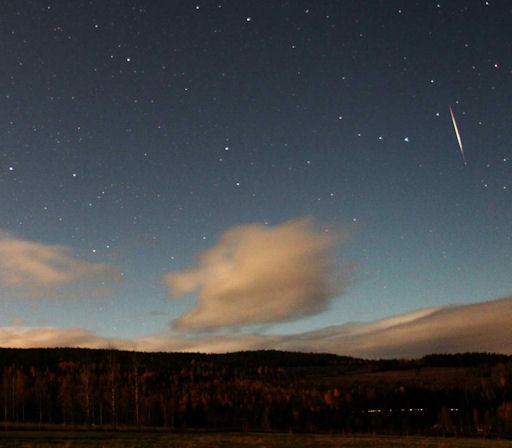
The meteor rate and overall faintness of the display was in good accord with predictions by leading forecasters such as Jeremie Vaubaillon of the Institute for Celestial Mechanics in France and analysts at NASA's Meteoroid Environment Office. more images: from Jesper Grønne of Silkeborg Denmark; from Runar Sandnes of Reed, Norway; from Frank Martin Ingilæ of Tana, Finnmark, Norway; from Ronny Tertnes of Bergem, Norway; from Richard Klofac of Czech Republic, Zlechov; from Thomas Hagen of Oslo, Norway; from Adrian West of West Berkshire United Kingdom; from Pete Glastonbury of Devizes, Wiltshire, UK; from Jaromír Němec of Davle, Czech Republic Draconid resources: AURORAS IN THE CRYSTAL BALL: On Oct. 6th, Frank Olsen stood on the beach in Tromso, Norway, watching the Northern Lights as Earth's magnetic field reverberated from a CME impact one night earlier. He was so impressed with the display, he decided to photograph it through a crystal ball. Look to the lower right of the image for the fortune-teller's view: 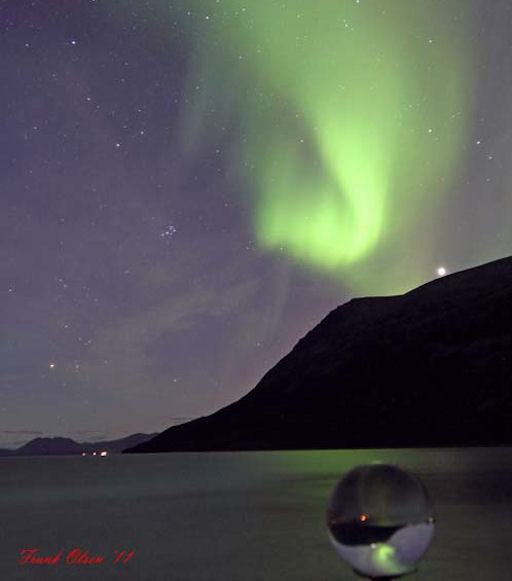
"This wasn't a major outburst," he says, "but at times the auroras were quite bright." And now for the fortune: Another display is in the offing. A solar wind stream is heading for Earth, due to arrive on Oct. 9-10. NOAA forecasters estimate a 10% chance of geomagnetic storms. Aurora alerts: text, voice. more images: from Fredrik Broms of Kvaløya, Norway; from Michel Tournay flying over South Dakota September 2011 Aurora Gallery
[previous Septembers: 2010, 2009, 2008, 2007, 2006, 2005, 2004] TODAY'S BONUS SHOTS: Red Tide from Steve Shuey of San Diego, California Pale Halo from Jean-Paul Godard of Pic du Midi, France; Sunset Rays from Doug Zubenel of De Soto, Kansas; Meteors from Hal Yeager of Higden, Arkansas Potentially Hazardous Asteroids ( PHAs) are space rocks larger than approximately 100m that can come closer to Earth than 0.05 AU. None of the known PHAs is on a collision course with our planet, although astronomers are finding new ones all the time. On October 9, 2011 there were 1250 potentially hazardous asteroids. Notes: LD means "Lunar Distance." 1 LD = 384,401 km, the distance between Earth and the Moon. 1 LD also equals 0.00256 AU. MAG is the visual magnitude of the asteroid on the date of closest approach. | | The official U.S. government space weather bureau | | | The first place to look for information about sundogs, pillars, rainbows and related phenomena. | | | Researchers call it a "Hubble for the sun." SDO is the most advanced solar observatory ever. | | | 3D views of the sun from NASA's Solar and Terrestrial Relations Observatory | | | Realtime and archival images of the Sun from SOHO. | | | from the NOAA Space Environment Center | | | the underlying science of space weather | | | for out-of-this-world printing and graphics | |