They came from outer space--and you can have one! Genuine meteorites are now on sale in the Space Weather Store. They make a unique Valentine's gift. | | |
X-FLARE: Earth-orbiting satellites have just detected an impulsive X1-class solar flare. Stay tuned for analysis.
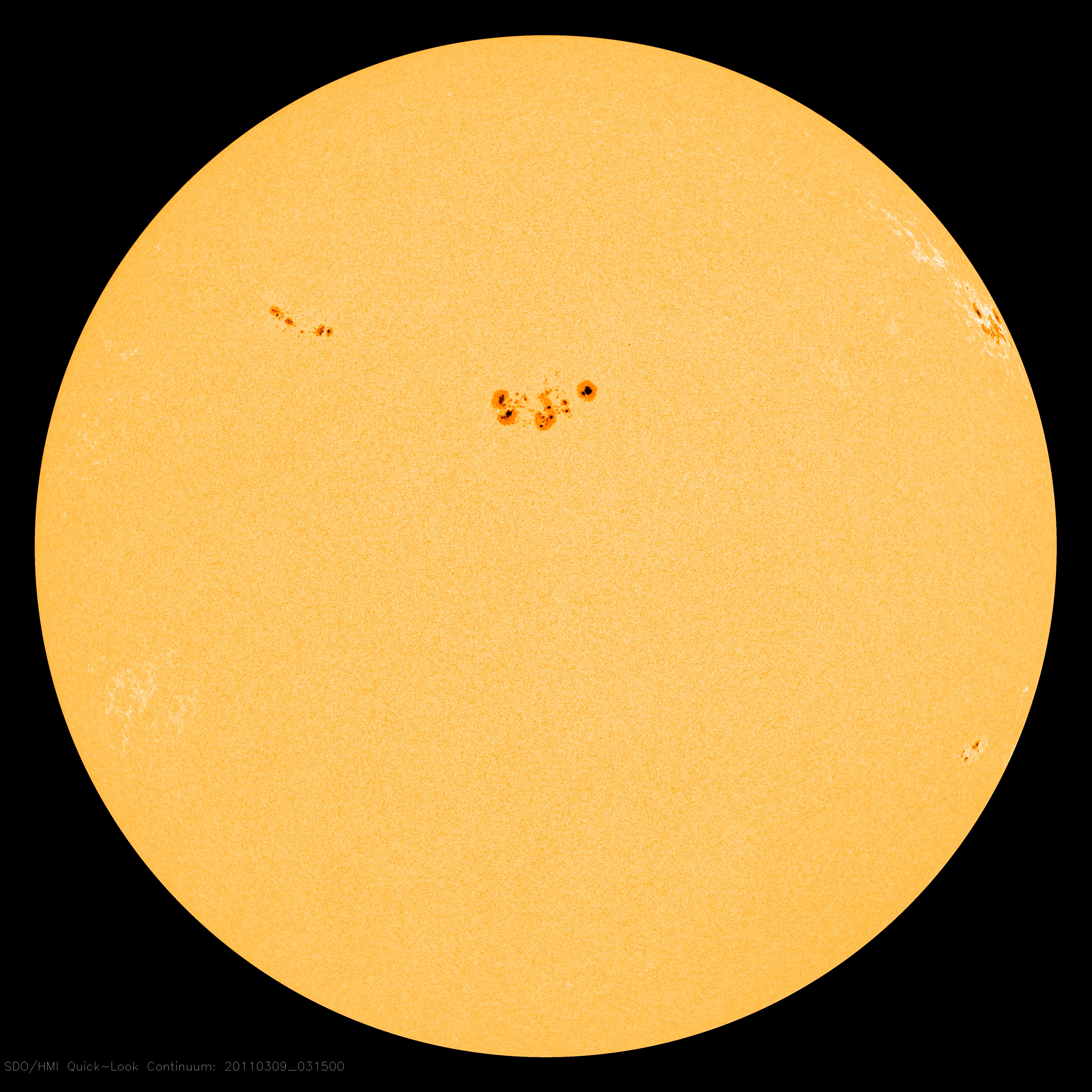
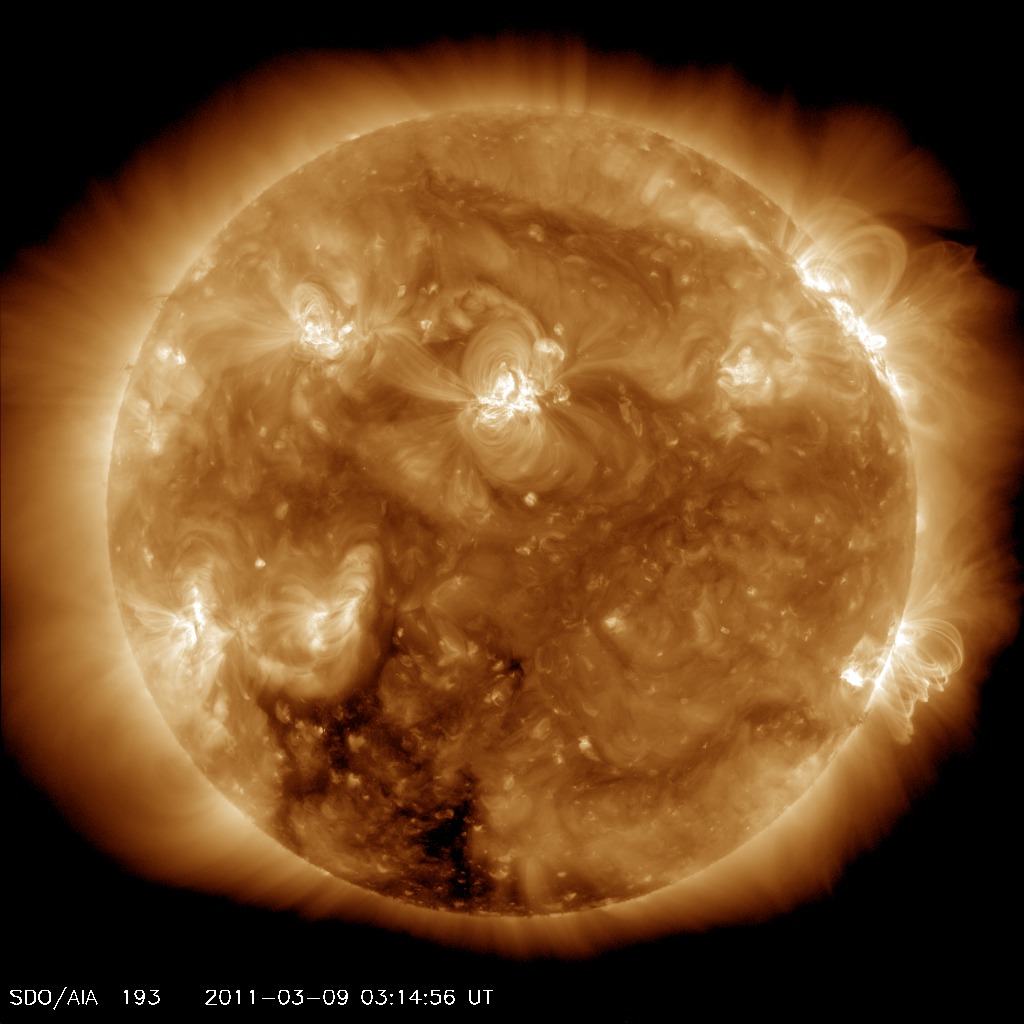
FAST CORONAL MASS EJECTION: A coronal mass ejection (CME) exploded from the vicinity of sunspot 1164 during the late hours of March 7th. It leapt away from the sun traveling ~2200 km/s, making it the fastest CME since Sept. 2005. A movie of the cloud prepared by Karl Battams of the Naval Research Lab shows a possibly substantial Earth-directed component. This CME and at least one other could brush against Earth's magnetic field on March 9th or 10th. High-latitude sky watchers should be alert for auroras.
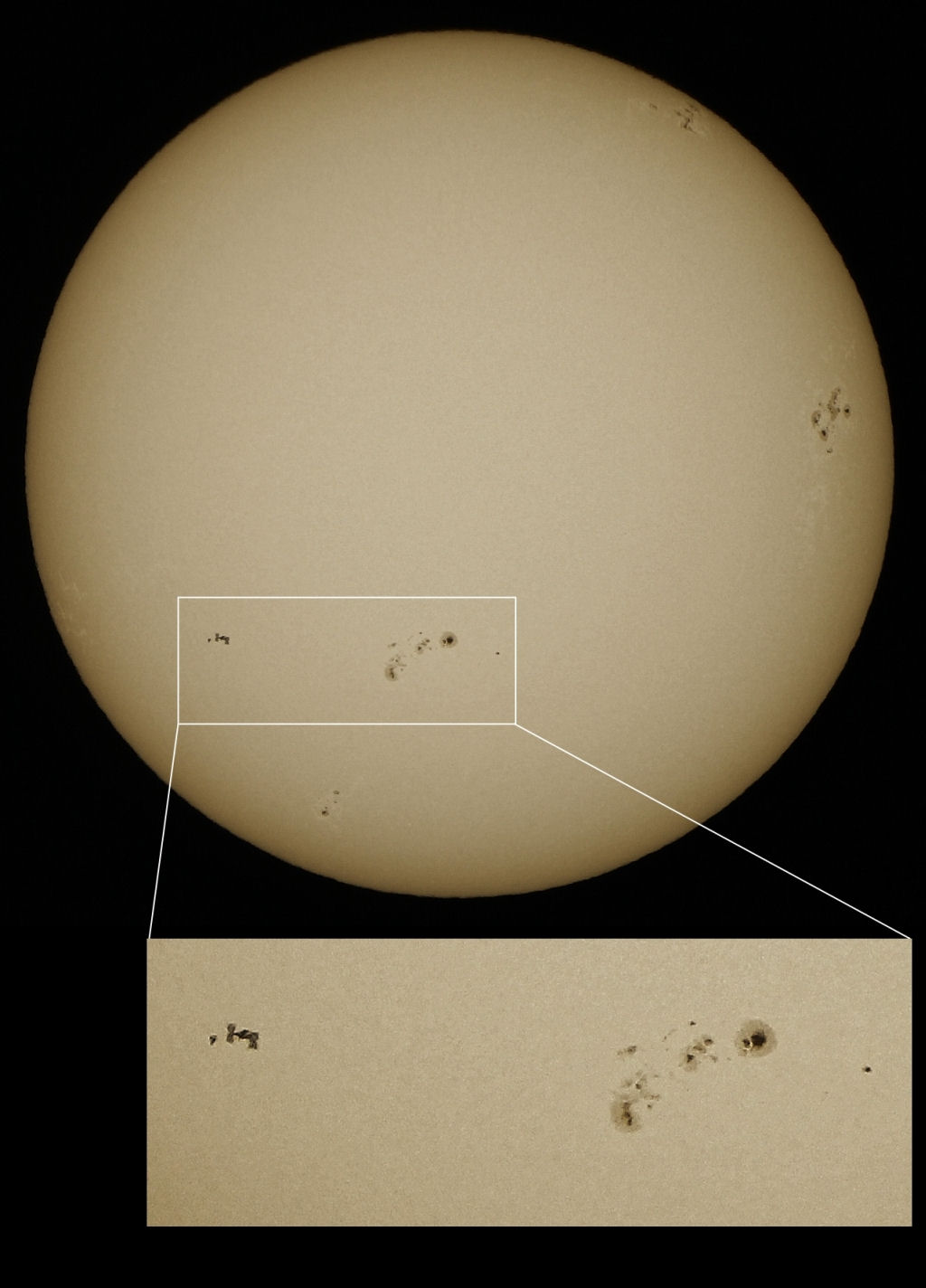
SUNSPOT CONJUNCTION: On March 7th, shortly after space shuttle Discovery undocked from the International Space Station, the two ships flew directly in front of the sun over Europe. Catalin Fus of Krakow, Poland, had his solar-filtered telescope trained on sunspot 1166 and recorded this amazing conjunction:
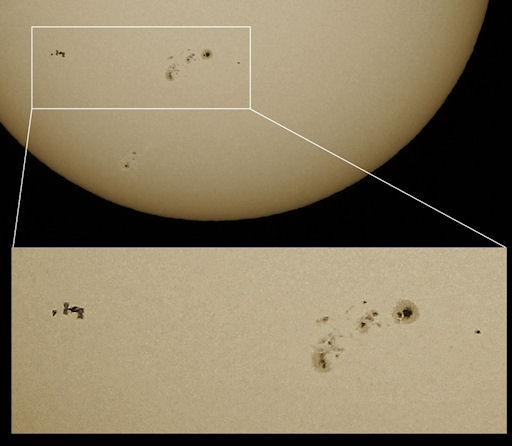
"I was surprised that I could see Discovery flying around the station," says Fus. "The shuttle is so small compared to the ISS." Nevertheless, both silhouettes were clearly visible alongside the sunspot. Browse the links for more transit images: from Jérôme DELPAU of Coemont, Sarthe, France; from Jan Eric Krikke of Heerenveen, The Netherlands; from Pawel Warchal of Cracow, Poland.
LAST WATER DUMP: At the end of the day on March 8th, a strange curlicue-shaped comet appeared in the twilight skies of Europe. It was space shuttle Discovery performing a dump of waste water. Crystals of flash-frozen urine and other substances glistened in the sunlight, putting on an impressive show. Click on the image to view of a movie of the event recorded by Jens Hackmann of Weikersheim, Germany:
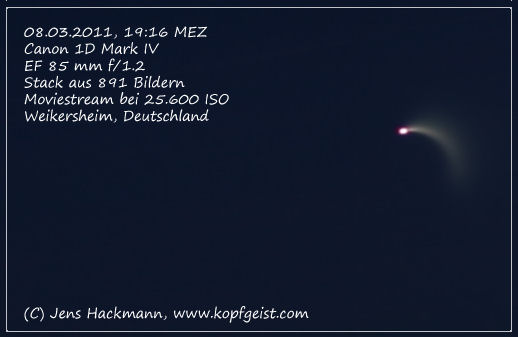
Discovery landed safely this morning at the Kennedy Space Center in Florida, bringing the orbiter's final mission to an end. The spacecraft will now be retired as part of NASA's wind-down of the shuttle program. Farewell, Discovery, and thanks for everything--water dumps and all.
more images: from Ralf Vandebergh of the Netherlands
March 2011 Aurora Photo Gallery
[previous Marches: 2010, 2009, 2008, 2007, 2006, 2005, 2004, 2003, 2002]
Potentially Hazardous Asteroids (
PHAs) are space rocks larger than approximately 100m that can come closer to Earth than 0.05 AU. None of the known PHAs is on a collision course with our planet, although astronomers are finding
new ones all the time.
On March 9, 2011 there were 1204 potentially hazardous asteroids.
Notes: LD means "Lunar Distance." 1 LD = 384,401 km, the distance between Earth and the Moon. 1 LD also equals 0.00256 AU. MAG is the visual magnitude of the asteroid on the date of closest approach. | | The official U.S. government space weather bureau |
| | The first place to look for information about sundogs, pillars, rainbows and related phenomena. |
| | Researchers call it a "Hubble for the sun." SDO is the most advanced solar observatory ever. |
| | 3D views of the sun from NASA's Solar and Terrestrial Relations Observatory |
| | Realtime and archival images of the Sun from SOHO. |
| | from the NOAA Space Environment Center |
| | the underlying science of space weather |
| | for out-of-this-world printing and graphics |