They came from outer space--and you can have one! Genuine meteorites are now on sale in the Space Weather Store. | | | SOLAR WIND: For the third day in a row, a stream of fast solar wind is buffeting Earth's magnetic field. NOAA forecasters estimate a 40% chance of geomagnetic storms around the poles on June 7th. Magnetic storm alerts: text, voice. HUBBLE TRANSIT OF VENUS: One of the big ironies of the 2012 Transit of Venus was that NASA's greatest telescope didn't dare photograph the event. Hubble's instruments are so sensitive, one look at the glaring sun would have crippled its instruments. Nevertheless, Hubble managed to join the show. Astrophotographer Theirry Legault caught the observatory flitting in front of the sun alongside Venus: 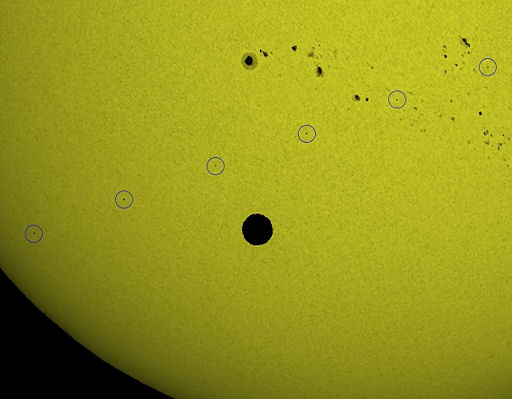
"I was in north-east Australia for the full transit of Venus and a transit of Hubble in the middle," says Legault. "My Nikon D4 digital camera was working at 10 fps on a Takahashi FSQ-106ED telescope to record 9 images of HST during its 0.9s transit." This is certainly an historic photo. Imagine what James Cook would think of a telescope in space crossing his field of view as he watched the transit of 1769 from a beach in Tahiti. Moreover, imagine what kind of telescopes will be crossing the sun when the next Transit of Venus occurs in 2117. Congratulations to Legault for capturing a truly rare 0.9s slice of history. More slices of history may be found in the Transit of Venus Photo Gallery: Realtime Transit of Venus Photo Gallery
[Submit your photos] [NASA videos: 2012 Transit of Venus, ISS Transit of Venus] Transit of Venus Web Links: CHANCE OF FLARES: The odds of a significant solar flare are improving as three sunspots develop complex magnetic fields with energy for M-class eruptions. NASA's Solar Dynamics Observatory recorded this extreme ultraviolet flash (category M3) from sunspot AR1494 on June 6th: 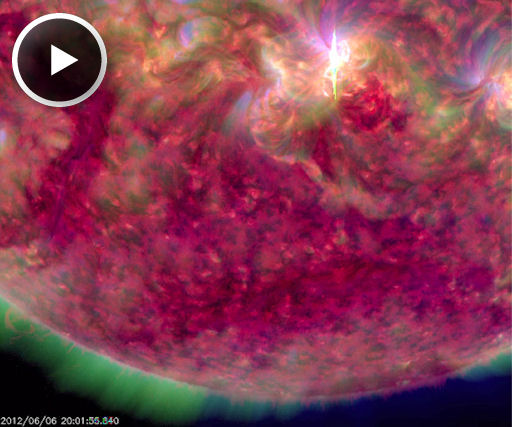
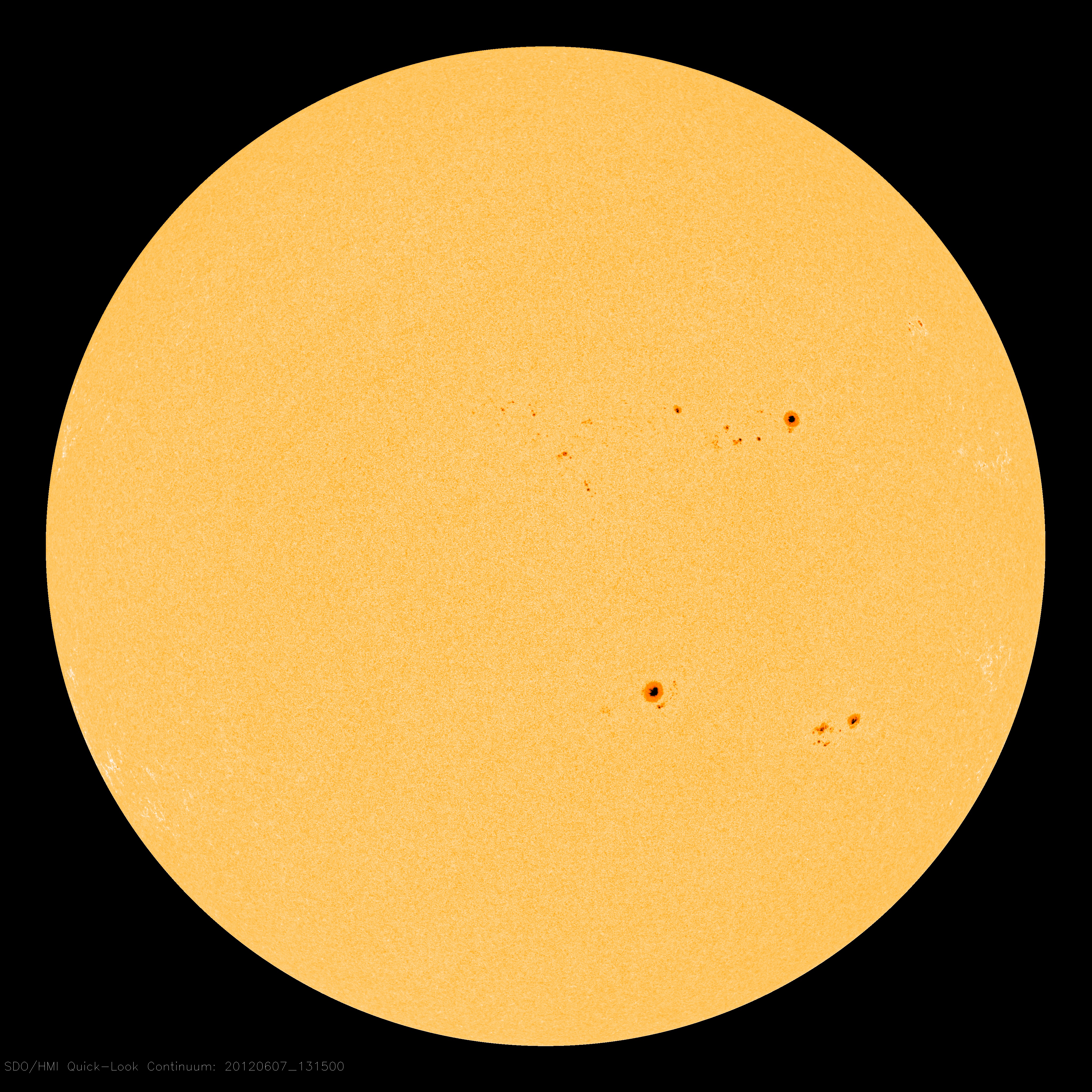
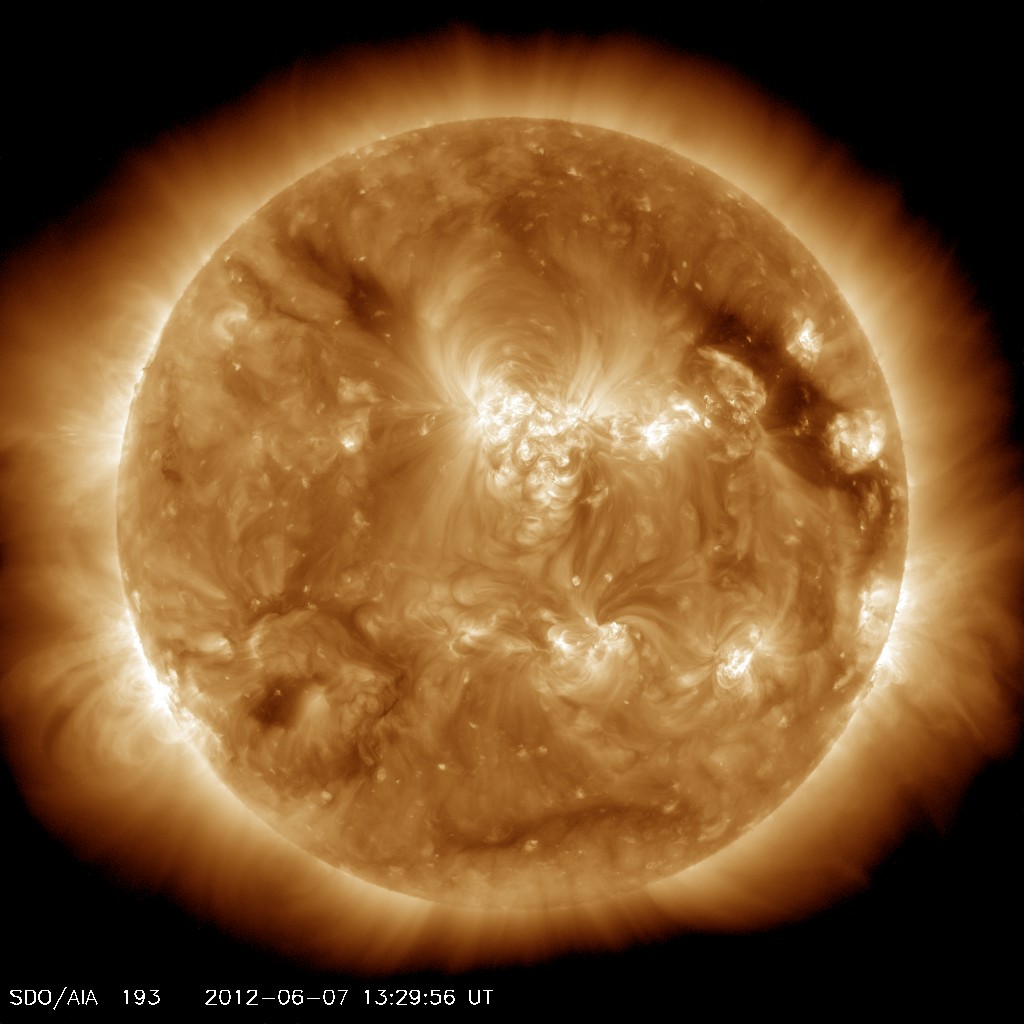
The impulsive flare hurled a coronal mass ejection into spacce, but not directly toward Earth. The cloud should sail mostly south of our planet on June 8-9. The other two sunspots that pose a threat for M-flares are AR1493 and AR1499. Solar flare alerts: text, voice. Potentially Hazardous Asteroids ( PHAs) are space rocks larger than approximately 100m that can come closer to Earth than 0.05 AU. None of the known PHAs is on a collision course with our planet, although astronomers are finding new ones all the time. On June 7, 2012 there were 1293 potentially hazardous asteroids. Notes: LD means "Lunar Distance." 1 LD = 384,401 km, the distance between Earth and the Moon. 1 LD also equals 0.00256 AU. MAG is the visual magnitude of the asteroid on the date of closest approach. | | The official U.S. government space weather bureau | | | The first place to look for information about sundogs, pillars, rainbows and related phenomena. | | | Researchers call it a "Hubble for the sun." SDO is the most advanced solar observatory ever. | | | 3D views of the sun from NASA's Solar and Terrestrial Relations Observatory | | | Realtime and archival images of the Sun from SOHO. | | | from the NOAA Space Environment Center | | | the underlying science of space weather | |