Thirty-five new items have just been added to our Meteorite Jewelry collection. Browse the Space Weather Store for something out of this world. | | |
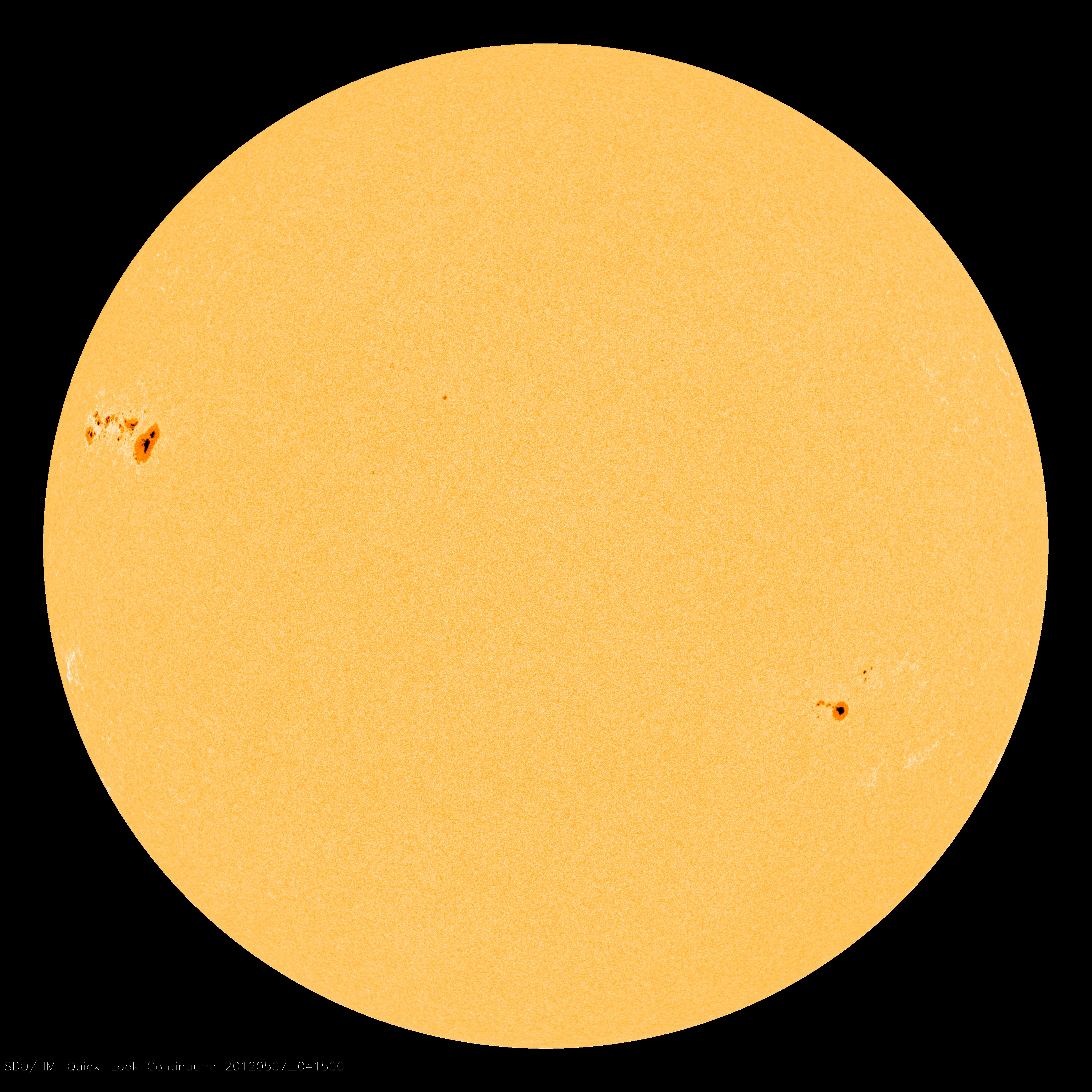
BIG SUNSPOT: One of the largest sunspot groups in years rotated over the sun's northeastern limb this weekend. With a least four dark cores larger than Earth, AR1476 sprawls more than 100,000 km from end to end, and makes an easy target for backyard solar telescopes. Amateur astronomer Alan Friedman sends this picture of the behemoth from his backyard in Buffalo, NY:
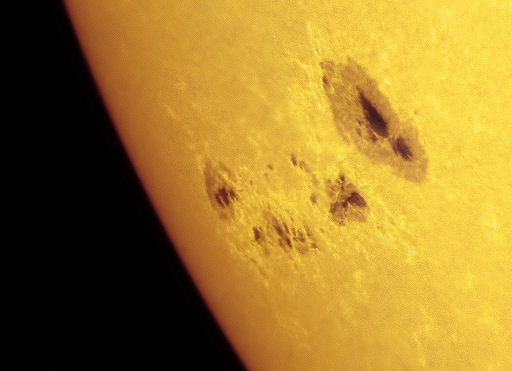
"AR1476 is firecrackler," says Friedman.
Indeed, the active region is crackling with impulsive M-class solar flares. Based on the sunspot's complex 'beta-gamma' magnetic field, NOAA forecasters estimate a 70% chance of more M-flares during the next 24 hours. There is also a 5% chance of powerful X-flares.
"This one is going to be fun as turns to face us!" predicts Friedman. He might be right. Solar flare alerts: text, phone.
more images: from John Chumack of Dayton, Ohio; from Dave Gradwell of Birr, Ireland; from Dave Gradwell of Birr, Ireland; from Robert Arnold of Isle of Skye, Scotland; from Howard Eskildsen of Ocala, Florida; from Peter Desypris of Athens, Greece; from Erika Rix of Liberty Hill, Texas
SUPER LUNAR GREEN FLASH: Over the weekend, photographer Laurent Laveder learned an important lesson: Never take your eyes off a super moon. Laveder's back was turned when the biggest full Moon of the year rose over coast of Île Garo in Brittany, France. Fortunately, his camera was running and it caught the lunar green flash:
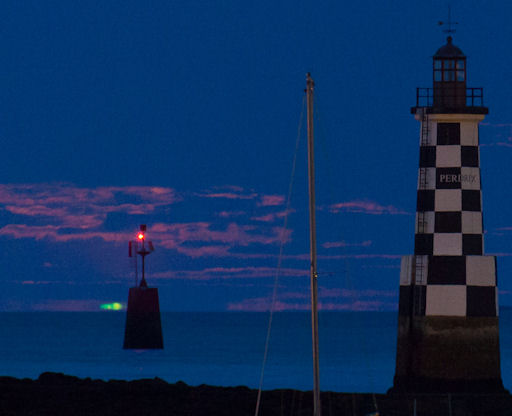
"I stitched together the images from my camera and made a time-lapse movie," says Laveder. "The fleeting green flash was visible in only the first frame."
Other coastal effects of the super moon included high tides, bright reflections, and ducks abroad after curfew. A NASA video explains why this moon was so influential.
more moonshots: from Rodney Hale of Houghton Conquest, Bedfordshire, UK; from Ronny Tertnes of Bergen, Norway; from Ray Pacion of Morristown, Arizona; from John E Cordiale of Queensbury, NY; from Val Germann of Columbia, Missouri; from Kamila Mazurkiewicz of Janowiec, Poland; from Mitchell Krog of Magaliesburg, South Africa; from Margo Werle of Las Vegas, Nevada; from David Hoffmann of Ashland, Oregon; from Mike Hutchinson of Muncie, Indiana; from Anthony Ayiomamitis of Cape Sounion, Greece; from Alberto Lao of Binondo, Manila, Philippines; from Marsha Adams of Sedona, Arizona
Potentially Hazardous Asteroids (
PHAs) are space rocks larger than approximately 100m that can come closer to Earth than 0.05 AU. None of the known PHAs is on a collision course with our planet, although astronomers are finding
new ones all the time.
On May 7, 2012 there were 1287 potentially hazardous asteroids.
Notes: LD means "Lunar Distance." 1 LD = 384,401 km, the distance between Earth and the Moon. 1 LD also equals 0.00256 AU. MAG is the visual magnitude of the asteroid on the date of closest approach. | | The official U.S. government space weather bureau |
| | The first place to look for information about sundogs, pillars, rainbows and related phenomena. |
| | Researchers call it a "Hubble for the sun." SDO is the most advanced solar observatory ever. |
| | 3D views of the sun from NASA's Solar and Terrestrial Relations Observatory |
| | Realtime and archival images of the Sun from SOHO. |
| | from the NOAA Space Environment Center |
| | the underlying science of space weather |