Don't just watch shooting stars. Wear them! Authentic meteorite jewelry for Christmas is now available in the SpaceWeather Store. | | |
INCOMING CME? A magnetic filament in the sun's northern hemisphere erupted on Jan. 5th and hurled a CME in the general direction of Earth. At first it appeared that the cloud would sail north of Earth and completely miss our planet. Subsequent work by analysts at the Goddard Space Weather Lab suggests a different outcome: the CME might deliver a glancing blow to Earth's magnetic field on Jan. 7th. Click to view an animated forecast track:
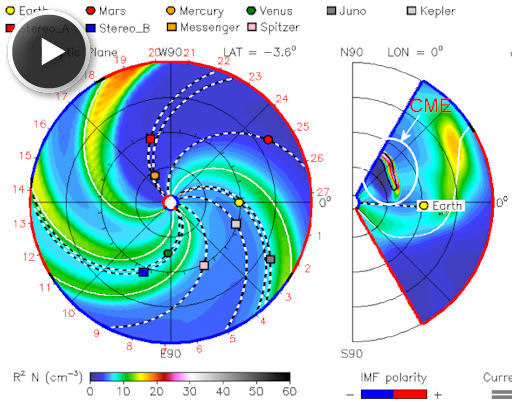
NOAA forecasters were already calling for a 40% chance of polar geomagnetic storms on Jan. 7-8 in response to a high-speed solar wind stream. The arrival of a CME would boost the chances even more. Storm alerts: text, voice.
AURORA WATCH: Even without a CME, auroras are lighting up the Arctic Circle. Sindre Nedrevåg sends this picture taken Jan. 5th from Bodø, Norway:
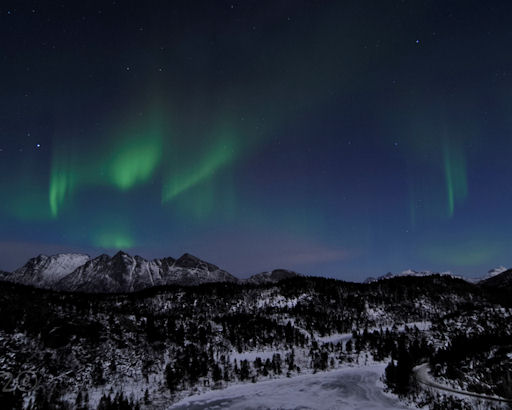
"The Northern Lights sparkled above us for nearly 20 minutes. It was awesome," says Nedrevåg. "These were the first auroras I've seen and photographed in 2012."
more images: from Earl Jones of Fairbanks, AK; from Andy Keen of Inari, Northern Lapland, Finland; from Marketa Stanczykova of Chatanika Alaska; from Gaute Frøystein of Bodoe, Norway;
DOOMED MARS PROBE PHOTOGRAPHED: Russia's Mars probe, Phobos-Grunt, has been stranded in Earth orbit since a main engine failure in early November. The spacecraft is now sinking back into Earth's atmosphere, with re-entry expected in mid-January. "On New Year's Day, I traveled to the French Riviera (850km from home) to record Phobos-Grunt's last passage over France," says astrophotographer Thierry Legault. This is the picture he took through a 14-inch telescope:
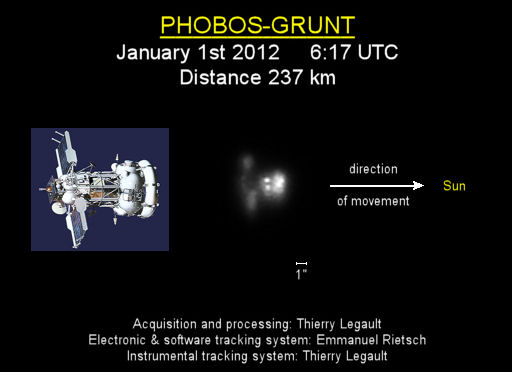
"It appears that the satellite is moving backwards with its solar panels deployed but not receiving the sunlight," notes Legault. "This may explain why Phobos-Grunt had no energy to communicate with Earth." An 80-second video shows the probe soaring almost directly above Legault's observing site on the Plateau de Calern. "At the scale of the video the satellite would cross your screen in about 1/30s," he says.
While a telescope is required to see the outlines of the spacecraft, the human eye alone is sufficient to see Phobos-Grunt as a speck of light in the night sky. On high passes, it glows almost as brightly as a first magnitude star. Check SpaceWeather's online Satellite Tracker or your smartphone for flyby times.
Potentially Hazardous Asteroids (
PHAs) are space rocks larger than approximately 100m that can come closer to Earth than 0.05 AU. None of the known PHAs is on a collision course with our planet, although astronomers are finding
new ones all the time.
On January 6, 2012 there were 1272 potentially hazardous asteroids.
Notes: LD means "Lunar Distance." 1 LD = 384,401 km, the distance between Earth and the Moon. 1 LD also equals 0.00256 AU. MAG is the visual magnitude of the asteroid on the date of closest approach. | | The official U.S. government space weather bureau |
| | The first place to look for information about sundogs, pillars, rainbows and related phenomena. |
| | Researchers call it a "Hubble for the sun." SDO is the most advanced solar observatory ever. |
| | 3D views of the sun from NASA's Solar and Terrestrial Relations Observatory |
| | Realtime and archival images of the Sun from SOHO. |
| | from the NOAA Space Environment Center |
| | the underlying science of space weather |