Don't just watch shooting stars. Wear them! Authentic meteorite jewelry for Christmas is now available in the SpaceWeather Store. | | |
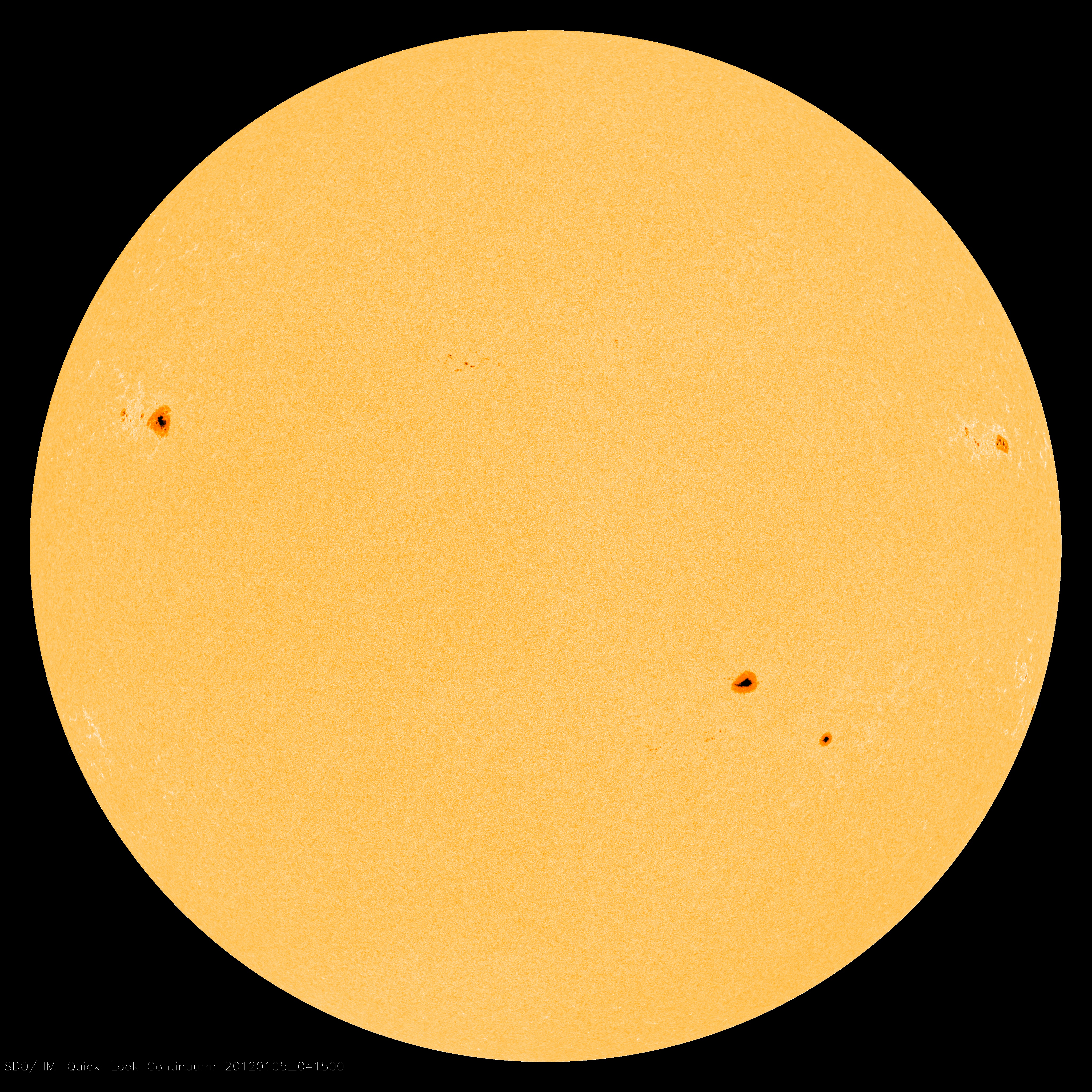
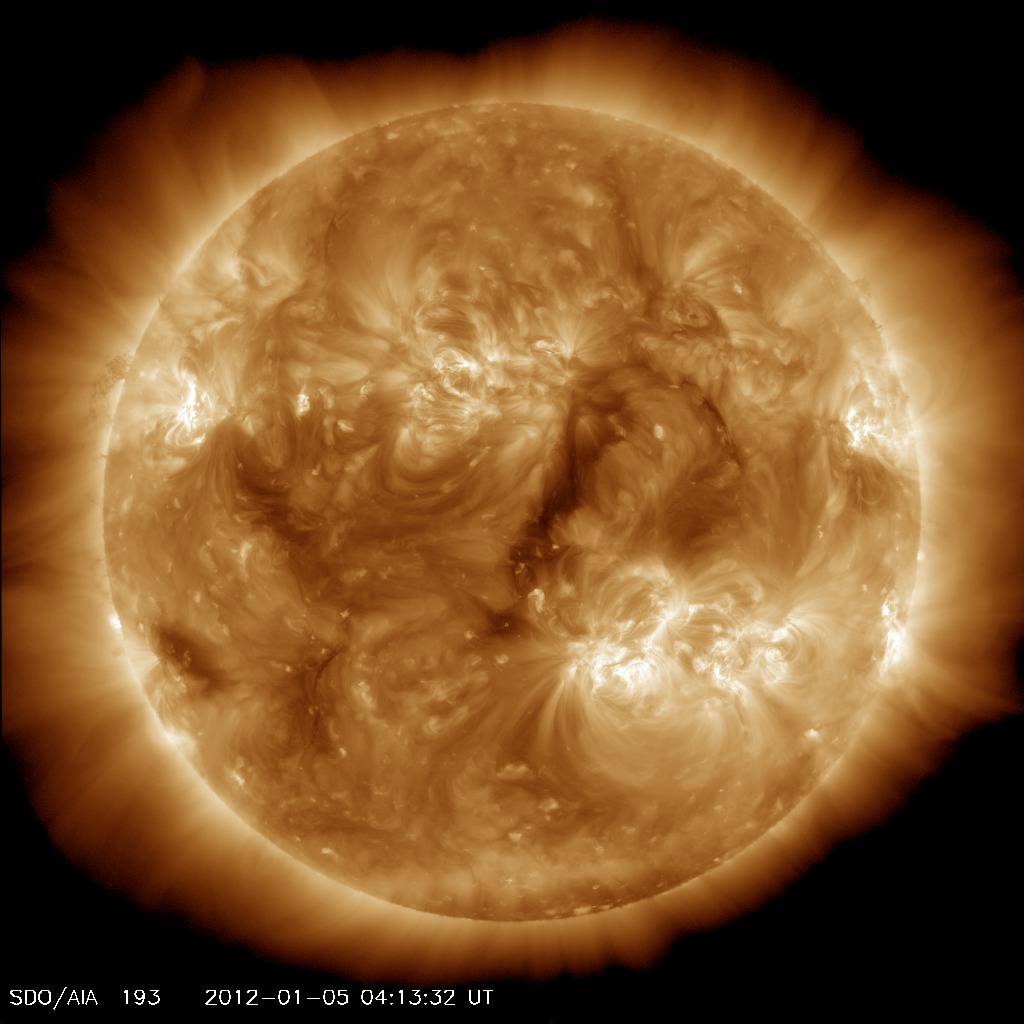
BEAUTIFUL EXPLOSION: A magnetic filament in the sun's northern hemisphere erupted today, Jan. 5th, at approximately 1300 UT. The beautiful explosion hurled a CME in the general direction of Earth, but the cloud might sail north of our planet with little to no impact. Stay tuned for updates.
DOOMED MARS PROBE PHOTOGRAPHED: Russia's Mars probe, Phobos-Grunt, has been stranded in Earth orbit since a main engine failure in early November. The spacecraft is now sinking back into Earth's atmosphere, with re-entry expected in mid-January. "On New Year's Day, I traveled to the French Riviera (850km from home) to record Phobos-Grunt's last passage over France," says astrophotographer Thierry Legault. This is the picture he took through a 14-inch telescope:
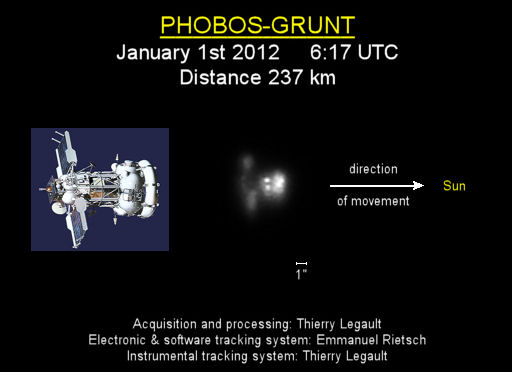
"It appears that the satellite is moving backwards with its solar panels deployed but not receiving the sunlight," notes Legault. "This may explain why Phobos-Grunt had no energy to communicate with Earth." An 80-second video shows the probe soaring almost directly above Legault's observing site on the Plateau de Calern. "At the scale of the video the satellite would cross your screen in about 1/30s," he says.
While a telescope is required to see the outlines of the spacecraft, the human eye alone is sufficient to see Phobos-Grunt as a speck of light in the night sky. On high passes, it glows almost as brightly as a first magnitude star. Check SpaceWeather's online Satellite Tracker or your smartphone for flyby times.
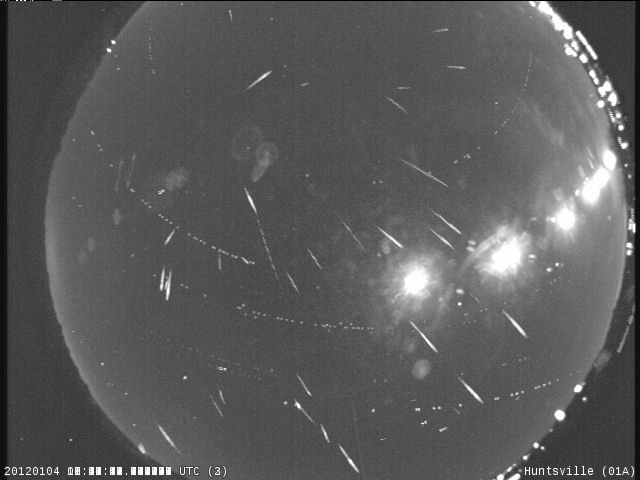
QUADRANTID METEOR UPDATE: Yesterday, Jan. 4th, Earth passed through a stream of debris from shattered comet 2003 EH1. The encounter produced a strong display of Quadrantid meteors over the Atlantic side of our planet, as many as 80 per hour according to the International Meteor Organization. Meteor rates peaked hours later and remained high hours longer than forecasters expected, which shows that we still have a lot to learn about the debris stream of 2003 EH1.
Zack Clothier of Thurman, New York, photographed this Quadrantid streaking over a lake in the Adirondacks:

"Temperatures were below zero here in the Adirondacks, but the sky put on such a show I stayed and watched it for four hours," says Clothier. "I counted nearly 60 meteors during that time, including this one shooting through the Milky Way. It was a wonderful night to be out under the stars, and one I definitely won't forget anytime soon!"
NASA's All-Sky Fireball Network recorded 20 fireballs during the shower's peak. Data from multiple cameras allowed the orbits of the meteoroids to be calculated, and they are shown here in a diagram of the inner solar system:
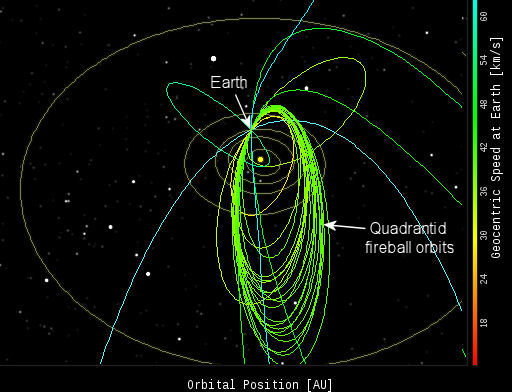
The green orbits are a good match for the orbit of the parent comet fragment 2003 EH1. Colors in the diagram correspond to velocity. The Quadrantids hit Earth's atmosphere traveling between 38 and 42 km/s (85,000 and 94,000 mph).
more images: from Pete Lawrence of Selsey, West Sussex, UK; from Luis Argerich of Buenos Aires, Argentina; from John Cordiale of Queensbury, New York; from Chris Peterson of Guffey, Colorado; from Chris Allington of Crofton, Nebraska; from John Stetson of Falmouth, Maine; from Brian Emfinger of Ozark, Arkansas; from John Chumack of Dayton, Ohio; from Fredrik Broms of Kvaløya, Norway; from Wally Pacholka of Joshua Tree National Park in California; from Mohammad Mehdi Asgari of Zanjan, Iran; from Ronald Zincone of Richmond, Rhode Island; from Didier Schreiner of Wormhout, France; from Renata Arpasova of Avebury, Wiltshire, UK; from Glenn Wester of Smithtown, New York; from Yu Jun of Beijing, China; from Sylvain Weiller of Saint Rémy lès Chevreuse, France;