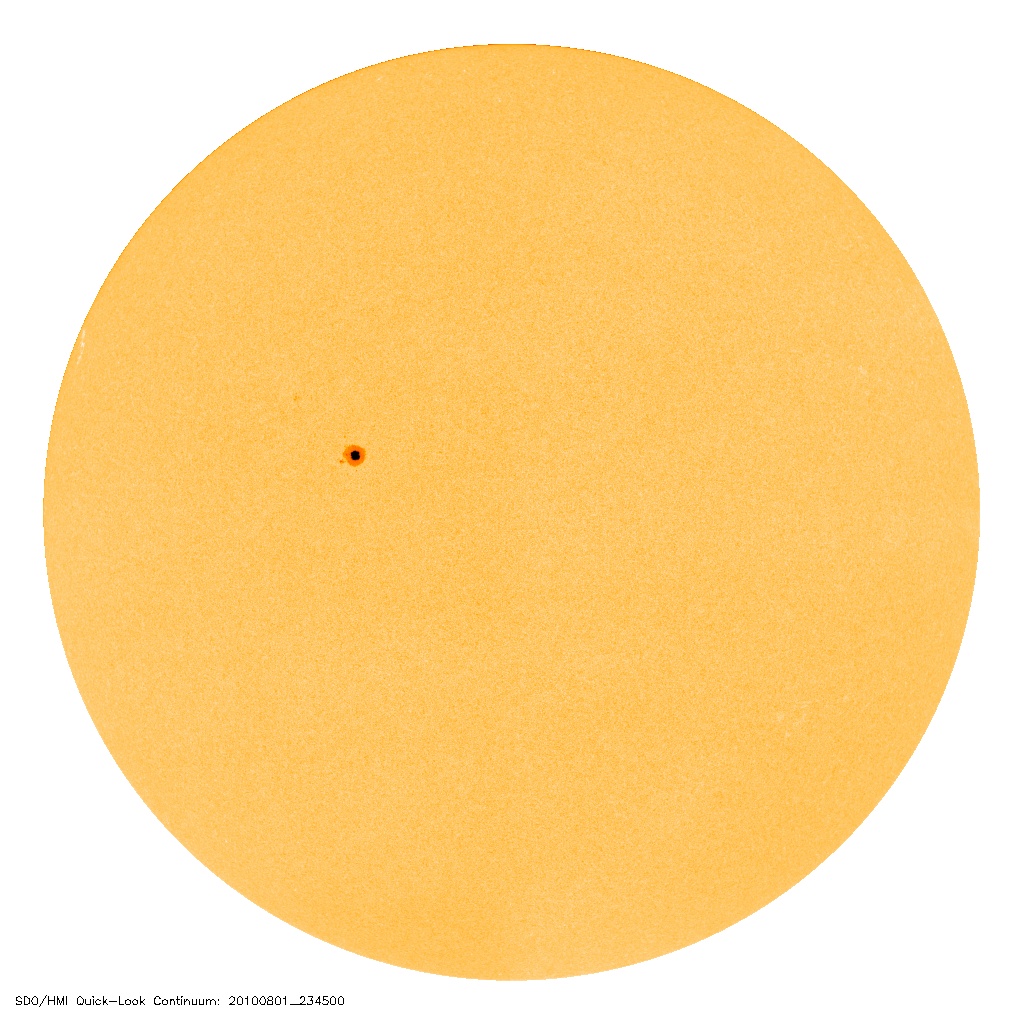
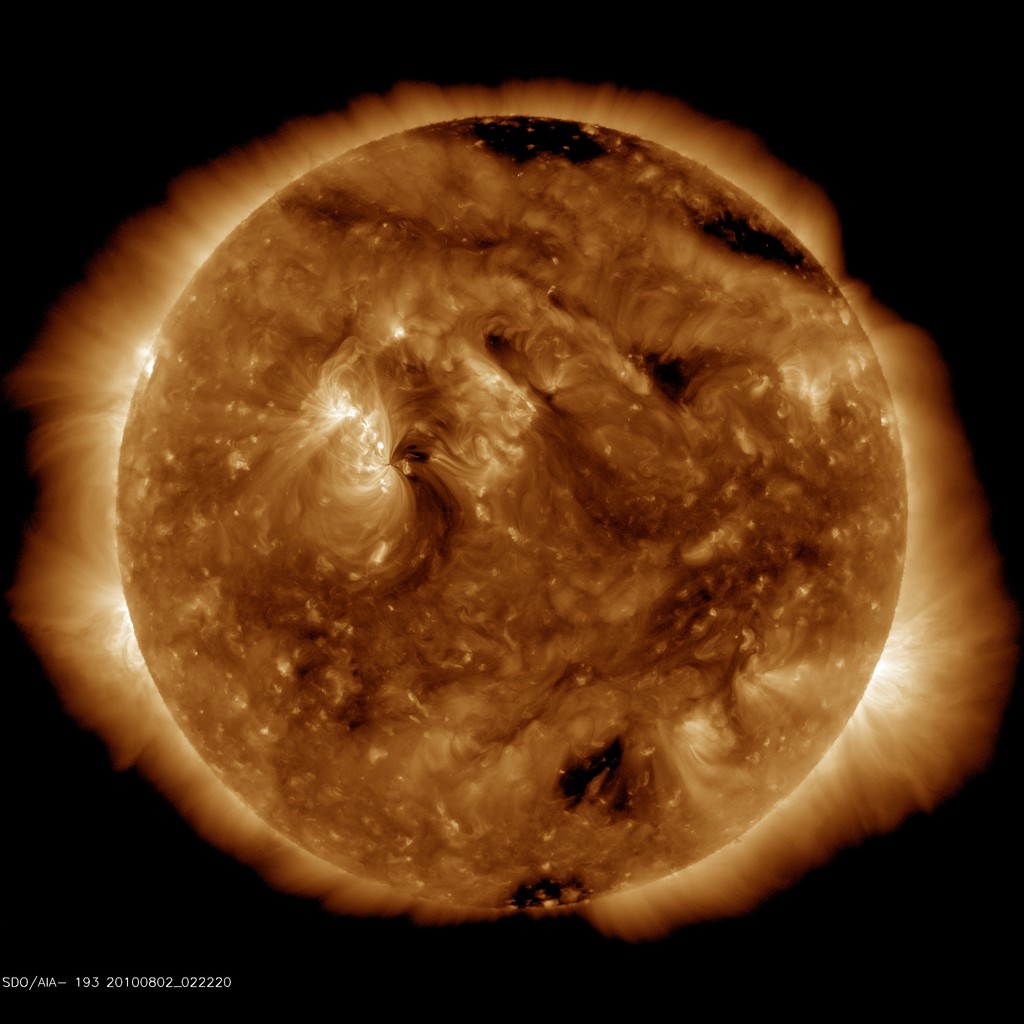
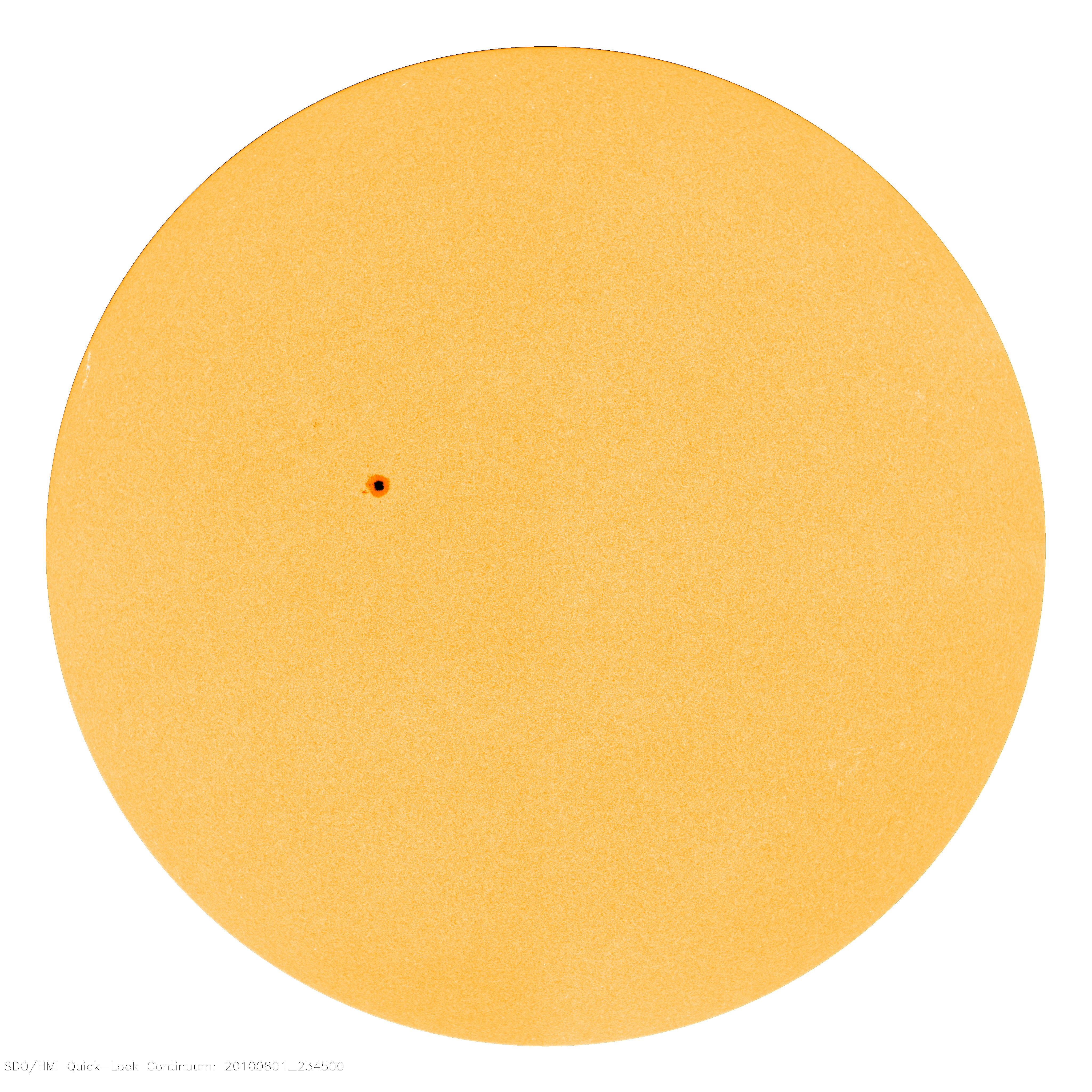
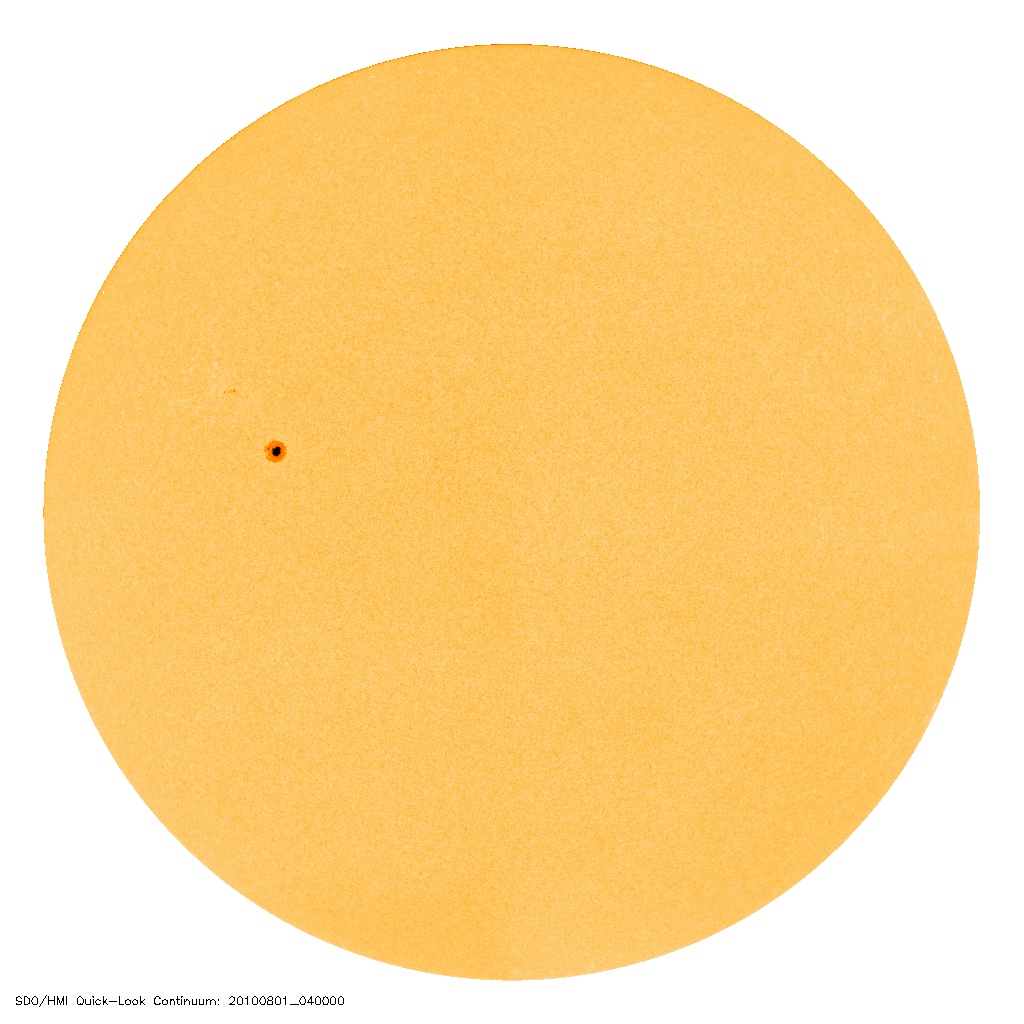
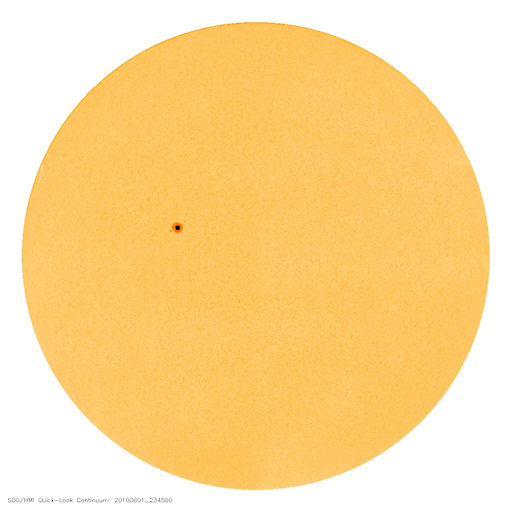
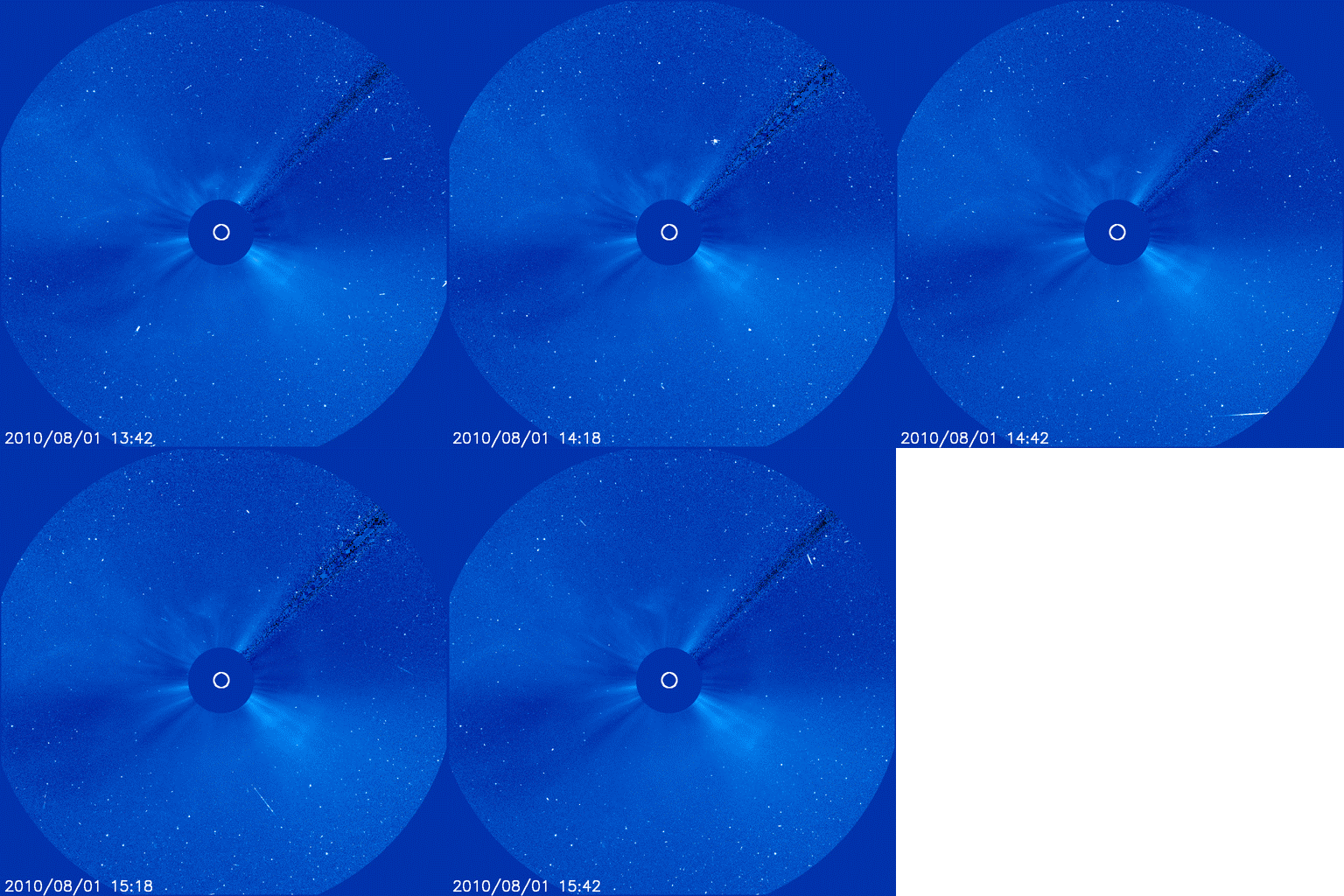
ANDROID FLYBYS: Our field-tested satellite tracker is now available for Android phones. Features: Global predictions and flyby alarms! Learn more. | | | NEW MOVIE: Researchers working with data from the Solar Dynamics Observatory have prepared a new movie of yesterday's eruption. Click on the following links to watch the filament lift off the sun in red-hot color: 21 Mb Quicktime, 2 MB iPad, 0.8 MB iPhone. COMPLEX ERUPTION ON THE SUN: On August 1st around 0855 UT, Earth orbiting satellites detected a C3-class solar flare. The origin of the blast was sunspot 1092. At about the same time, an enormous magnetic filament stretching across the sun's northern hemisphere erupted. NASA's Solar Dynamics Observatory recorded the action: 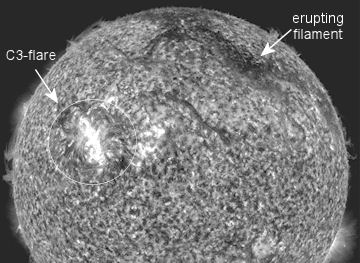
Click to launch a movie (EUV 304 Å)
The timing of these events suggest they are connected, and a review of SDO movies strengthens that conclusion. Despite the ~400,000 km distance between them, the sunspot and filament seem to erupt together; they are probably connected by long-range magnetic fields. In this movie (171 Å), a shadowy shock wave (a "solar tsunami") can be seen emerging from the flare site and rippling across the northern hemisphere into the filament's eruption zone. That may have helped propel the filament into space. In short, we have just witnessed a complex global eruption involving almost the entire Earth-facing side of the sun. A coronal mass ejection (CME) produced by the event is heading directly for Earth: SOHO movie. High-latitude sky watchers should be alert for auroras when it arrives on or about August 3rd. more images: from Francois Rouviere of Mougins, France; from Rogerio Marcon of Campinas SP Brasil; from Didier Favre of Brétigny-sur-Orge, France; from Cai-Uso Wohler of Bispingen, Germany; from Wouter Verhesen of Sittard, The Netherlands; from Michael Buxton of Ocean Beach, California SUNSPOT SUNRISE: Sunspot 1092, a key player in yesterday's Earth-directed eruptions, is big enough to see without the aid of a solar telescope. Oleg Toumilovitch "spotted" it on July 31st rising over Blairgowrie, South Africa: 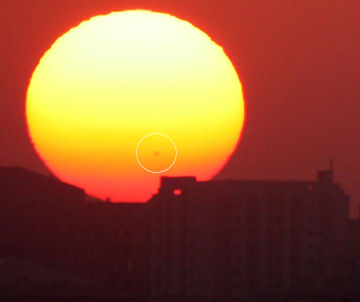
Photo details: Canon EOS-350D, ISO-800, 1/1600s exposure
"During the first few minutes of sunrise only a fraction of the sunlight makes it's way to the observer - mostly from the red part of visible spectrum," notes Toumilovitch. "During this time large sunspots can be seen without a special solar filter." Be careful, though! Even when dimmed by clouds and haze, direct sunlight can hurt your eyes. "If you try to take a picture like this," advises Toumilovitch, "look only at the screen of your digital camera, not the optical viewfinder." more sunspot shots: from Roman Vanur of Nitra, Slovakia, EU; from Alan Friedman of Buffalo, NY; from Pavol Rapavy of Observatory Rimavska Sobota, Slovakia; from Rogerio Marcon of Campinas SP Brasil; from Michael Boschat of Halifax, Nova Scotia; from THEO BAKALEXIS of Peristeri, Attikh, Greece;
Solar Eclipse Photo Gallery
[NASA: South Pacific Eclipse] [animated map] |