They came from outer space--and you can have one! Genuine meteorites are now on sale in the Space Weather Store. | | |
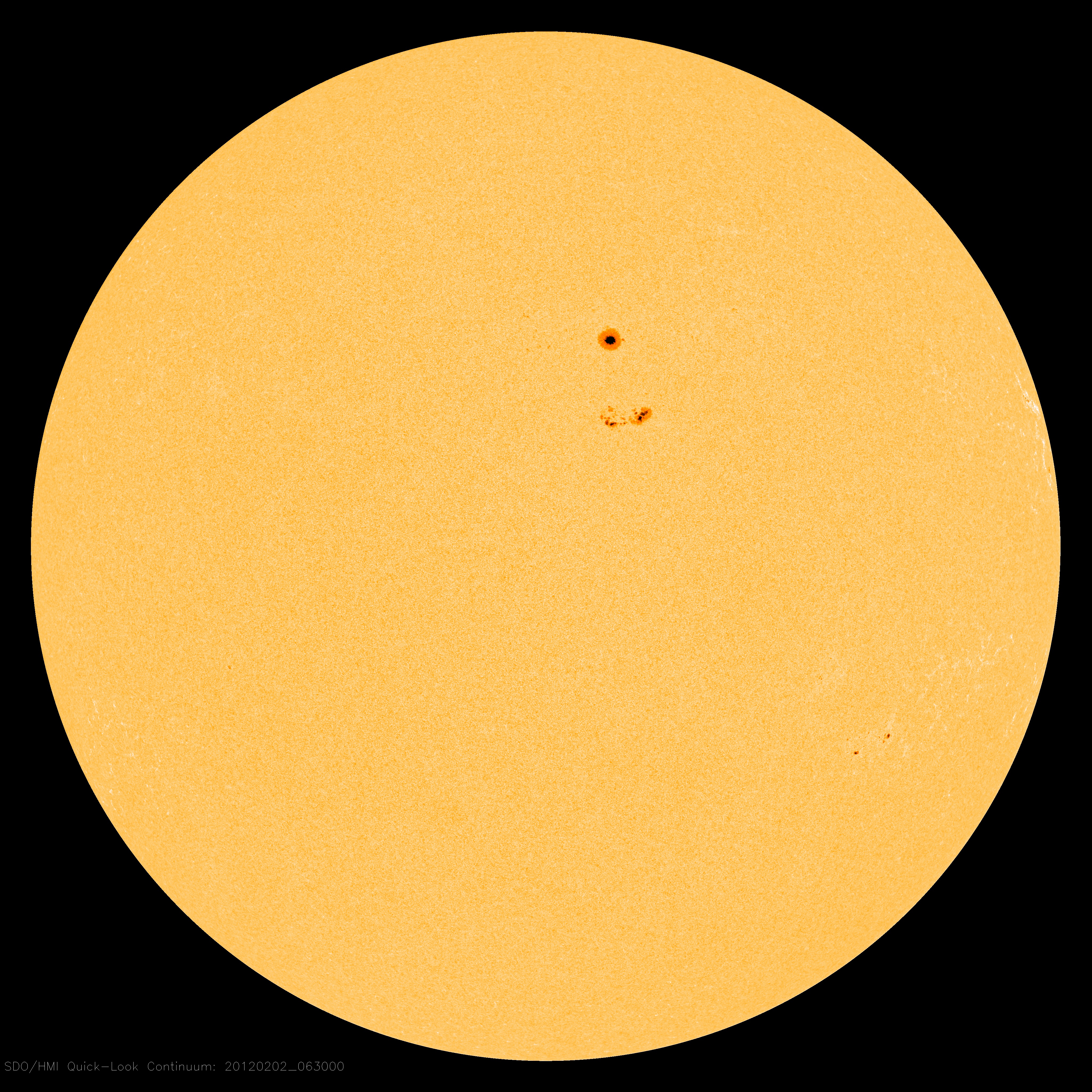
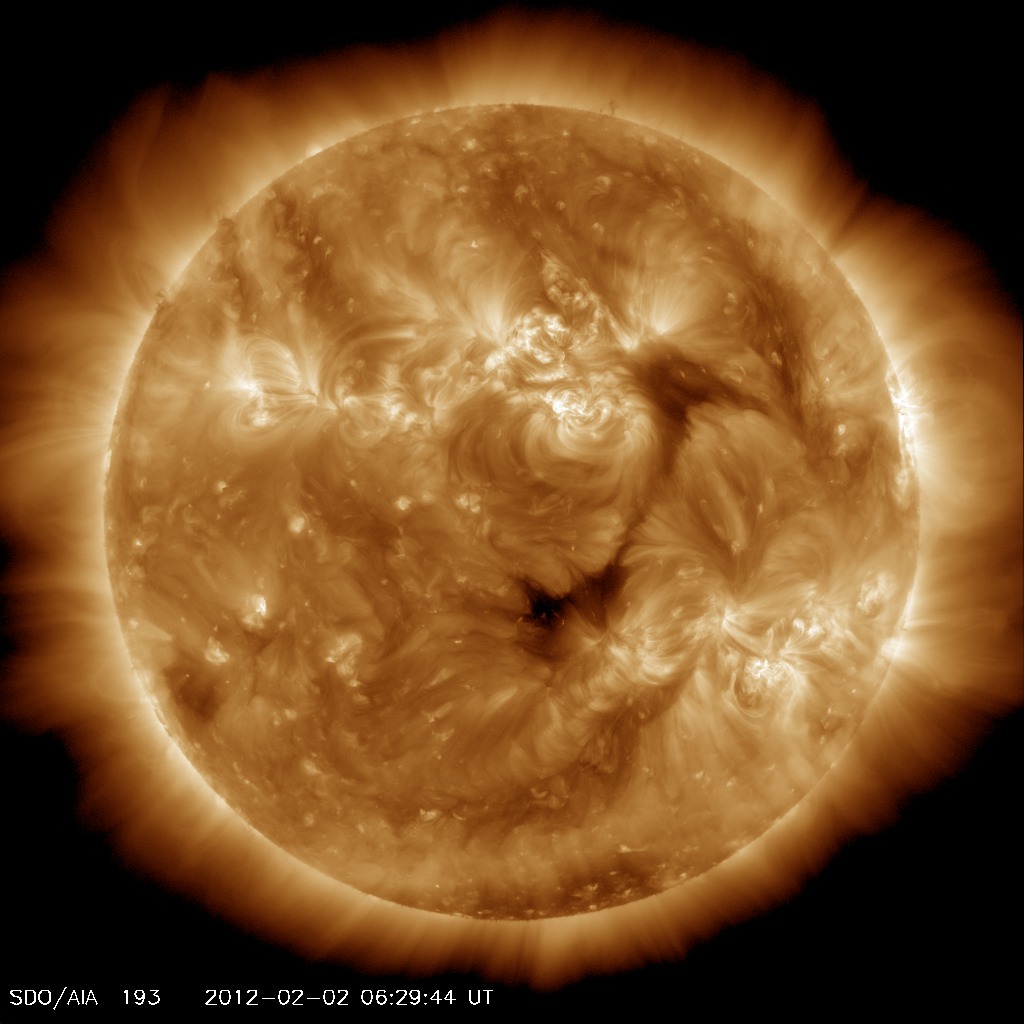
QUIET SUN: Solar activity is low. None of the sunspots on the Earthside of the sun is actively erupting. NOAA forecasters estimate no more than a 1% chance of M-class flares during the next 24 hours. Solar flare alerts: text, voice.
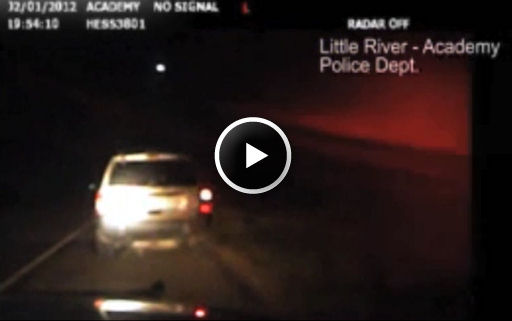
TEXAS FIREBALL: Last night, a spectacular fireball appeared in the skies of eastern Texas and Oklahoma. As is often the case for unexpected night-sky phenomena, few pictures are available. The best so far comes from a police dash-board camera in the small town of Little River-Academy, TX:
Eye-witness Daryn Morran reports: "At approximately 756pm CST, over Abilene, Texas, I saw an object falling from the sky much brighter and long-lasting than anything I've seen. [The fireball] lasted close to 8 secs before completely burning out. At first, it was bright white, and then started slowing down and getting brighter. Then it exploded like a firecracker artillery shell into several pieces, flickered a few more times and then slowly burned out... awesome!!!"
Another observer in Coppell, Texas, reported a "double boom heard at 8:00:30 CST. [The object appeared to be] 1/2 the size of the waxing moon, and broke into two major chucks with many smaller pieces. It had a 'white plasma' (sun-colored) look with a long golden tail." (This report was relayed by NWS meteorologist Joe Harrris in Frt Worth.)
According to Bill Cooke of NASA's Meteoroid Environment Office, this was probably a natural object--a small asteroid about the size of a car or bus--not a decaying satellite or other manmade space debris. The fireball, which disintegrated in the general vicinity of Dallas-Fort Worth, was bright enough to be seen on NASA cameras located in New Mexico more than 500 miles away. "It was about as bright as the full Moon (astronomical magnitude -13)," estimates Cooke, who is still analyzing data and sighting reports in hopes of calculating the object's orbit. He might yet figure out where the Texas fireball came from. Stay tuned for updates.
ASTROPHOTO-OP: Astrophotographers, ready your cameras. On Friday morning, February 3rd, Comet Garradd (C/2009 P1) will pass approximately 0.5 degrees from globular cluster M92 in Hercules. On Jan. 31st, Rolando Ligustri took this picture of the converging pair using a remotely-controlled 106mm telescope in New Mexico:
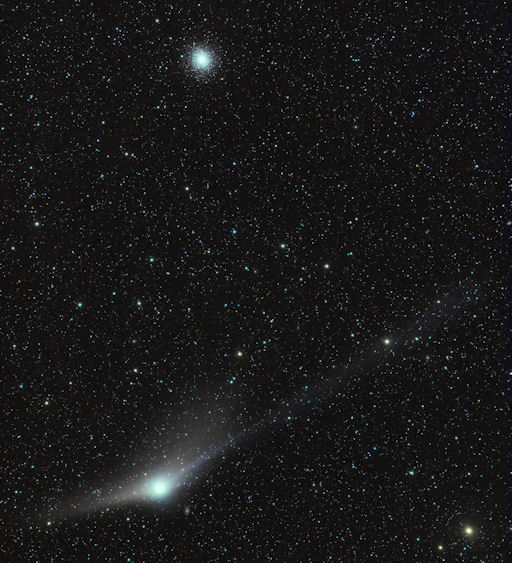
The ten minute exposure shows the comet's fan-shaped dust tail, which roughly traces the comet's orbit, and its pencil-thin gas tail, which points almost directly away from the sun due to the action of the solar wind.
The star cluster and the comet are both located in the constellation Hercules, high overhead in northern hemisphere skies before sunrise. Sky and Telescope offers a sky map of the comet's path. Observers with computerized GOTO telescopes can track the comet by plugging in orbital elements from the Minor Planet Center.
At the moment, Comet Garradd has an astronomical magnitude of +6.5, invisible to the naked eye but an easy target for backyard telescopes. Forecasters expect it to brighten by a factor of ~2 in the weeks ahead as the comet approaches Earth for a 1.3 AU close encounter in early March. This could be a good time to invest in a Comet Hunter.
more images: from Lorenzo Comolli of Bogli, Italy; from Gregg Ruppel of Ellisville, MO; from Mike Broussard of Maurice, Louisiana; from Dr Paolo Candy of Ci.A.O. Cimini Astronomical Observatory - Italy
BE ALERT FOR MOON HALOES: With the full Moon less than a week away, now is the time to be alert for Moon haloes. Last night in Moray, Scotland, amateur astronomer Alan C. Tough photographed this specimen:
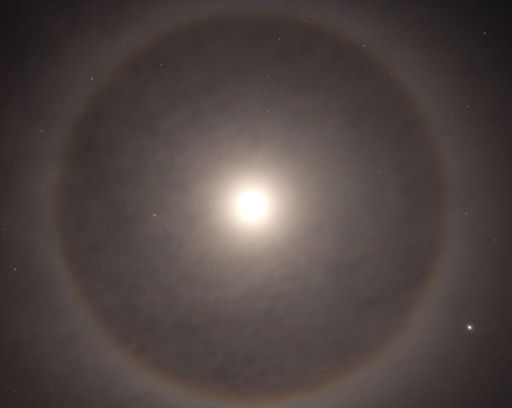
"I intended to photograph the Moon beside the Pleiades, but the cold and cloudy conditions were better suited to capturing this spectacular halo," says Tough.
Moon halos are formed by ice crystals in high clouds, which catch moonbeams and bend them as shown. The brighter the Moon, the brighter the Moon halo, so any halos this week should be very bright indeed. The Moon is full on Feb. 7th. Browse the links below for more examples of what's in store.
more images: from Jim Henderson of Kincardine O'Neil, Scotland; from Eric Walker of Conon Bridge, Ross-shire, Scotland; from Tyler Piskor of Karnes City, Texas;
January 2012 Aurora Gallery
[previous Januaries: 2010, 2009, 2008, 2007, 2005, 2004]
Comet Lovejoy Gallery
[previous comets: McNaught, Holmes, Lulin, Tuttle, Ikeya-Zhang]