| FLYING SPACE JUNK: The Early Ammonia Servicer (EAS), a refrigerator-sized piece of space junk thrown overboard from the International Space Station last year, is expected to re-enter Earth's atmosphere in late 2008 or early 2009. It should make a nice fireball. Meanwhile, you can see the EAS intact as it zips across the night sky almost as bright as the stars of the Big Dipper. Check the Simple Satellite Tracker for flyby times. SOLAR ECLIPSE: Earlier today, ordinary sunbeams in Europe and Asia shape-shifted, suddenly taking the form of crescents. That's what happens during a solar eclipse. In Esfahan, Iran, the sun was about 20% covered when Mohamad Soltanolkotabi photographed these crescents decorating the floor of the Sheikh Lutffullah mosque: 
"Sunlight beaming through windows in the Mosque's dome created these eclipsed suns on the floor," he explains. Meanwhile in Novosibirsk, Russia, the Moon covered the sun 100%, completely extinguishing all sunbeams. Eclipse chaser Anthony Ayiomamitis took advantage of the darkness to photograph the sun's corona and a pair of stunning diamond rings: pictures. Browse the gallery for more: UPDATED: Solar Eclipse Photo Gallery
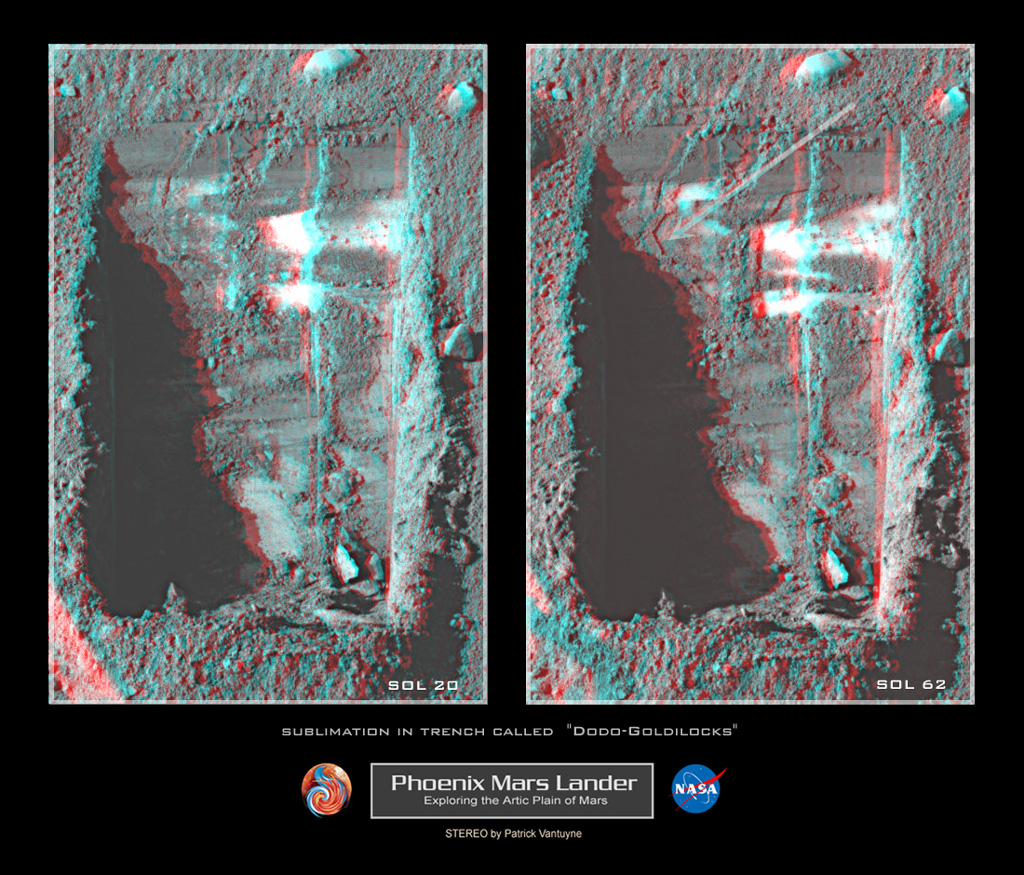
[interactive eclipse map] WATER ON MARS CONFIRMED: For the first time, the Phoenix Mars Lander has "touched and tasted" water on the red planet. The milestone came just two days ago when Phoenix's robotic arm successfully dumped a sample of soil into one of the lander's internal ovens. Heat was applied and water vapor emerged. Voilà! H20. This chemical evidence confirms visual clues that have been accumulating since Phoenix landed in May. Put on your 3D glasses and consider the following: 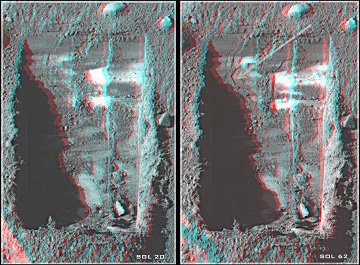
Click to view the full-sized anaglyph
The anaglyph was made by Patrick Vantuyne using images taken by Phoenix's stereo camera. It shows the same trench 42 martian days apart. The arrow points out a new shadow where a patch of ground has seemingly disappeared. "The only explanation is that an exposed layer of ice-rich material is slowly sublimating, causing the surface to drop a few millimeters," says Vantuyne. Other patches of white material in the image have likewise changed in response to solar heating. Phoenix's Thermal and Evolved Gas Analyzer oven confirms that the changes are genuine signs of martian water. The next step for Phoenix's chemistry lab: conduct tests for nutrients and minerals that could support life in moist martian soil. NASA has extended Phoenix's mission an extra 30 days to allow such tests to be done. Get the full story from nasa.gov.
2008 Noctilucent Cloud Gallery
[Strange Clouds] [Sky Cameras] |