POSSIBLE METEORS FROM COMET HARTLEY 2: A pair of unusual fireballs over Canada and the southeastern USA have experts wondering if Comet Hartley 2 might produce a meteor shower in early November. Get the full story from Science@NASA.
DEAD SPACECRAFT WALKING: Two NASA spacecraft that were supposed to be dead a year ago are instead flying to the Moon for a breakthrough mission in lunar orbit. The research they conduct could lead to important advances in space weather forecasting. For more information, read "Dead Spacecraft Walking" from Science@NASA.
BIG BRIGHT OBJECT NEAR THE SUN: Don't panic, it's just Venus. The brilliant evil twin of Earth is passing between our planet and the sun this week, making a bright UFO-like light in SOHO coronagraph images:
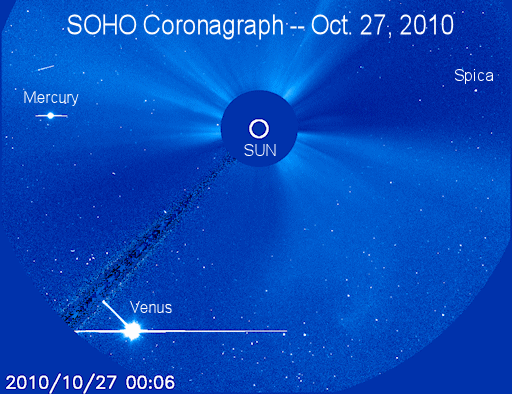
The bright rays and luminous bloom centered on the planet are digital artifacts. Venus is so bright, it saturates SOHO's CCD detectors, causing electrons to "bleed" across pixel boundaries. The same thing happens to a lesser degree with Mercury, which is bisected by a horizontal bar--another artifact. Note how the star Spica, dimmer than the planets, appears as a normal pinprick. It does not saturate the CCD.
Venus will continue its flamboyant passage for the next few days. Join SOHO for a ringside seat.
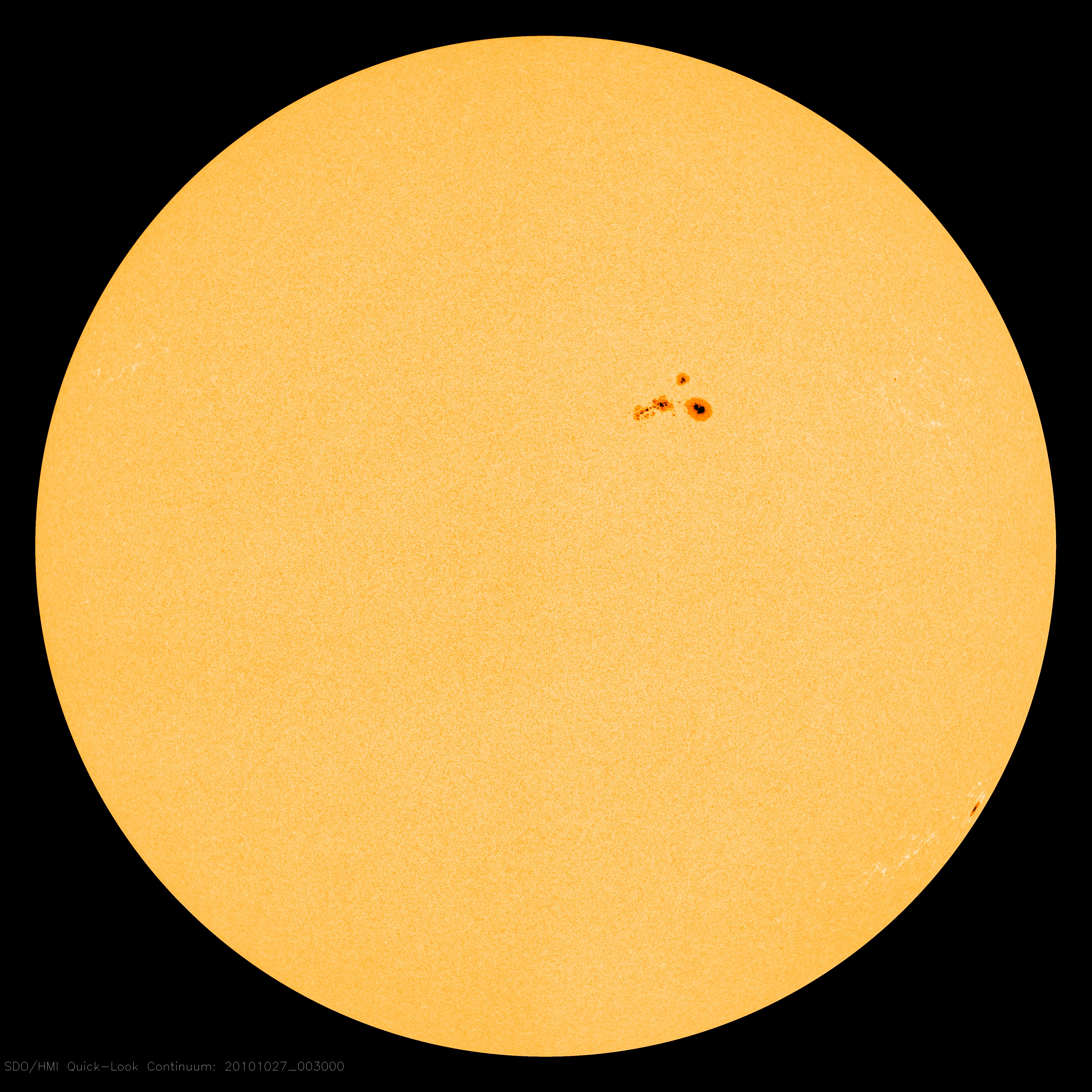
A BIG SUNSPOT GETS BIGGER: Behemoth sunspot 1117 is not merely growing, it is transmogrifying. Click on the image to launch a two-day movie from NASA's Solar Dynamics Observatory (8 MB):
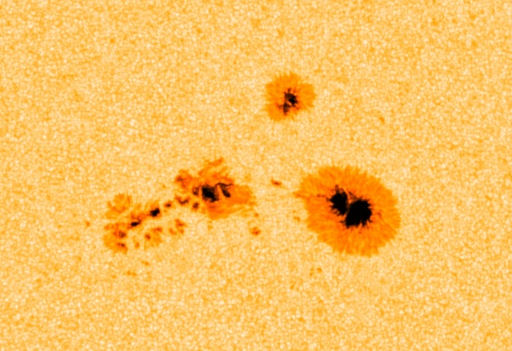
Since yesterday, the shape-shifting sunspot has developed a "beta-gamma" magnetic field that harbors energy for M-class solar flares. Any such eruptions will likely be geoeffective because the sunspot is almost-squarely facing Earth. Readers with solar telescopes are encouraged to monitor developments.
more images: from Rogerio Marcon of CASLEO Observatory, San Juan, Argentina; from Patrick Bornet of Saint Martin sur Nohain, Nièvre, France; from David Arditti of Edgware, UK; from John Stetson of Portland, Maine
October 2010 Aurora Gallery
[previous Octobers: 2009, 2008, 2007, 2006, 2004, 2003, 2002, 2001]
Potentially Hazardous Asteroids (
PHAs) are space rocks larger than approximately 100m that can come closer to Earth than 0.05 AU. None of the known PHAs is on a collision course with our planet, although astronomers are finding
new ones all the time.
On October 27, 2010 there were 1155 potentially hazardous asteroids.
Notes: LD means "Lunar Distance." 1 LD = 384,401 km, the distance between Earth and the Moon. 1 LD also equals 0.00256 AU. MAG is the visual magnitude of the asteroid on the date of closest approach. | | The official U.S. government space weather bureau |
| | The first place to look for information about sundogs, pillars, rainbows and related phenomena. |
| | Researchers call it a "Hubble for the sun." SDO is the most advanced solar observatory ever. |
| | 3D views of the sun from NASA's Solar and Terrestrial Relations Observatory |
| | Realtime and archival images of the Sun from SOHO. |
| | from the NOAA Space Environment Center |
| | the underlying science of space weather |