Turn your cell phone into a field-tested satellite tracker. Works for Android and iPhone. | | |
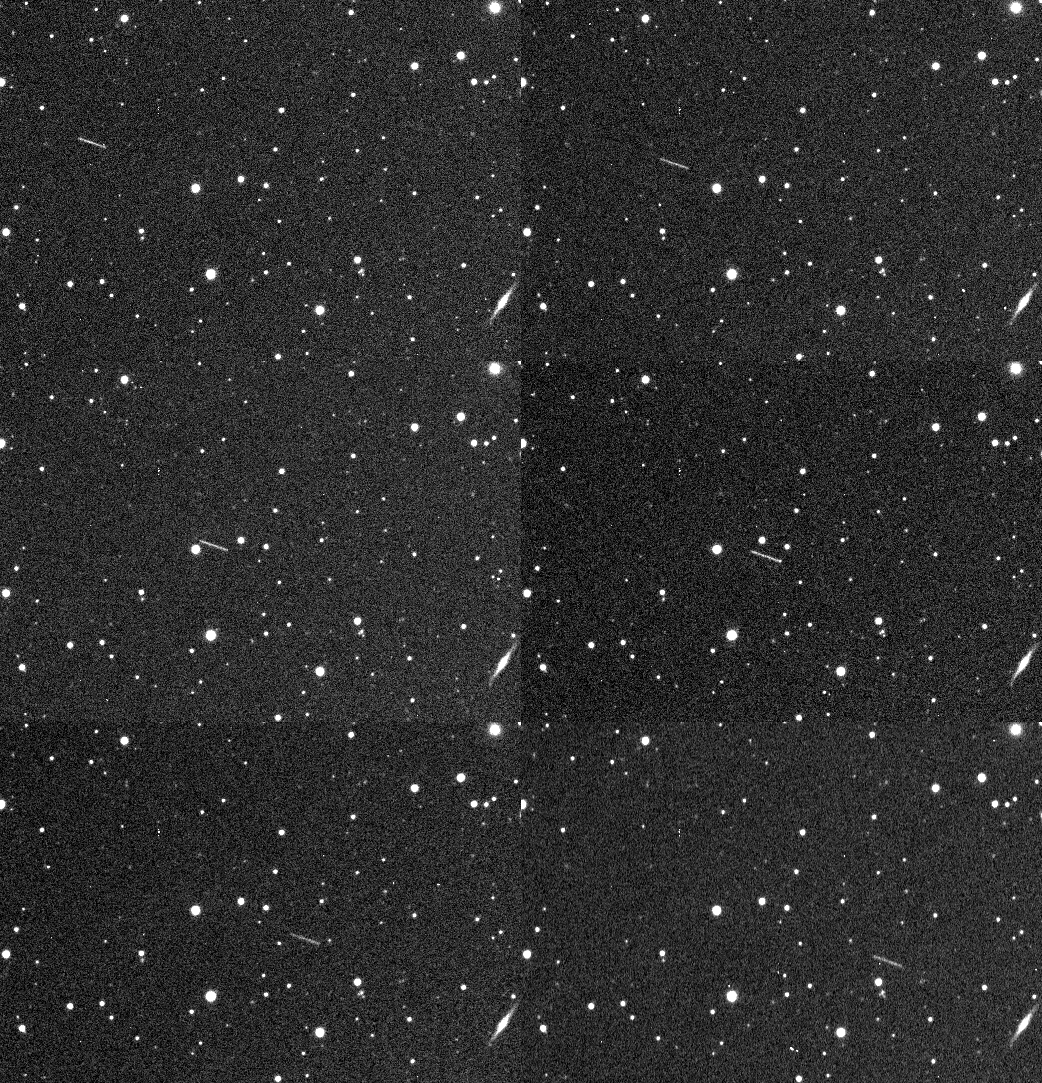
INCOMING ASTEROID MOVIE: Click here. That was a movie of incoming asteroid 2011 MD. Astronomer Rafael Ferrando recorded the streaking space rock on June 25th using a 16-inch telescope at the Observatory Pla d'Arguines in Segorbe, Spain. Read the story "Asteroid Flyby," below, for more information about this object.
ASTEROID FLYBY: Newly-discovered asteroid 2011 MD will pass only 12,000 kilometers (7,500 miles) above Earth's surface on Monday June 27 at about 1:00 p.m. EDT (1700 UT). NASA analysts say there is no chance the space rock will strike Earth. Nevertheless, the encounter is so close that Earth's gravity will sharply alter the asteroid's trajectory:
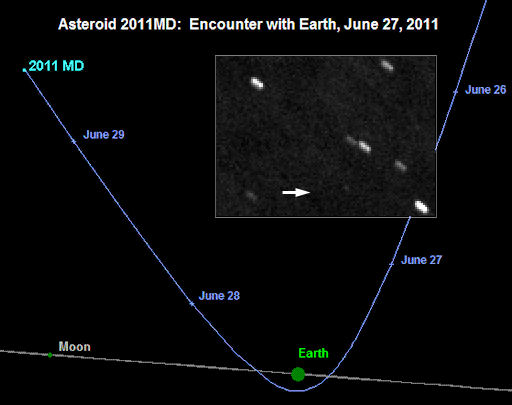
At closest approach, 2011 MD will pass in broad daylight over the southern Atlantic Ocean near the coast of Antarctica. As the asteroid recedes from Earth, it will pass through the zone of geosynchronous satellites. The chances of a collision with a satellite or manmade space junk are extremely small, albeit not zero.
Judging from the brightness of the asteroid, it measures only 5 to 20 meters in diameter. According to JPL's Near Earth Object Program office, one would expect an object of this size to come this close to Earth about every 6 years on average. For a brief time, it will be bright enough to be seen even with a medium-sized backyard telescope. [observing tips] [3D orbit]
SPACE STATION TRANSIT: Blink your eyes. That's about how long it takes the International Space Station traveling at 17,000 mph to cross the face of the sun. Yesterday, June 24th, photographer Dennis Simmons recorded a split-second transit over Brisbane, Australia:
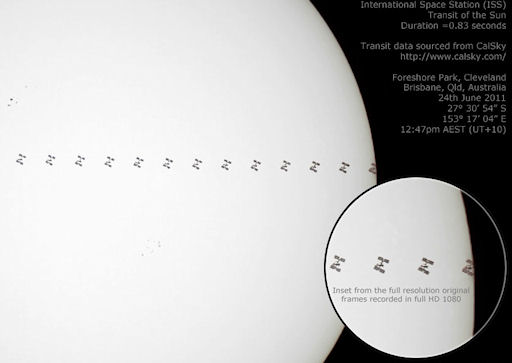
Simmons explains how he did it: "According to Calsky, the ISS was scheduled to cross the sun at 12:47 pm with the centerline passing over Cleveland, a bayside suburb of Brisbane. The width of the ground track was only ± 6 km. If I was outside of this narrow strip, I would miss the transit. I set up my equipment early; the entire transit lasted only 0.83 seconds, and I did not want to miss those fleeting 83/100s of a second after carting all my gear to the Foreshore Park at Cleveland only 160 meters from the centerline. A Canon 7D digital camera attached to my telescope recorded the transit beautifully."
Simmons notes that a safe solar filter is essential for this kind of work. "Never look at the sun through an unfiltered telescope or camera lens – you will destroy your eyes," he says.
more transits: from Steve Riegel of Albuquerque, New Mexico
June 2011 Aurora Gallery
[Aurora alerts: text, voice] [previous Junes: 2010, 2008, 2001]
June 15th Lunar Eclipse Gallery