Don't just watch shooting stars. Wear them! Authentic meteorite jewelry for Christmas is now available in the SpaceWeather Store. | | |
DECEMBER SOLSTICE: Tonight is the longest night of the year in the Northern Hemisphere and the shortest night in the Southern Hemisphere. The December Solstice, which marks the change of seasons, occurs at 12:30 a.m. on the 22nd EST (9:30 p.m. on the 21st PST) when the Sun reaches its farthest point south on the celestial sphere. Happy Solstice!
THE AMAZING TAIL OF COMET LOVEJOY: Widespread reports of Comet Lovejoy's tail are being received from around the southern hemisphere. The ghostly plume emerges just before sunrise, jutting vertically upward into the eastern sky ahead of the sun.
"I observed the comet with my unaided eye for 55 minutes this morning," says Colin Legg of Mandurah, Western Australia. "I also captured a timelapse sequence of the comet rising as twilight progressed." Click on the image to set the scene in motion:
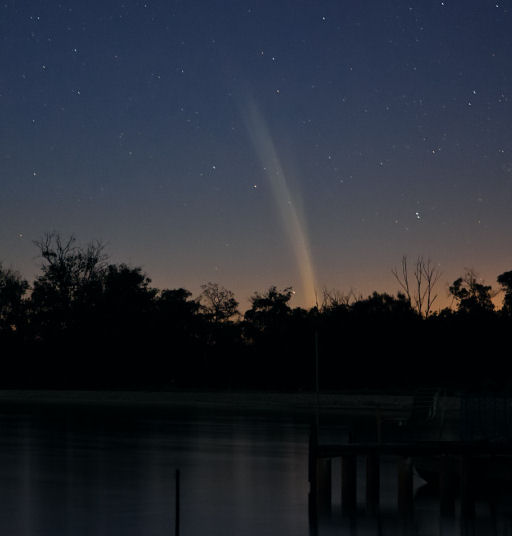
"In the image you can see 2 tails," notes Clegg. These are the dust and ion tails. The gaseous ion tail is blow almost directly away from the sun by the solar wind, while the heavier, brighter dust tail more closely follows the comet's orbit.
The visibility of both tails could improve in the days ahead as the comet moves away from the sun and the background sky darkens accordingly. Early-rising sky watchers should be alert for this rare apparition. [finder chart]
more images: from Steve Chadwick of Himatangi Beach, New Zealand; from Chris Picking of Wellington, New Zealand; from Paulo Morales Valdebenito of San Francisco de Mostazal, Chile; from Kosma Coronaios of Louis Trichardt, Limpopo Province, South Africa; from Willian Souza of Sao Paulo, Brazil; from Grahame Kelaher of Perth, Western Australia; from Minoru Yoneto of Queenstown, New Zealand;
THE SUN IN A BEER CAN: "I have captured the sun in an empty beer can," reports Jan Koeman of Kloetinge, the Netherlands. In June 2011, Koeman assembled a solargraph--a simple pinhole camera consisting of a beer can lined with photographic paper--and for the past six months he has used it to record the sun's daily motion across the Dutch sky. Today he removed the photo-paper for inspection:
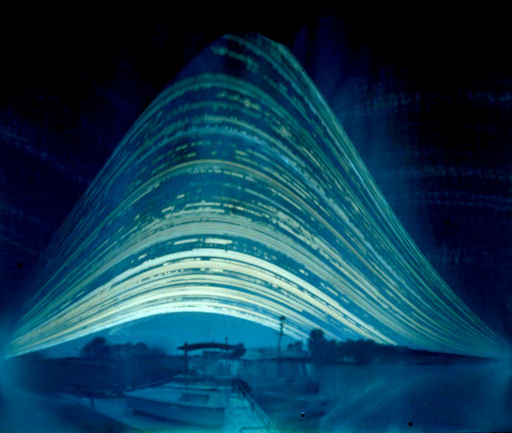
"This is what a photo with an exposure time of nearly 6 months looks like," says Koeman. The highest arcs were traced by the summer sun of June 2011. The lowest arc was made just today, Dec. 21st, on the eve of the 2011 winter solstice. Occasional gaps are caused by clouds.
Curiously, Koeman had more than one empty beer can to work with on that hot summer day in June when he began his project, so there are multiple views to enjoy. Click here for more solargraphs.
6-month Solargraph How-to Guides: #1, #2, #3
Dec. 10th Total Lunar Eclipse Gallery